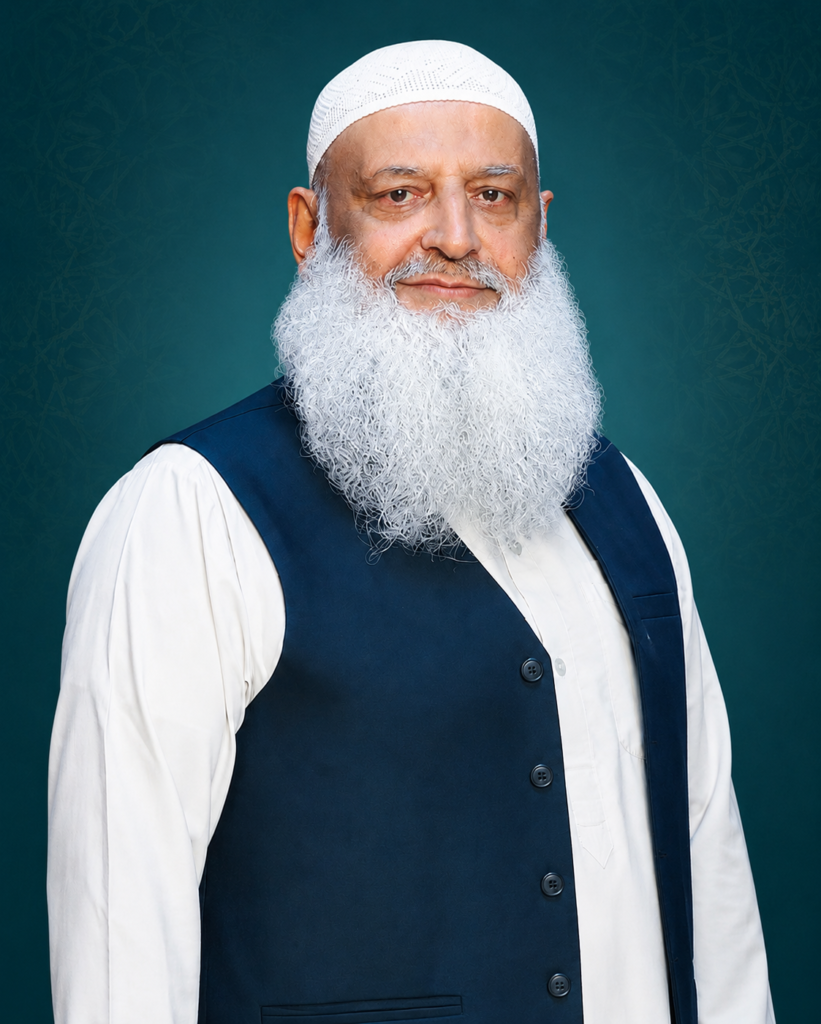
Scholar Profile
Dr Muhammad Hammad Lakhvi
Islamic Scholar • Professor • Former Dean
Prof. Dr Muhammad Hammad Lakhvi is a senior Islamic scholar, academic, researcher, and former Dean of the Faculty of Islamic Studies at the University of the Punjab, Lahore. His scholarly work spans Quranic studies, Hadith, Islamic history, Islamic thought, and research supervision.
In the academic, religious and educational circles of Pakistan, the name of Professor Dr Muhammad Hammad Lakhvi needs no introduction.
He is a distinguished scholar, educationist and a visionary reformer who believes in the beautiful fusion of traditional religious education and modern contemporary sciences.
His life journey, family background and his vision for the future of the Muslim Ummah are a beacon of light for every reader.
About Prof. Dr Muhammad Hammad Lakhvi
Dr. Muhammad Hammad Lakhvi belongs to a prominent Rajput family. His ancestors settled in a village called “Lakho Ke” (or Lakhoke) near Lahore, after which the entire family became known as “Lakhvi” worldwide.
This family has been dedicated to the propagation of Islam and scholarly services for centuries. Some of the salient features of their family heritage are as follows:
The first Punjabi poetic commentary on the Holy Quran: His ancestor Hafiz Muhammad Anwar Lakhvi wrote the first regular poetic commentary (Tafsir-e-Lakhvi) of the Holy Quran in Punjabi, which consists of 7 volumes.
Defence of the Last Prophethood: Among those who were the first to issue individual fatwas against the Qadiani sedition and played an active role in the Khatm-e-Nabuwwat movement, his great-grandfather Maulana Mohiuddin Lakhvi and his grandfather are at the top of the list.
Family Background and Scholarly Lineage
Dr Lakhvi belongs to the well-known Lakhvi scholarly family, a family with a long history of religious scholarship, teaching, writing, and public service in the Indian subcontinent. This scholarly background has played an important role in shaping his academic and religious identity.
His family lineage is connected with generations of scholars who served the cause of Islamic learning, Quranic explanation, Hadith teaching, religious writing, and public da‘wah. Among his ancestors were scholars known for their contributions to Islamic literature, religious education, and the defence of Islamic beliefs.
This strong family tradition of knowledge and service provided Prof. Dr Muhammad Hammad Lakhvi with a scholarly environment from an early age. It also became an important foundation for his later work as a teacher, researcher, professor, and public religious guide.
Early Life and Education
Hammad Lakhvi was born on 9 December 1965 in Qila Tara Singh, a village near Depalpur. He received his early education in his local area and began his learning journey with Quranic reading and school education.
He completed his matriculation from Depalpur High School in 1982 and later completed F.Sc. from Government College Depalpur in 1984. He passed his B.A. examination from the University of the Punjab in 1986.
His higher education continued at the University of the Punjab, where he completed M.A. Islamic Studies in 1988 with first position and received a gold medal. He then completed M.A. Arabic in 1990 with first division, followed by a PhD in 2001.
Later, he completed LL.B. from Punjab University Law College in 2008 and also received post-doctoral study experience at the University of Glasgow, Scotland, under a Government of Pakistan scholarship.
Academic Career and University Service
He has served in teaching and academic leadership for over 3 decades, starting his teaching career in his government college in 1990 and later joining the Institute of Islamic Studies, University of the Punjab, Lahore.
He has also supervised research students at MA, MPhil, and PhD levels and provided teaching and research guidance and services.He served as a professor at the Institute of Islamic Studies from 2014 until his retirement in 2025.
He also served as the Dean of the Faculty of Islamic Studies from 2019 to 2025 and assumed the responsibilities of both Director and Dean of the Institute of Islamic Studies in 2024. His academic services reflect a long commitment to Islamic education, research, and university-level scholarship.
Research, Publications, and Conferences
Research, Publications and Conferences
This person has done a lot of work in the field of scholarship. He has done research, written articles, supervised students and attended conferences for scholars. His research is on many things, including Islamic thought, Quranic studies, Hadith, Islamic history, family and social issues and the relationship between Islam and the modern world.
He has written academic papers and articles that have been published in well known journals and academic websites. What he writes is based on his research. It covers both old and new topics that are important to Muslim communities.
He has also been to more than seventeen conferences, both in his own country and in other countries. At these conferences, he has given talks about his research. Joined in discussions with other scholars about Islamic studies and related subjects.
Islamic studies is a part of his work, and he is very interested in Islamic thought, Quranic studies and Hadith. His research and publications are all about scholarship.
Da‘wah, Media & Public Guidance
Hammad Lakhvi has been actively involved in da‘wah work, public teaching and religious guidance throughout his life.He has given sermons, lectures and religious talks in mosques, schools, media platforms and public forums alongside his work.
He has worked as an expert on various radio and TV stations.He has also helped educate people about Islam through programs on explanation, Islamic guidance, zakat, faith, supplication and current religious issues.
His weekly Quran lessons on Paigham TV have helped viewers worldwide.His da‘wah work is about sharing knowledge in a clear and responsible way.He wants to make it easy for students and general audiences to understand.
Through sermons, lectures, media programs and public guidance, he keeps contributing to education and community awareness. Dawah work is important to him.He is committed to it.
Areas of Guidance
- Quranic Studies
- Hadith Studies
- Islamic History
- Islamic Thought
- Research Methodology
- Family and Social Issues
- Islamic Law
- Contemporary Religious Questions
- Da‘wah and Public Guidance
Latest Answers by Dr Hammad Lakhvi
Is Forex Trading and Digital Currency Business Halal or Haram?
Does the Difference in Currency Rates in Forex Trading Count as Riba? A woman asked about Forex currency trading, saying that she wished to engage in this business but had a concern: when she purchases one currency in exchange for another,there is often a significant price difference between them,and she wanted to know whether that…