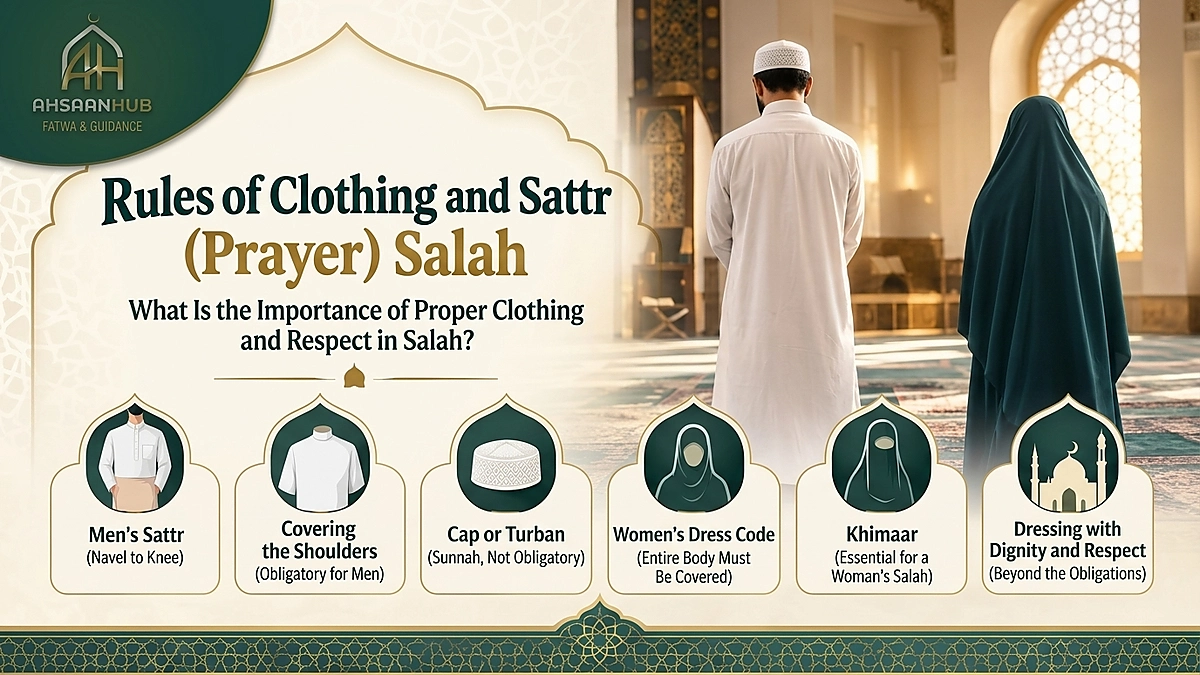
What Is the Importance of Proper Clothing and Respect in Salah?
In Salah, a person stands before Allah the Almighty.
It is therefore necessary to approach this standing with full propriety and respect.
There are certain parts of the body that must be covered, and beyond that, a person should also observe the requirements of dignity and decorum in their appearance.
What Is the Sattr of Men in Salah?
The area of the body that a man is obliged to cover is called his Sattr:
- The boundaries of Sattr: For a man, the Sattr extends from the navel to the knee.
- Covering this area is obligatory at all times, and it becomes even more essential in Salah.
Is Covering the Shoulders Obligatory for Men in Salah?
In addition to covering the Sattr, a man must also have some form of covering over
his shoulders during Salah.
Hazrat Abu Hurairah (RA) narrates that the Messenger of Allah (PBUH) said:
Hadith:
- None of you should pray in a single garment in such a way that nothing covers his shoulders.
- (Sahih al-Bukhari: 359)
Although it is permissible to pray in a single garment that covers the body, the shoulders
must be covered.
Therefore, the two requirements for men in Salah are: covering the Sattr from the navel
to the knees under all circumstances, and ensuring the shoulders are also not left uncovered.
These are among the obligatory conditions.
What Does the Quran Say About Dressing Well for Salah?
Beyond these obligatory requirements, Allah the Almighty commands in the Quran:
O children of Adam, take your adornment at every place of prayer.
(Surah al-A’raf: 31)
When going to Salah, a person should make an effort to dress well and present themselves with dignity.
The obligations mentioned above are compulsory, and beyond those, dignity and decorum are also expected.
Is Wearing a Cap or Turban Obligatory for Men in Salah?
A question often raised is whether it is obligatory for men to cover their heads during Salah.
- Wearing a turban (‘Imamah) is among the general Sunnah of the Prophet (PBUH), and it is an established practice of his.
- However, covering the head merely for the sake of covering it in Salah, using any available item, is not the intended purpose.
The actual objective is to attain dignity and honour before Allah.
For example, if a person were to tie a dirty cloth or the handkerchief they use to wipe their nose around their head before standing for Salah, while they would never appear
before an esteemed and respected person in such a state, then this is not the purpose
before Allah either.
The goal is not merely to place something on the head, but to observe proper
respect and honour.
If a person has something that genuinely fulfils the requirement of dignity and respect, covering the head is appropriate.
But the objective is dignity, not simply covering the head for its own sake.
What Is the Ruling on Prayer Caps Kept in Mosques?
The purpose of covering the head is not satisfied by simply placing something on it, such as the grimy plastic caps that are kept in some mosques, covered in filth, and placed
on the head just to stand for Salah.
This is not the intended objective of the Shariah.
The true purpose is to observe decorum, respect, and to take one’s adornment.
What is specifically commanded by Allah and His Messenger (PBUH) in Salah is:
- The Satr must be covered.
- The shoulders must not be left bare.
Beyond these obligations, a man should observe as much dignity and respect in his
clothing as he is able to.
What Is the Required Dress Code for Women in Salah?
For women, the ruling in Salah is established by the principle:
The entire body of a woman is Satr (i.e., must be covered).
A woman’s entire body from head to foot must be covered during Salah, with the exception of:
- The face: The face may remain uncovered.
- The palms: If both palms (Kaffayn) are uncovered during Salah, this is permissible.
Does a Woman’s Prayer Count Without a Proper Khimaar?
Aisha (RA) narrates that the Messenger of Allah (PBUH) said:
Hadith:
- Allah does not accept the Salah of a woman who has reached puberty unless she
is wearing a Khimar. - (Jami` at-Tirmidhi: 377)
- Explanation of Khimaar: A Khimaar is the head covering that covers the head
and drapes down to cover the body properly. - The full boundaries of a woman’s Sattr in Salah: A woman must cover her entire body. If the palms are slightly visible, that is acceptable.
However, the hair on the head must not be visible at all. Similarly, the area below the chin must also be covered.
Only the face is permitted to remain visible. Apart from the face, the woman’s entire body must be fully covered from head to foot.