What Is Sutrah and Why Is It Necessary in Salah?
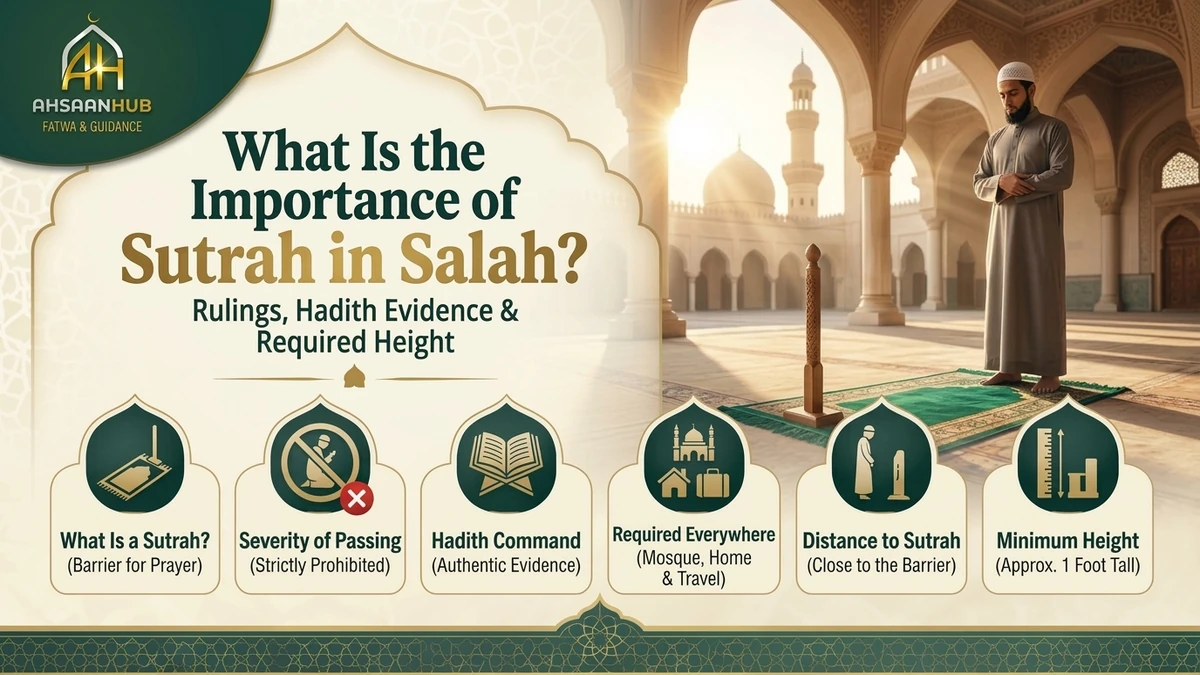
A Sutrah is a barrier or object that a person praying places in front of them before
beginning their Salah.
A person should avoid praying in the middle of an open desert, an open field, an exposed area, or even at any spot inside the home where there is nothing in front of them.
There must always be something placed ahead of the person praying, and this object
is called a Sutrah. It can be a wall, a pillar, or any other upright object.
What Is the Severity of Passing in Front of a Praying Person?
The Prophet (PBUH) prohibited passing in front of a person who is praying.
If the person who passes in front of someone praying were to realize the gravity of this sin, it would be better for him to stand and wait for forty [the narrator was unsure whether forty days, months, or years] rather
than walk across (Sahih al-Bukhari: 510; Sahih Muslim: 507a).
Just as there is sin upon the one who crosses in front, the person praying is also bound
by a responsibility.
He should pray in a place where there is something in front of him, without inconveniencing others, so that passers-by are not put in a difficult position.
That object is what is called the Sutrah.
What Is the Hadith on Praying Towards a Sutrah?
The Prophet (PBUH) made it binding to place a Sutrah before praying.
Abu Sa’id al-Khudri (RA) narrates that the Messenger of Allah (PBUH) said:
Hadith:
- When any one of you performs prayer, let him pray facing towards a Sutrah and draw close to it, and not let anyone pass in front of him. If someone attempts to pass in front of him, let him restrain him, for he has a Shaytan with him.
- (Sunan Ibn Majah: 954; Sunan Abi Dawud: 698; see also Sahih Muslim: 506a)
This Hadith makes the following points clear:
- There must always be some form of barrier in front of the person praying.
- The person praying should not allow anyone to pass in front of them. If someone attempts to cross, they should be stopped by a hand gesture.
- If the person does not stop at the gesture, they should be physically restrained, because Shaytan may be accompanying them.
- Passing in front of a person praying is prohibited, and the Prophet (PBUH) gave a direct command to the person praying to place a Sutrah.
Is Sutrah Required Everywhere or Only in Open Places?
It is important to understand that the ruling regarding Sutrah is general and applies universally.
It is not restricted to praying in the desert, nor is it specific only to open areas.
This ruling applies in all situations:
- Whether a person is in a mosque,
- At home,
- Or at any other location.
One should always pray close to a Sutrah. Even if there is no possibility of anyone passing by, Salah should still be performed close to a wall or similar barrier.
What Should Be the Distance Between the Person Praying and the Sutrah?
The distance between the place where the Prophet (PBUH) made Sujud and the wall (Sutrah) in front of him was so minimal that only a sheep could pass through.
Sahl ibn Sa’d al-Sa’idi (RA) narrates:
Hadith:
- The distance between the prayer place of the Messenger of Allah (PBUH) and the wall was just enough for a sheep to pass through.
- (Agreed upon: Sahih al-Bukhari: 496 and Sahih Muslim: 508)
The gap between the spot where the Prophet (PBUH) prostrated and the wall ahead of him was only wide enough for a single sheep to pass.
This narration is recorded in both Bukhari and Muslim.
Therefore, one should pray as close to the Sutrah as possible, and this is the clear instruction of the Prophet (PBUH).
What Is the Minimum Height of a Sutrah?
Regarding the height of the Sutrah, it is important to understand whether simply placing a handkerchief on the floor or drawing a line in front counts as a valid Sutrah.
The guidance on this matter is found in the Hadiths.
Aisha (RA) narrates that the Prophet (PBUH) was asked how tall the Sutrah of a person praying should be. He replied:
Hadith:
- Like the rear part of a camel saddle.
- (Sahih Muslim: 500a)
- The rear part of the saddle: The saddle placed on a camel for riding had a wooden backrest at the rear against which the rider would lean.
The Prophet (PBUH) said that the Sutrah should be at least as tall as this piece of wood. - The measurement in Arabic lexicon (two-thirds of a cubit): In the Arabic lexicon, the minimum height of this backrest is described as two-thirds of a Dhira’ (cubit). A Dhira’ is the length from the fingertips to the elbow.
Two-thirds of this measurement is approximately one foot. - The required height of a Sutrah: The Sutrah placed in front of a person praying must be at least approximately one foot tall. This is the minimum threshold meant by “like the rear part of a camel saddle.”
Simply drawing a line on the ground, or laying a small handkerchief, cap, or piece of cloth flat on the floor is not sufficient as a valid Sutrah according to the stronger scholarly opinion. While a narration mentions drawing a line if no stick is found (Sunan Abi Dawud: 689), leading Hadith scholars (including Imam al-Bukhari and al-Albani) have classified that narration as Da’if (weak).
Therefore, according to sound Fiqh analysis, a Sutrah should be an upright physical object with a tangible height (approximating the back of a camel saddle, roughly one foot tall).
It can be a person standing in front of you, behind whom you begin your prayer, or it can be a wall, pillar, stick, or any upright object of sufficient height near which the prayer is performed.
This is the command of the Prophet (PBUH), and arranging this before beginning the prayer is essential.