In the name of Allah, the Most Gracious, the Most Merciful. All praise belongs to Allah, Lord of all the worlds, and peace and blessings be upon the seal of the Prophets and Messengers.
O my Lord, expand my chest, ease my task, and untie the knot from my tongue so that they may understand my speech.
Allah (SWT) says in the Quran:
“وَمِنْ آيَاتِهِ أَنْ خَلَقَ لَكُم مِّنْ أَنفُسِكُمْ أَزْوَاجًا لِّتَسْكُنُوا إِلَيْهَا”
Wa min ayatihi an khalaqa lakum min anfusikum azwajan li-taskunu ilayha.
And among His signs is that He created for you spouses from among yourselves so that you may find tranquillity in them.
Al-Rum 30:21
All praise is due to Allah (SWT), Lord of all the worlds, and peace and blessings be upon His final Prophet Muhammad (PBUH).
Before proceeding with the topic of the etiquette of marital intimacy, it is necessary to address certain fundamental matters about which widespread misunderstandings exist in society.
When anyone attempts to speak on this subject, the common response is that it is shamelessness; it is indecency; such things should not be said, or if they must be said, they should be said behind closed doors and should not be addressed publicly through the media.
Yet this is such an important subject that at some point in life, not only Muslims but all human beings need someone to guide them in these matters.
When a person reaches the important stage in life of marriage and Nikah, and thereafter engages in marital relations with his wife, what Shariah terms jima’ and what is commonly called intimacy or sex, every person needs to know its proper etiquette.
The tragedy is that we do not want to learn about this, and the subject has become surrounded by so much darkness and so many misunderstandings that there seems to be no end to it.
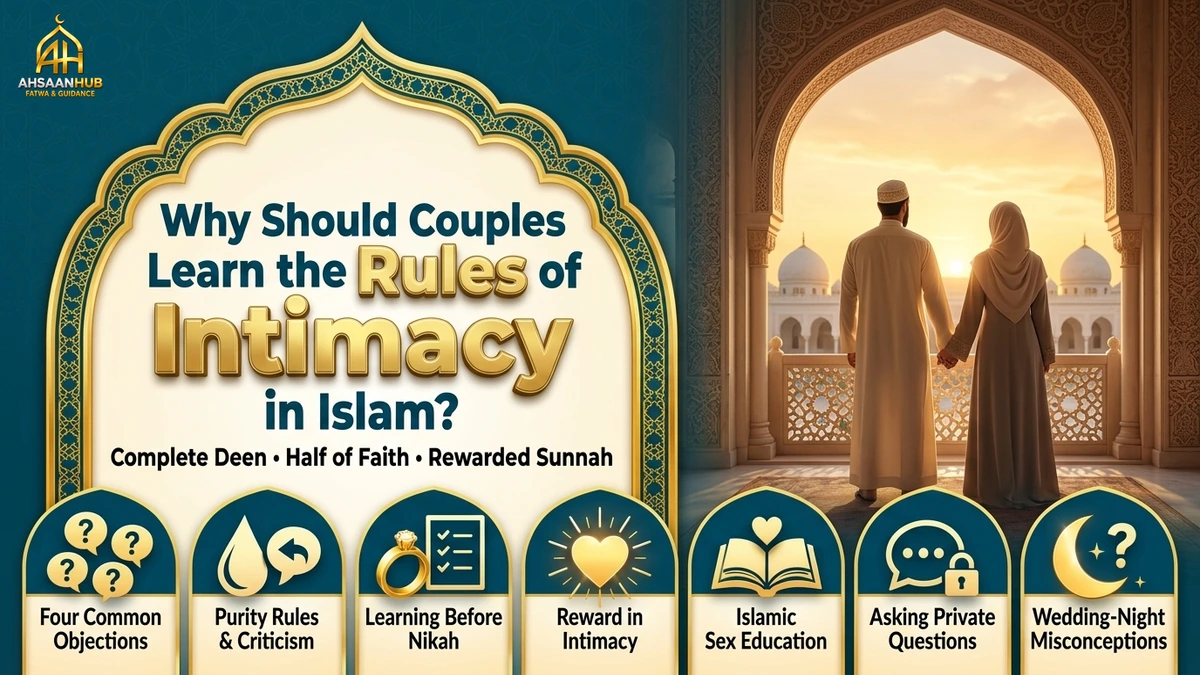
What Are Four Common Objections to Discussing Sex in Islam?
Whenever this subject is addressed, four types of objections and accusations arise.
It is necessary to clarify each of them.
1. The Objection of Non-Muslims and Islam as a Complete Way of Life
The first objection comes from some of our non-Muslim brothers.
When they see this subject being addressed, they say: what kind of religion is Islam that it explicitly and openly discusses all these things? This is not right.
Our non-Muslim brothers need to understand that Islam is a complete Deen,
a comprehensive way of life.
It teaches us the manner of conducting every affair from birth to death.
Whether it is the matter of birth, marriage, or death, Islam provides complete guidelines so that a human being may live every stage of life guided by the light of the Quran and the Sunnah of the Prophet (PBUH).
2. The Objection of Muslims and the Prophet’s (PBUH) Status as the Perfect Example
The second objection comes from some of our Muslim brothers who say that such matters should not be discussed publicly through the media because when these subjects are brought out openly, it raises questions and objections regarding Islam, the Prophet of Islam (PBUH), the Mothers of the Believers (Ummahat al-Mu’minin), and the Companions (RA).
People also ask: would anyone go and tell others about the personal life of their own parents, or about this aspect of their own private life?
The answer to this is: absolutely correct. If an ordinary person were to disclose his intimate marital secrets to others, that would be strictly forbidden, impermissible, and sinful.
Sahih Muslim: 1437a (in some editions: 3542)
However, the Prophet (PBUH) is a role model and the guide for humanity in every stage of life.
“لَّقَدْ كَانَ لَكُمْ فِي رَسُولِ اللَّهِ أُسْوَةٌ حَسَنَةٌ”
Laqad kana lakum fi Rasulillahi uswatun hasanah.
Indeed, in the Messenger of Allah you have an excellent example.
Al-Ahzab 33:21
For this reason, Allah (SWT) caused His Prophet (PBUH) to convey even those aspects of his life that it would be impermissible and forbidden for an ordinary person to disclose.
Whether the matters of purification, menstruation and postnatal bleeding, or the etiquettes of marital intimacy, the Prophet (PBUH) is our guide in all of these.
Allah (SWT) made this dimension of the Prophet’s (PBUH) life clear precisely so that we may receive guidance, and this guidance is not only for Muslims but also for our non-Muslim brothers, to know what divine guidance says about this aspect of life as well.
Consider: if this subject were concealed and left unaddressed, the resulting misguidance and confusion, where people seek guidance from corrupt individuals, media, and films, act wrongly, and then repent in regret, would that be better?
Or would it be better to address this subject so that people understand the Book of Allah and the Sunnah of the Prophet (PBUH) and act accordingly, with every person learning the etiquettes of marital intimacy before marriage?
3. The Doubt of Hadith Rejectors and the Distinction Between Human and Animal
The third objection comes from those who reject the Hadith.
They use this topic as a basis to claim that, God forbid, the books of Hadith contain obscene and indecent material about Prophets, the Mothers of the Believers, and the Companions.
They argue: would anyone discuss this aspect of their life or their parents’ lives publicly or in books? And therefore, they say, the Hadith should not be accepted.
The clarification is this: if the Prophet (PBUH) had concealed these matters and the Mothers of the Believers had not made them clear, you and I would have been left to live in this regard like animals doing whatever, wherever, however.
What distinction would then remain between human beings and animals? Look at animals: they have no etiquette for this; a male simply sees a female and pursues her.
Should human beings have no guidelines for this? Those very guidelines were conveyed to us through the Prophet (PBUH).
So rather than hearing this and rejecting the Hadith, give thanks to Allah that He blessed us with complete guidance even in this matter, including how a person remains in control of himself even in the state of intense emotion and passion that follows marriage.
4. The Excuse of Modesty and the Approach of the Quran and Sunnah
The fourth objection is that this is shamelessness and indecency and should not happen.
The response to this is: open Surah al-Baqarah.
When people asked questions about menstruation, Allah (SWT), despite being the Most Modest of all, addresses it directly in His Book:
“وَيَسْأَلُونَكَ عَنِ الْمَحِيضِ”
Wa yas’alunaka ‘anil-maheedi.
And they ask you about menstruation.
Al-Baqarah 2:222
Where matters of Shariah are to be discussed and understood, we should not feel shy because Allah (SWT) does not shy away from stating the truth and explaining Shar’i rulings.
This subject is connected to our purification, and only when our purification is correct will our acts of worship be accepted.
Therefore, how a husband and wife should live together after marriage, what is permissible and what is forbidden, what they should and should not do all of these guidelines have been placed before us through the Prophet (PBUH), the Mothers of the Believers, and the questions of the Companions and Companion women, so that this domain of life may be brought out of darkness.
How Did the Companions Respond to Criticism of Islamic Purity Rules?
We should not feel embarrassed in these matters. The finest example of this is the incident of Salman al-Farisi (RA).
Jami` at-Tirmidhi: 16 (Sahih), Sahih Muslim: 262
The People of the Book (Jews and Christians) said to him mockingly: O Salman al-Farisi! The Prophet Muhammad (PBUH), whom you follow, we have heard that he even teaches you how to relieve yourselves.
Salman al-Farisi (RA) replied: “Alhamdulillah! Yes, we follow that Prophet who has taught us how to use the toilet, how to relieve ourselves, and all the etiquette of doing so.
The Companions were not suffering from an inferiority complex or feeling at a loss for words; they stood firm and answered with pride: yes, our Prophet teaches us everything.
Why Learn Islamic Marriage Rulings Before Nikah?
Anas ibn Malik (RA) narrates that the Prophet (PBUH) said: “When a person contracts Nikah, he completes half of his Deen, so let him fear Allah and be mindful regarding the remaining half.”
Mishkat al-Masabih: 3096, Shu’ab al-Iman al-Bayhaqi: 5486 (Graded Hasan li-ghayrihi by al-Albani in Sahih al-Targhib: 1916)
Now the question is: if this subject is abandoned in the name of modesty, who will explain how this half of the Deen is to be completed? Nikah, at its core, is the union of a man and a woman in marriage, establishing marital relations.
If Nikah is half of the Deen, how can it be fulfilled without studying the life of the Prophet (PBUH) and his pure Sunnah?
There is a real danger that through ignorance, a person may fall into misguidance and wrong practices after marriage, committing something forbidden while believing it to be permissible, then spending years in regret, blaming himself, and asking what expiation he owes and how much repentance is required.
To illustrate with a simple example: if a person wants to buy a car, he should learn to drive and acquire knowledge of the vehicle before purchasing it.
In exactly the same way, before contracting Nikah, we should gain knowledge about what Islam and the Prophet (PBUH) have guided us regarding this matter
so that we can not only perform the Nikah in accordance with the Sunnah, but also fulfil the marital relationship itself in a manner that is Sunnah-compliant.
Is Marital Intimacy Rewarded in Islam?
Abu Dharr al-Ghifari (RA) narrates in Sahih Muslim that the Companions asked the Prophet (PBUH): O Messenger of Allah, when one of us fulfils his marital relations with his wife, will he receive reward for that?
The Prophet (PBUH) said: “Yes.” The Companions were amazed and said: O Messenger of Allah, how can there be reward in that? He (PBUH) replied: “Tell me, if you were to fulfil that same act with a woman other than your wife in a forbidden manner, would there not be sin and punishment for that?”
Because in Islam, the punishment for zina for a married person is stoning (capital punishment), and for an unmarried person it is one hundred lashes.
Jami` at-Tirmidhi: 1433 (Sahih), Sahih Muslim: 1690a
The Companions said: Yes, there would certainly be punishment.
He (PBUH) then said: “In the same way, when you fulfil this act in the permissible manner with your own wife, Islam grants reward for it too.”
Sahih Muslim: 1006 (in some editions: 2329)
Alhamdulillah! Islam is that Deen and way of life which teaches that even being with one’s wife carries reward.
But naturally, this reward will only be received when the act is performed in accordance with the guidelines of the Sunnah and Shariah, not according to one’s own whims.
Whoever lives by his own desires runs a serious risk of committing acts he considers permissible while they are, in fact, forbidden in Islam.
What Does Islam Say About Sex Education?
Some who consider themselves intellectuals due to incomplete knowledge of Islam claim that Islam is a strange religion that prohibits and restricts sex education.
The clear message to such people is: Islam is not against sex education.
What Islam opposes is the vulgar and explicit manner in which sex education is sometimes presented, gathering people and demonstrating the act practically in front of them.
Such a demonstration is also unnecessary, because Allah (SWT) has placed certain things within human nature (fitra) from birth.
Just as science tells us that laughing, crying, or an infant instinctively putting something in its mouth when hungry does not need to be taught because it is part of human nature, similarly, marital intimacy is part of human nature, and Allah has placed a natural attraction between men and women, which gives them an instinctive understanding of the basic reality.
What people need are guidelines and boundaries: what is permissible and what is forbidden.
Therefore, if sex education means teaching mature individuals or those entering marriage within the framework of Islam and the guidelines of Shariah what is halal and what is haram, and what the Sunnah method is then this is entirely correct and necessary.
How Did the Companions Ask About Private Matters?
In these matters, the life of the Prophet (PBUH) is the finest example, and the Companions and Companion women would ask him (PBUH) whenever any matter arose for them. Aisha (RA) praised their dedication to knowledge, saying:
“نِعْمَ النِّسَاءُ نِسَاءُ الأَنْصَارِ لَمْ يَكُنْ يَمْنَعُهُنَّ الْحَيَاءُ أَنْ يَتَفَقَّهْنَ فِي الدِّينِ”
How excellent are the women of the Ansar! Their modesty did not prevent them from learning and understanding the religion.
Sunan Abi Dawud: 316 (Hasan by Al-Albani), Sahih Muslim: 332c, Sahih al-Bukhari (Book 3, Chapter 50)
They would come to the Prophet (PBUH) with their questions, ask repeatedly, and felt no hesitation or embarrassment whatsoever.
The Companions and Companion women had different approaches to asking questions:
- Sometimes a Companion woman would come directly to the Prophet (PBUH) and ask, and he (PBUH) would answer without ever feeling embarrassed.
- If a Companion woman felt shy about asking directly, she would go to the Mothers of the Believers (the Prophet’s wives), who would then ask the Prophet (PBUH) on her behalf and convey the answer.
- At other times, a Companion woman would share her concern with her husband, and he would come and ask the Prophet (PBUH) directly.
It is precisely because of the questions of these Companions and Companion women that we have today a complete treasury of guidance on these matters, because this is an inseparable part of the Deen and of human life from which no married person is exempt.
What Are Common Wedding Night Misconceptions?
Modesty and decency certainly demand that these matters not be discussed openly without necessity.
But when we see the youth of the Muslim community seeking guidance from irreligious individuals, corrupt magazines, porn, novels, and wrong sources leading them to un-Islamic and unnatural practices, it becomes obligatory and necessary to address these matters.
The consequences of not learning and taking advice from the wrong people have resulted in strange misunderstandings and harms among young people, evident from the questions that arrive through phone calls and emails:
- Some young men are told before their wedding night: “Tonight you have to win,” as if they are being taught wrestling rather than the etiquette of marital intimacy.
- Some are told: “If you succeed tonight, your life is a success; otherwise, your wife will dominate you for the rest of your life,” so the young man enters the room not to meet his wife with love but like a soldier going into battle.
- Some young men are burdened with unfounded myths and extreme medical fears—such as false rumors that a woman might require surgical intervention on the wedding night—causing severe mental distress and panic over whether they can fulfil marital intimacy at all.
- Many people, out of ignorance, engage in unnatural and forbidden acts that cause harm in both this world and the next, acts that require expiation (kaffarah), or about which the Prophet (PBUH) gave stern warnings, and then years later, when they learn of the ruling, they are consumed with regret, wishing someone had told them beforehand so they would not have fallen into that wrong.
To prevent spiritual destruction and physical harm, Islam clearly establishes inviolable boundaries regarding marital relations:
- Strict Prohibition of Anal Intercourse: The Prophet (PBUH) strongly condemned this unnatural act, stating: “He who has intercourse with his wife through her anus is accursed.”
Sunan Abi Dawud: 2162 (Sahih by Al-Albani), Jami` at-Tirmidhi: 135 - Intercourse During Menstruation & Kaffarah: Relations during menstruation are strictly unlawful (Al-Baqarah 2:222). Whoever commits this sin must repent and pay an expiation (kaffarah) of one dinar or half a dinar in charity.
Sunan Abi Dawud: 264 (Sahih) - Sunnah Supplication Before Intimacy: The Prophet (PBUH) instructed couples to seek Allah’s protection before intimacy by reciting:
“بِسْمِ اللَّهِ، اللَّهُمَّ جَنِّبْنَا الشَّيْطَانَ، وَجَنِّبِ الشَّيْطَانَ مَا رَزَقْتَنَا”
“Bismillah, Allahumma jannibnash-shaytana wa jannibish-shaytana ma razaqtana” (In the name of Allah, O Allah! Keep Satan away from us and keep Satan away from what You bestow upon us).
Sahih al-Bukhari: 6388, Sahih Muslim: 1434
For this reason, Muslim scholars must come forward and guide young people in these matters.
And the appeal to young people themselves is: before completing your half of the Deen, learn these matters thoroughly in the light of the Quran and Sunnah, and give thanks to Allah that our Deen has provided us with complete guidance even in this domain of life.
Summary of Key Islamic Rulings and Etiquettes of Intimacy
| Category / Aspect | Islamic Ruling & Guidance | Authentic Citation |
|---|---|---|
| Spiritual Reward | Permissible intimacy within marriage is rewarded as an act of charity (Sadaqah). | Sahih Muslim: 1006 |
| Pre-Intimacy Sunnah | Reciting the Sunnah supplication for spiritual blessing and safeguarding future offspring. | Sahih al-Bukhari: 6388, Sahih Muslim: 1434 |
| Seeking Knowledge | Modesty must never prevent Muslims from learning lawful rulings of purity and intimacy. | Sunan Abi Dawud: 316, Sahih Muslim: 332c |
| Marital Privacy | Disclosing intimate bedroom secrets to anyone is strictly forbidden (Haram). | Sahih Muslim: 1437a |
| Menstruation (Hayd) | Intercourse is strictly prohibited until complete purification; requires kaffarah if violated. | Al-Baqarah 2:222, Sunan Abi Dawud: 264 |
| Anal Intercourse | Completely prohibited and cursed in Islam under all circumstances. | Sunan Abi Dawud: 2162, Jami` at-Tirmidhi: 135 |
| Significance of Nikah | Marriage fulfills half of a believer’s religion, guarding chastity and piety. | Mishkat al-Masabih: 3096 (Hasan li-ghayrihi) |