Can You Sleep, Eat, or Fast in Janabah Without Ghusl?
Regarding a person in a state of janabah (one who has been intimate with their spouse and upon whom ghusl has become obligatory), several important Shar’i rulings and the clarification of common social misconceptions are as follows:
- Refuting the misconception about sleeping without ghusl: Some people say that if a person has intercourse at night and then sleeps without performing ghusl, and dies during that sleep, the angels curse him and nothing good happens to him.
Know clearly that this is not the case at all, and it is completely incorrect to say that a person in janabah simply cannot sleep without ghusl.
It is narrated that the angels of mercy do not approach a person in a state of janabah unless they perform wudu.
(Sunan Abi Dawud: 4180 Hasan)
Therefore, performing wudu before sleeping removes this concern, and bathing may comfortably be delayed until the morning. - The social confusion about bathing in the middle of the night: Among those communities where this incorrect idea is very widespread, one must absolutely bathe and then sleep when these people are intimate with their wives in the middle of the night; they then get up in the middle of the night, heat water, and bathe.
This alerts the entire household and neighbourhood that someone was bathing at midnight, and in the morning even the children ask why they were bathing in the middle of the night, causing much embarrassment and difficulty.
It must be understood that bathing at night is not obligatory. You may get up in the morning and perform the ghusl then. - The Sunnah method of performing wudu before sleeping or eating: The best and most recommended practice for a person in janabah is to perform ghusl before sleeping. But if one wishes to sleep or eat before bathing, the established Sunnah is to perform wudu.
(Sahih Muslim: 305b)
When Umar (RA) asked whether one may sleep in a state of janabah, the Prophet (PBUH) replied: “Yes, let him perform wudu and then sleep if he wishes.”
(Sahih al-Bukhari: 287) - Having intercourse on the nights of Ramadan and suhoor in janabah: Sunan Ibn Majah records from Aisha (RA) that the Prophet (PBUH) would spend the night in a state of janabah, and upon the morning call to prayer, he would perform ghusl before offering the Fajr prayer.
(Sunan Ibn Majah: 1703 Sahih)
Regarding intimacy on the nights of Ramadan, the Holy Quran explicitly permits it:
(Surah Al-Baqarah 2:187)
The common superstition that intimacy during the nights of Ramadan causes disobedient children is completely fabricated and refuted by this clear Quranic verse.
Know clearly that intimacy is not a sin or something outside of Islam, and that a child would not be disobedient because of it.
Ramadan is certainly the month of worship; during the day, a person is fasting, and this act is prohibited during the fast, but at night a person may fulfil their need, desires, and satisfaction of the self. - The ruling on having suhoor and keeping the fast without performing ghusl: If someone was intimate at night and did not perform ghusl before dawn, they may have suhoor in a state of janabah, and their fast is completely valid.
(Sahih al-Bukhari: 1925, 1926)
However, performing ghusl is obligatory before offering the Fajr prayer to attain purity for Salah.
(Surah Al-Ma’idah 5:6)
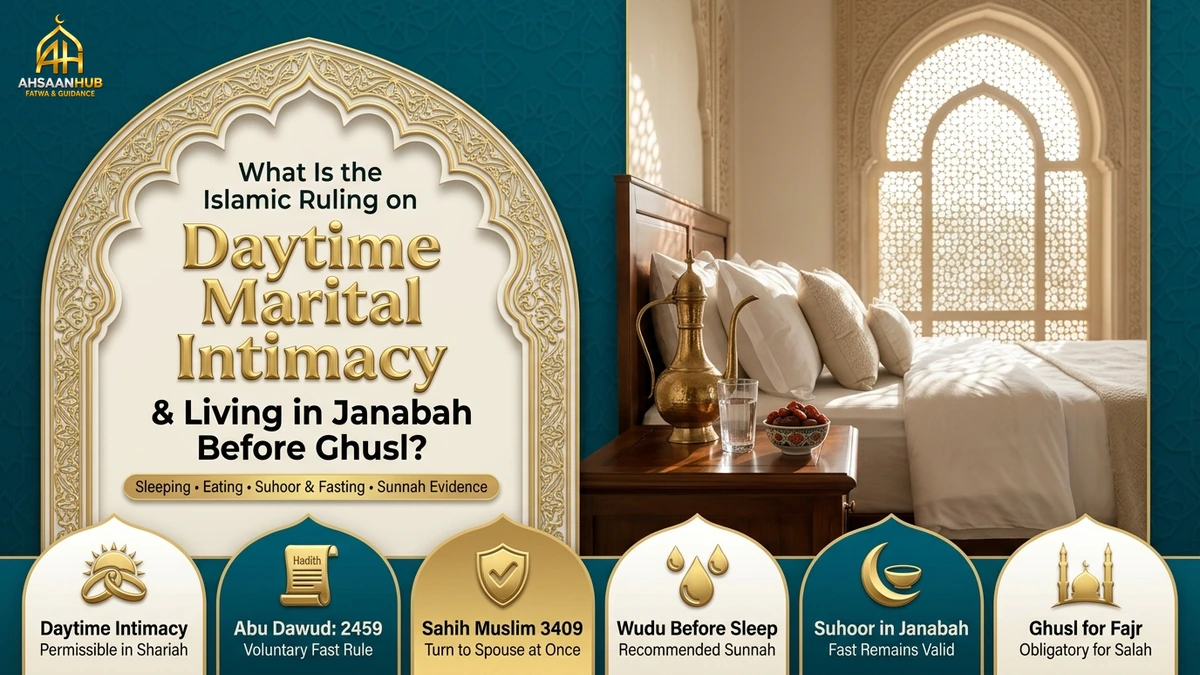
Is It Permissible to Have Marital Intimacy During the Daytime?
Many people also believe that having intercourse during the day is haram, and that the children born of it will be corrupted and go astray.
Know clearly that this is not the case, and no prohibition on daytime intercourse is established in the Shariah.
What is preferable is that a person be intimate at night, because at night after the Isha prayer a person is free and relaxed; the gap between Isha and Fajr is quite long, providing ample opportunity for ghusl and sleep, whereas during the day the gaps between prayers are shorter.
However, if a person cannot find time at night, is busy, or the circumstances are not suitable, then from a Shar’i perspective, intercourse may be had at any time, by day or by night.
Two clear pieces of evidence for this are found in the hadiths:
- First evidence (husband’s permission for a voluntary fast): The Prophet (PBUH) said: “No woman should observe a voluntary fast when her husband is present except with his permission.”
(Sunan Abi Dawud: 2458; Sahih al-Bukhari: 5195)
Scholars write in the explanation of this hadith that the voluntary fast is prohibited without permission because a fast is during the day, and it is possible that the husband may come home during the day and have need of his wife.
If she is fasting, it will create difficulty for the husband. This establishes that intercourse during the day is permissible. - Second evidence (the hadith about one’s gaze falling on a woman): The Prophet (PBUH) instructed that if a man sees a woman and feels desire in his heart, he should go to his wife and fulfill his need.
(Sahih Muslim: 1403c; Darussalam: 3409)
In the narration of Jami’ al-Tirmidhi, the Prophet (PBUH) added: “for that will dispel what is in his heart, because she has what the other woman has.”
(Jami’ al-Tirmidhi: 1158 Sahih)
It is obvious that a person’s gaze generally falls on a woman during the day
(things are not as clearly visible in the darkness of the night), and the Prophet (PBUH) did not stipulate waiting until evening or night.
Rather, he said to go immediately to one’s wife, which makes it clear that intercourse during the day is entirely permissible.