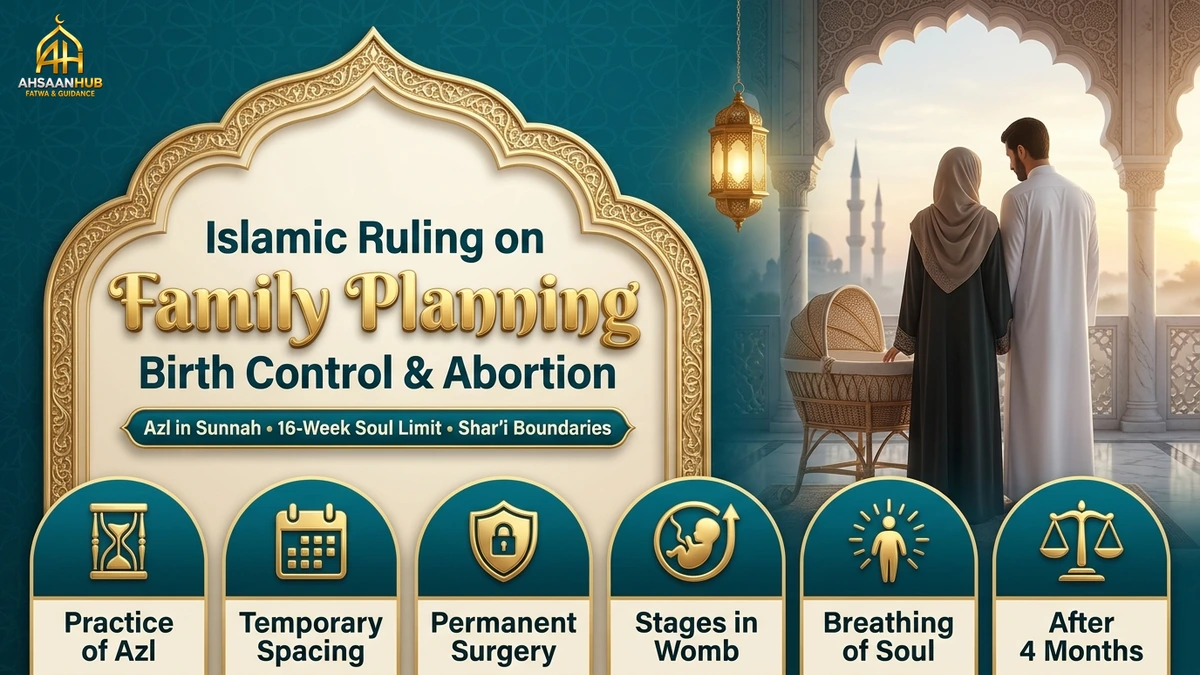
Was Birth Control (Azl) Practiced in the Prophet’s Time?
There should be no embarrassment in understanding the truth and the rulings of the Shariah, and this issue must therefore be understood clearly and appropriately.
During the era of the Prophet (PBUH), a practice known as Azl (coitus interruptus) existed among the Companions.
Azl is when a husband, during marital relations with his wife, withdraws before ejaculation so that conception does not occur.
What is the Hadith about azl?
This practice was present among the Companions during the lifetime of the Prophet (PBUH). Jabir (RA) narrates:
“كُنَّا نَعْزِلُ وَالْقُرْآنُ يَنْزِلُ”
Kunna na’zilu wal-Qur’anu yanzil.
We used to practice Azl while the Quran was being revealed.
(Sahih al-Bukhari: 5208, 5209, also 5207; Sahih Muslim: 1440a)
Had this practice been impermissible, it would have been prohibited through revelation or by the Prophet (PBUH) directly.
Since the Prophet (PBUH) did not forbid it, this establishes that Azl is permissible.
Is Family Planning and Temporary Birth Control Allowed in Islam?
From the permissibility of Azl, we derive the principle that there is room to delay conception before a pregnancy is established.
At the same time, Islam holds having many children in high regard.
The Messenger of Allah (PBUH) said:
“تَزَوَّجُوا الْوَدُودَ الْوَلُودَ فَإِنِّي مُكَاثِرٌ بِكُمُ الْأُمَمَ”
Tazawwajul-wadudal-waluda fa-inni mukathirun bikumul-umam.
Marry the loving and fertile woman, for I will take pride in your great numbers before
the other nations on the Day of Resurrection.
(Sunan Abi Dawud: 2050, Sunan an-Nasa’i: 3227 Hasan/Sahih)
Having many children is therefore beloved and praiseworthy in Islam.
However, alongside this, Shariah does permit a temporary delay in conception for a limited and defined period, just as Azl was practised by the Companions of the
Prophet (PBUH).
The following Shar’i boundaries apply:
- Permanently eliminating the ability to conceive is strictly forbidden: Any procedure or operation that permanently removes a woman’s capacity to bear children altogether is impermissible and absolutely haram.
- Temporary methods are permissible: However, using any modern method for a limited period to delay pregnancy, as Azl served in earlier times, is not considered sinful or blameworthy in Islam, provided it is temporary and not permanent.
It must be clearly understood that this does not mean spacing must be done; having many children is the preferred and beloved practice in Islam.
But where a genuine need exists, a temporary measure for a limited time carries some room within the Shariah.
How Does a Fetus Develop Before Four Months?
If a pregnancy has already been established, the question arises: is there any room after conception?
Here, a crucial point must be noted regarding the stages of the child’s development in the womb, as the Quran itself has described:
- First, it is a nutfah (a drop of fluid).
- Then it becomes a ‘alaqah (a clinging clot of blood).
- Then it becomes a mudghah (a lump of chewed flesh).
- Then bones form upon it, and a complete human skeleton takes shape.
(Surah Al-Mu’minun 23:12–14)
When the child reaches four months, which, calculated according to the Shariah stages of forty days (40 + 40 + 40), equals 120 days (approximately 17 weeks), an angel is sent, and the soul (ruh) is breathed into it.
(Sahih al-Bukhari: 3208, Sahih Muslim: 2643)
At this point, the angel records what was already known to Allah (SWT) from eternity: whether the child will be among the fortunate or the wretched, what his provision (rizq) will be, and how long he will live.
This is not Allah (SWT) deciding at that moment; He has always known, but it now enters the knowledge of the angels and is formally inscribed for that soul.
What is recorded reflects the choices the person will freely make in his life, which Allah (SWT) knew before creation.
Is Abortion Haram After Four Months of Pregnancy?
Once four months have passed, and the angel has breathed the soul into the child, the fetus begins to move in the womb and has become a complete human being.
After this four-month threshold, removing or terminating the child constitutes outright killing (qatl al-nafs), the taking of a human life.
The gravity of this in Shariah is underscored by the Prophet’s (PBUH) judgment regarding harm inflicted on an unborn child: when assault on a pregnant woman caused the loss of her fetus, the Prophet (PBUH) ruled that legal compensation known in Islamic jurisprudence as Ghurrah (fetal blood compensation / a fraction of Diyah) must be paid.
(Sahih al-Bukhari: 6904–6909, Sahih Muslim: 1681a)
If the child is born alive after the injury and subsequently dies as a consequence, the full diyah becomes obligatory in Islamic law.
After the soul has been breathed in at four months (120 days), abortion is strictly prohibited (haram) by scholarly consensus.
The sole exceptional circumstance recognized by contemporary Islamic jurisprudence bodies (such as the Islamic Fiqh Academy) is when qualified, trustworthy medical specialists confirm that continuing the pregnancy poses an imminent, fatal threat to the mother’s life, operating under the Shar’i principle of choosing the lesser of two harms to preserve the established life of the mother.
Is Abortion Before Four Months (120 Days) Allowed in a Medical Emergency?
If the matter concerns a period before four months (120 days), before the soul has been breathed in and the embryo is developing through the stages of a clot of blood or a lump of flesh, is there any room in extreme circumstances?
During this period, if a qualified specialist physician determines that the pregnancy poses a grave danger to the mother’s health or that there is a serious medical threat to the fetus itself, some scholars allow for flexibility because at this stage, the embryo has not yet become a full human being and is closer in nature to a growing part of the body.
Just as a surgeon removes an overgrown appendix, a nasal bone, or an ear bone through an operation, the embryo before the soul is breathed in is treated with similar consideration.
If such a termination occurs before four months due to a genuine and severe necessity, it cannot be termed qatl al-nafs (the killing of a soul). Allah (SWT) says:
“وَلَا تَقْتُلُوا أَوْلَادَكُم مِّنْ إِمْلَاقٍ”
Wa la taqtulu awladakum min imlaq.
And do not kill your children out of poverty.
(Surah Al-An’am 6:151; see also Surah Al-Isra 17:31)
The embryo before four months does not yet fall under the category of awlad (children/offspring) in this verse; it enters that category only after the soul has been breathed in, and it has become an awlad (a child) in the full sense.
In many issues, extreme positions are taken in our society: some permit everything without restriction, while others declare everything forbidden.
True Islam is the way of the Ummat al-Wasat, the balanced and moderate community
(Surah Al-Baqarah 2:143), one that considers all dimensions, wisdoms, and circumstances.
Without question, having many children is beloved to Allah (SWT) and His Messenger (PBUH). However, applying the verse:
“وَلَا تَقْتُلُوا أَوْلَادَكُم مِّنْ إِمْلَاقٍ ۖ نَّحْنُ نَرْزُقُكُمْ وَإِيَّاهُمْ”
Wa la taqtulu awladakum min imlaq, nahnu narzuqukum wa iyyahum.
Do not kill your children out of poverty; We will provide for you and for them.
(Surah Al-An’am 6:151; compare with Surah Al-Isra 17:31: “We provide for them and for you. Indeed, their killing is a great sin.”)
To treat every case of temporary spacing or a pre-four-month medical emergency as not accurate or just. The clear boundaries are:
- Permanently eliminating the capacity to conceive is absolutely haram; this constitutes taghyeer khalq-Allah (altering Allah’s creation).
(Surah An-Nisa 4:119) - Becoming a tool or advocate for organised movements that promote population control and suppression of human generations is also wrong.
- But declaring every temporary delay or genuine medical necessity as completely forbidden is equally wrong.
If a person already has five or ten children and takes a temporary break to manage their care and upbringing responsibly, it is unjust to immediately declare this impermissible.
This world is the Dar al-Asbab, the realm of means and causes, and sensible, fair-minded decisions must be made in light of real circumstances.
May Allah (SWT) grant us the ability to understand these matters correctly and to remain upon justice in all of them.
A sincere appeal is made, however: these words must never be misused or taken out of context.
No one should take one portion of this discussion and claim that “the scholar has declared everything permissible”; that is not the intent at all.
The only purpose is to clarify the Shar’i boundaries and the consideration that applies in genuine medical necessity.
Summary of Islamic Rulings on Family Planning, Birth Control, and Abortion
| Topic / Stage | Shar’i Ruling & Conditions | Foundational Proofs & References |
|---|---|---|
| Temporary Birth Control (Azl & modern methods) | Permissible (Ja’iz) for valid reasons (e.g., mother’s health, child spacing, care of existing offspring) with mutual spousal consent. Not a mandatory requirement. | Sahih al-Bukhari: 5208–5209, Sahih Muslim: 1440a |
| Desirability of Children & Large Families | Highly Recommended (Mustahabb) in principle; the Prophet (PBUH) takes pride in the large numbers of his Ummah. | Sunan Abi Dawud: 2050, Sunan an-Nasa’i: 3227 |
| Permanent Sterilization (Vasectomy / Tubal Ligation) | Strictly Prohibited (Haram) as it permanently destroys the God-given faculty of procreation and alters Allah’s creation (taghyeer khalq-Allah), unless a critical medical necessity endangers life. | Surah An-Nisa 4:119 |
| Embryonic Stages & Ensoulment (Nafkh ar-Ruh) | Three 40-day developmental stages (40 + 40 + 40 = 120 days / ~17 weeks) culminating in the breathing of the soul and recording of destiny. | Surah Al-Mu’minun 23:12–14, Sahih al-Bukhari: 3208, Sahih Muslim: 2643 |
| Abortion Before 120 Days (Pre-Ensoulment) | Disliked/Impermissible in general; permitted ONLY for severe, verified medical necessity (e.g., severe danger to the mother’s physical health) certified by qualified physicians. | Surah Al-An’am 6:151, Classical & Contemporary Fiqh Consensus |
| Abortion After 120 Days (Post-Ensoulment) | Strictly Haram (Qatl al-Nafs / Taking a Soul); causes liability for Ghurrah/Diyah. Unanimous exception only if continuing pregnancy poses a direct, fatal threat to the mother’s life. | Sahih al-Bukhari: 6904–6909, Sahih Muslim: 1681a, Islamic Fiqh Academy Resolution |