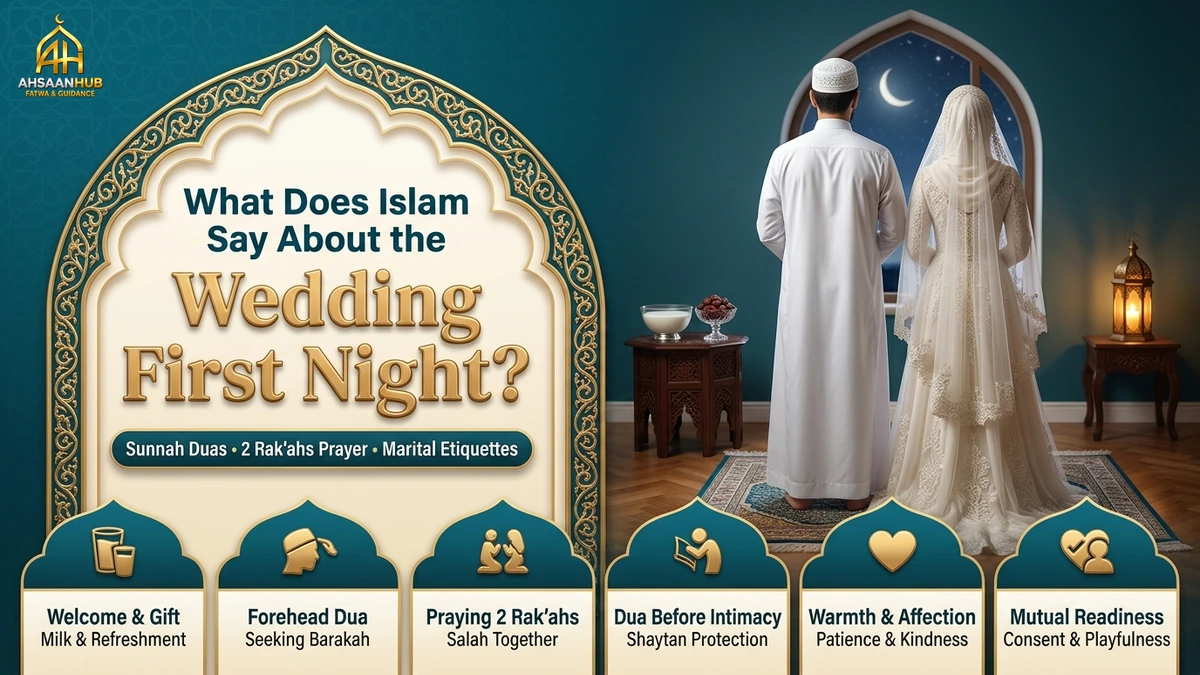
Within the subject of marital etiquettes, the first occasion a person meets his wife is the stage that follows the Nikah.
This topic covers two types of matters: first, how a husband should conduct himself when meeting his wife for the first time after Nikah, and second, the general rulings that arise in the course of repeated marital encounters throughout married life.
What Is the Sunnah for the Wedding Night?
When a husband meets his wife for the first time, there should be affection, warmth, and love between them, and he should present her with a gift or something to eat or drink at the time of the meeting.
When the Prophet (PBUH) first met his wife Aisha (RA) after the Nikah, his conduct provides us with the finest example to follow. The narrator of this hadith is Asma bint Yazid (RA).
She relates: when the Messenger of Allah (PBUH) came to meet Aisha (RA) on the occasion of her coming to his home, I had prepared, adorned, and dressed Aisha (RA) for him.
After he (PBUH) arrived and sat beside Aisha (RA), I brought a bowl of milk.
The Prophet (PBUH) drank from it and then extended the bowl toward Aisha (RA) so that she might also drink. Aisha (RA), out of shyness, said she did not feel the need or declined.
Asma (RA) says: I said to her: Do take it from the hands of the Messenger of Allah (PBUH), for he was waiting for her to accept.
Aisha (RA) then took the bowl and drank a little from it. After she drank, the Prophet (PBUH) said: Now pass the bowl to Asma. Asma (RA) said: O Messenger of Allah, you take from it first, and she handed the bowl to him.
The Prophet (PBUH) drank a little, and then Asma (RA) placed her lips on the very spot from which the Prophet (PBUH) had drunk.
After this, the Prophet (PBUH) said: ” Now give the bowl to the women sitting in the house.
They said: We do not need it. The Prophet (PBUH) smiled and said: “Hunger and a lie cannot be combined,” meaning: you are hungry, so why are you being overly formal and
refusing to drink?
(Musnad Ahmad: 27591, Al-Risalah ed.; also 28143 / Urdu Books: 27591)
What Does Asma bint Yazid’s Hadith Teach Us?
Three fundamental points regarding the first meeting are established from this narration:
Adorning and Preparing the Bride
The first lesson is that Aisha (RA) was prepared and adorned for the Prophet (PBUH).
This shows that the bride should be dressed, adorned, and made ready for the first meeting.
However, this preparation and adornment must remain within Shar’i boundaries, using only permissible means, and solely for the husband.
Offering a Gift or Refreshment at the First Meeting
The second point established is that the Prophet (PBUH) sat with Aisha (RA) and offered her the very milk he had drunk from.
What was available at that time was milk. This teaches us that when a man meets his wife for the first time, he should offer her something, whatever is available and within his means.
It could be something to eat or drink, something sweet, a small gift, jewellery, or anything she would appreciate.
The purpose is that when two people meet as strangers for the first time after Nikah, sharing food or presenting a gift removes that unfamiliarity, builds affection and closeness, and helps establish a warm and healthy relationship.
A Bride May Perform a Light Task When Needed
A third incidental point that emerges is that the Prophet (PBUH) asked Aisha (RA) to pass the bowl to Asma (RA).
This shows that a newly married woman (the bride) can perform a light task when needed.
It is not required that the bride sit completely idle; there is no Shar’i objection to her carrying out a small task when necessary.
What Dua Should You Recite When Meeting Your Bride?
After presenting a gift and conversing, the second important Sunnah act is supplication.
It is narrated in Sunan Abi Dawud and Sunan al-Nasa’i that the Prophet (PBUH) said: when a man meets his wife after Nikah for the first time, he should place his hand on her forehead, on the hair at the front of her head, and recite this supplication:
“اللَّهُمَّ إِنِّي أَسْأَلُكَ مِنْ خَيْرِهَا وَخَيْرِ مَا جَبَلْتَهَا عَلَيْهِ، وَأَعُوذُ بِكَ مِنْ شَرِّهَا وَشَرِّ مَا جَبَلْتَهَا عَلَيْهِ”
Allahumma inni as’aluka min khayriha wa khayri ma jabaltaha ‘alayh, wa a’udhu bika min sharriha wa sharri ma jabaltaha ‘alayh.
O Allah, I ask You for her goodness and the goodness of the nature and character You have placed within her, and I seek Your protection from her evil and the evil of the nature You have placed within her.
(Sunan Abi Dawud: 2160, Sunan Ibn Majah: 1918 Hasan)
This is an important Sunnah act, yet many people forget it or fail to give it proper importance when meeting their wife for the first time after Nikah.
It must be remembered that this supplication is read only once at the very first meeting after Nikah.
It does not need to be repeated at every subsequent meeting.
Is It Sunnah to Pray Two Rakats on the Wedding Night?
The third Sunnah act on the occasion of the first meeting is to pray two Rak’ahs of voluntary (Nafl) prayer together.
A person may choose to first place his hand on his wife’s forehead and make the supplication, then pray, or he may pray first and then make the supplication; both sequences are correct.
This practice is found in the narrations of the Companions, recorded in Musannaf
Ibn Abi Shaybah and Musannaf Abd al-Razzaq.
A Tabi’i (follower of the Companions) relates: when I got married, I invited some Companions; Abdullah ibn Mas’ud, Abu Dharr al-Ghifari, and Hudhayfah ibn al-Yaman (RA) came to my home.
We prayed together, and after the prayer the Companions, especially Abdullah ibn Mas’ud (RA) said to me:
“When your wife comes to you, pray two Rak’ahs together with her, then take hold of the front of her hair and make supplication after that; she is your wife, and you may do as you wish.”
(Musannaf Abd al-Razzaq: 10462; also Musannaf Ibn Abi Shaybah: 17154)
This narration from the Companions shows that this was a well-known and established practice among them, one they had undoubtedly learned from the Messenger of Allah (PBUH) himself.
The method of this prayer is that the husband stands in front as Imam and the wife stands behind him.
This prayer may be performed either aloud or silently, as no specific detail regarding its recitation has been narrated.
Consider how much importance Islam has given to spirituality even at the moment of Nikah, and the first meeting the first encounter of husband and wife is founded upon the remembrance of Allah: he is offering a gift, they are conversing warmly, together they are offering the finest act of worship (Salah) to please their Lord, and they are making Sunnah supplications.
What Dua Should Husband and Wife Recite Before Intimacy?
After the specific acts of the first night, the forehead supplication, and the two Rak’ahs, whenever a person intends to be intimate with his wife, the Shariah has prescribed a supplication that is not limited to the wedding night but must be recited every single time.
Ibn Abbas (RA) narrates that the Prophet (PBUH) said: when one of you intends to be intimate with his wife, let him say:
“بِسْمِ اللَّهِ، اللَّهُمَّ جَنِّبْنَا الشَّيْطَانَ، وَجَنِّبِ الشَّيْطَانَ مَا رَزَقْتَنَا”
Bismillah, Allahumma jannibna-sh-shaytana, wa jannibish-shaytana ma razaqtana.
In the name of Allah. O Allah, keep us away from Shaytan, and keep Shaytan away from what You have provided us (i.e., our offspring).
(Sahih al-Bukhari: 7396, Sahih Muslim: 1434)
The Prophet (PBUH) then said: if a child is conceived from that union, Shaytan will never be able to harm or mislead that child.
This means that if a person does not recite this supplication, Shaytan influences the offspring, but if he does recite it, the child is protected from Shaytan’s misguidance.
Since a person cannot know which particular encounter will result in a child, this protective supplication must be read every single time before marital intimacy.
Why Are Consent and Foreplay Important in Islamic Marriage?
A problematic behaviour observed among some young husbands today is that the moment people leave after the wedding night begins and he enters the room with his wife, he appears so impatient and rushed as though he has been waiting years for nothing else, that he completely forgets the prayer and the Sunnah supplications and immediately rushes toward the physical act.
Young men must understand that Islam is a complete way of life, and it requires a person to remain governed by principles and in control of himself in every matter, even in fulfilling his own desires.
The very first night, a husband’s impatient and rushed behaviour can leave a lasting impression on the wife that he has brought her solely for this one purpose, and this can damage the relationship for all the years that follow.
Marital intimacy is an act that requires both the husband and the wife to be willing and ready at the same time. Several important points follow:
- The difference between a man’s and a woman’s readiness: Whether a man is ready for this act or not is physically self-evident.
Whether a woman is ready, however, is not outwardly apparent, and especially on the first night, women naturally carry more shyness and modesty, which prevents them from expressing themselves openly.
- The problem with a one-sided act: If the husband is ready but the wife is not mentally or physically prepared, this is like a two-person game in which only one person is playing while the other simply sits there; this cannot be called a meaningful encounter.
- Preparing the wife: It is therefore the husband’s responsibility to begin with conversation, create a pleasant atmosphere, and prepare his wife mentally and physically before intimacy.
This includes warming up together, speaking words of affection, gentle touch, caressing, kissing, and other such means through which the wife becomes willing and drawn toward the act.
- An important counsel for wives: A frequent complaint from husbands in married life, and in some cases a grievance that has led all the way to divorce, is: “I am always willing, but not once in our entire married life has my wife given any sign or shown willingness on her own, and I always have to initiate.
“ Or the opposite happens: since the wife does not express her willingness, the husband comes, fulfils his need, and leaves, and the wife later complains that she was never asked and he simply came and went.
Wives should therefore express their willingness and desire through their words, movements, or gestures so that both parties participate as equal partners in this act.
The evidence for this mutual engagement and warmth is found in Sahih al-Bukhari, where Jabir (RA) came to the Prophet (PBUH) and mentioned that he had married.
The Prophet (PBUH) asked: a virgin, or a previously married woman? He replied: a previously married woman, because he had young sisters who needed care.
The Prophet (PBUH) said: Why did you not marry a virgin, so that “you could play with her and she could play with you”?
(Sahih al-Bukhari: 5367, Sahih Muslim: 715)
The words of this hadith make clear that both partners actively engaging and sharing warmth and playfulness with one another in this marital relationship is essential.
Summary of Authentic Hadith References for the Wedding Night
| Sunnah Practice / Event | Book & Hadith Number | Authentic Database Link |
|---|---|---|
| Welcoming the Bride with Refreshments (Milk) | Musnad Ahmad: 27591 (also 28143) | Musnad Ahmad (Hadith Unlocked) / Urdu Books: 27591 |
| Supplication upon Placing Hand on Bride’s Forehead | Sunan Abi Dawud: 2160 & Sunan Ibn Majah: 1918 | Sunan Abi Dawud: 2160 / Sunan Ibn Majah: 1918 |
| Two Rak’ahs Prayer Advised by the Companions | Musannaf Abd al-Razzaq: 10462 & Ibn Abi Shaybah: 17154 | Musannaf Abd al-Razzaq: 10462 |
| Protection Supplication Before Marital Intimacy | Sahih al-Bukhari: 7396 & Sahih Muslim: 1434 | Sahih al-Bukhari: 7396 / Sahih Muslim: 1434 |
| Mutual Affection, Warmth, and Playfulness | Sahih al-Bukhari: 5367 & Sahih Muslim: 715 | Sahih al-Bukhari: 5367 / Sahih Muslim: 715 |