In the previous discussions on the etiquette of marital intimacy, several important matters were covered: opening with the supplication from Surah Taha 20:25–28, the voluntary two Rak’ahs of prayer counselled by the Companions on the wedding night, the manner in which the Prophet (PBUH) first met Aisha (RA), the dua before intimacy, and the importance of mutual consent and tenderness.
Building on that foundation, a significant social misconception must now be addressed one that causes genuine harm to newlywed couples on their very first night together.
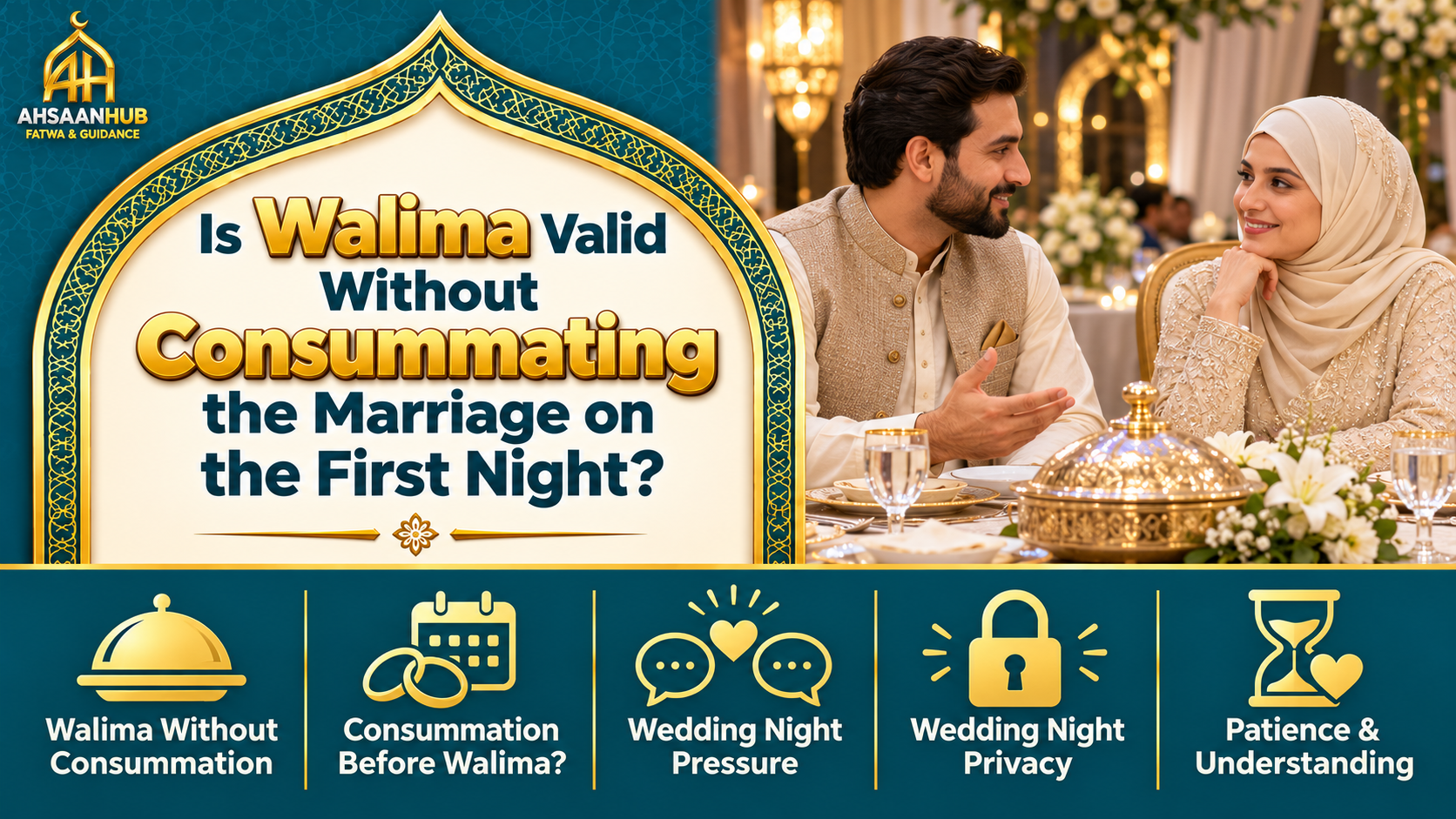
Is Walima valid without consummation?
In many communities, an ugly and deeply indecent custom has taken root.
After the wedding night, relatives and acquaintances approach the bride and groom or those close to them and ask words to the effect of: “Is the Walima halal or haram?” What they mean by this question is: did consummation take place or not?
This practice is completely baseless, un-Islamic, and morally reprehensible.
It has no foundation whatsoever in the Quran or the Sunnah.
Such a question is an outright invasion of the most private boundary of a couple’s life, and there is no justification for it in Islamic law.
(Surah Al-Hujurat 49:12, Jami` at-Tirmidhi: 2317)
In all likelihood, this custom was invented for no other purpose than to pry out the private secrets of the wedding night to satisfy a vulgar curiosity under the guise of a religious question. It must be rejected entirely.
Is Consummation Required Before Walima?
From a Shar’i standpoint, consummation of the marriage is not a condition for the validity of Walima.
(Sahih al-Bukhari: 5167)
Islamic jurisprudence establishes two important points on this matter:
First: Physical consummation is not a condition for Walima; having khalwat sahihah (lawful privacy between husband and wife after the Nikah) is sufficient, and according to many jurists, the feast is permissible once the marriage contract is solemnised.
Whether or not physical consummation takes place during that time is entirely irrelevant to the permissibility of Walima.
The moment khalwat sahihah has occurred, Walima is permissible, and its food is halal.
Second: It is entirely possible that a wife may be in her menstrual period at the time of the Nikah.
In such a case, the Nikah itself is completely valid, and correct menstruation has no bearing on the validity of the marriage contract.
However, consummation must be delayed until she has completed her period and attained purity.
(Surah Al-Baqarah 2:222)
In this situation too, if khalwat sahihah has taken place, Walima is permissible.
The husband does not need to wait for consummation before hosting the Walima feast.
How Can Wedding Night Pressure Harm Couples?
When the false belief that Walima is conditional on consummation takes hold in a community, it produces devastating consequences for the couple, particularly the wife.
The husband, feeling social pressure and the fear of embarrassment the following morning, stops behaving as a compassionate, patient companion; this pressure can lead to coercive behaviour.
He is no longer thinking about his wife’s feelings, her comfort, or her readiness.
He is thinking about what people will say and what questions will be asked.
This social pressure transforms the first night, which should be a moment of warmth, trust, and gentleness, into a traumatic experience.
(Surah An-Nisa 4:19, Sahih Muslim: 2594a)
The physical reality of a first-time experience for a woman must be acknowledged with honesty.
Some couples may experience pain, anxiety, or physical difficulty on the very first night without adequate time, emotional comfort, and readiness.
Forcing the matter under social pressure does not just cause physical pain; it causes lasting emotional and psychological harm.
It plants fear and aversion where there should be affection and trust.
Furthermore, the desperation created by this pressure leads some men to seek out unnatural or impermissible acts that are haram simply to claim that “something happened.”
(Sunan Abi Dawud: 2162, Musnad Ahmad: 9731)
This is a direct consequence of an invented, baseless custom that has no place in Islam.
Is Asking About or Sharing Wedding Night Secrets Haram?
Islam has addressed this matter with absolute clarity.
The Prophet (PBUH) did not merely discourage the sharing of marital secrets; he strongly condemned those who do so, warning that they will hold the worst status before Allah on the Day of Resurrection.
The Companion Abu Sa’id al-Khudri (RA) narrates that the Messenger of Allah (PBUH) said:
إِنَّ مِنْ أَشَرِّ النَّاسِ عِنْدَ اللَّهِ مَنْزِلَةً يَوْمَ الْقِيَامَةِ الرَّجُلَ يُفْضِي إِلَى امْرَأَتِهِ وَتُفْضِي إِلَيْهِ ثُمَّ يَنْشُرُ سِرَّهَا
Inna min asharrin-nāsi ʿindallāhi manzilatan yawmal-qiyāmati ar-rajula yufḍī ilā imra’atihi wa tufḍī ilayhi, thumma yanshuru sirrahā.
Among the worst of people in the sight of Allah on the Day of Resurrection will be the man who goes to his wife and she comes to him, and he then spreads her secrets.
This hadith establishes two rulings that are non-negotiable:
- Asking another person about what happened on their wedding night is haram.
- Answering such a question by disclosing any detail of what took place between husband and wife is also haram.
The Prophet (PBUH) described those who spread the secrets of their spouse as being among the worst people before Allah on the Day of Judgement.
This is not a minor matter. Anyone who participates in this custom, whether by asking, answering, or encouraging it, is committing a serious sin.
However, seeking medical help from a doctor or religious guidance from a mufti in cases of genuine necessity is entirely permissible.
Why Is Patience Important When Wedding Night Intimacy Is Difficult?
There is no Shar’i obligation on the couple to consummate the marriage on the first night. Islam has placed no such requirement.
The first night is a night of becoming acquainted, of building trust, of emotional connection, not a performance to satisfy the curiosity of relatives.
If physical union does not occur on the first night for any reason, there is no sin and no religious consequence.
Walima remains permissible. No one has any right to ask about it, and neither spouse has any obligation to disclose it.
Practically speaking, the couple should approach this stage with patience and wisdom:
- The husband must be gentle and understanding. If his wife is not physically or emotionally ready, he must not force the matter.
Patience on his part is not weakness; it is the Sunnah of the Prophet (PBUH), who showed tenderness and warmth above all else.
(Sahih Muslim: 2594a) - Communication between spouses is essential. Comfort, reassurance, and taking time to build familiarity are not contrary to the Sunnah; they are in the spirit of it.
- If physical difficulty is anticipated, the use of appropriate and permissible means, such as medically approved water-based lubricants, is not prohibited.
If pain or difficulty persists, consulting a qualified doctor or healthcare professional is advised. - If the wife is in her menstrual period at the time of the Nikah, the Nikah is fully valid. Consummation must simply wait until she has completed her period and become pure (Surah Al-Baqarah 2:222).
During this time, the couple can live together, speak, and be in each other’s company. Once she is pure, consummation is then permitted.
With these matters clarified, the next topic in this series addresses another important dimension of married life:
the permissible positions and methods of marital intimacy as guided by the Sunnah.