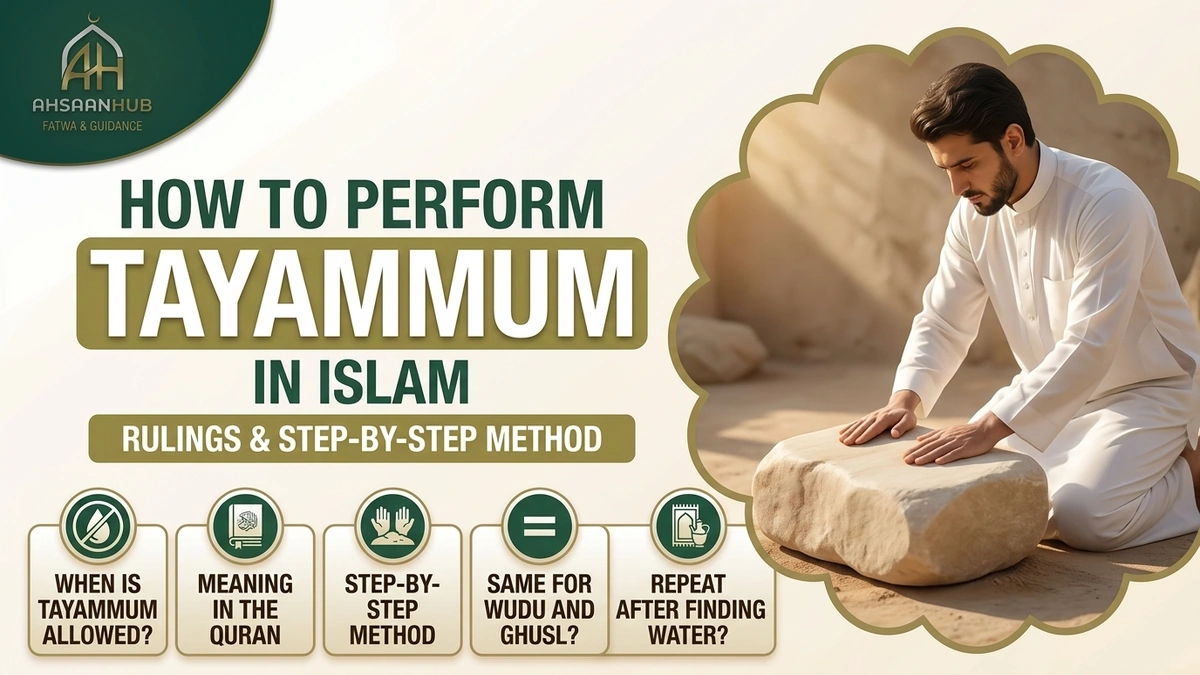
When Is Tayammum Allowed in Islam?
Islam provides great ease and concessions for Muslims in attaining ritual purity.
If a person is travelling and has no water available, or is a resident at home but cannot use water due to a genuine excuse or illness, Islam permits performing Tayammum instead
of using water.
What Does Tayammum Mean in Islam?
The linguistic meaning of Tayammum is to intend, aim, or resolve firmly.
It signifies forming a clear and sincere intention in the heart to attain ritual purity.
Following this intention, Islam prescribes a brief physical action.
Allah commands in the Quran that when water is unavailable for purification, whether
for Wudu or Ghusl, one must turn toward clean earth:
“Fatayammamu” (Therefore, seek clean earth) (Surah Al-Ma’idah: 6).
Step-by-Step Method of Tayammum?
The Sunnah method for performing Tayammum is as follows:
- Strike the ground or clean earth once with both hands.
- Blow gently over the hands to shake off any excess dust.
- Wipe the face and both palms using both hands.
- This simple procedure completes the entire method of Tayammum.
Hadith Evidence for the Method of Tayammum?
The primary evidence for the Sunnah method of Tayammum is the narration of
Ammar ibn Yasir (RA), recorded by Imam al-Bukhari in Sahih al-Bukhari.
Ammar ibn Yasir (RA) narrates:
Hadith:
- The Prophet (PBUH) said: It would have been sufficient for you to do this.
The Prophet (PBUH) then struck the ground with his palms, blew into them, and
wiped his face and palms with them. - (Sahih al-Bukhari: 338)
The Messenger of Allah (PBUH) taught him this method of Tayammum by striking the ground with both hands, blowing onto them so that any excess dust was removed, and wiping
his face and palms.
This is the exact procedure recognized as Tayammum in the Shariah.
Is Tayammum the Same for Both Wudu and Ghusl?
There is only one method of Tayammum, regardless of whether it is performed in place of Wudu or in place of Ghusl:
- If a person cannot find water for Wudu and only requires minor ablution, this identical method is performed.
- If a person is in need of Ghusl and cannot find water, or is unable to use it
due to illness, this exact same method applies.
In light of authentic Hadiths, particularly those in Sahih al-Bukhari, the only method established from the Prophet (PBUH) is striking both hands on the earth once and wiping
the face and palms.
Do You Need to Repeat Prayers After Finding Water?
When a person performs prayer after making Tayammum, that prayer is completely
valid, just as if it had been performed with regular Wudu.
The prayers completed in a state of Tayammum do not need to be repeated or made up
if water becomes available later. Those prayers are Islamically fulfilled and accepted (Sunan Abi Dawud: 338).
We ask Allah to grant us the ability to understand these rulings of the religion and to act
upon them.
📖 Complete Guide to Purification: How to Perform Wudu Step by Step: Complete Sunnah Guide →