Does Passing Urine or Stool Break Wudu?
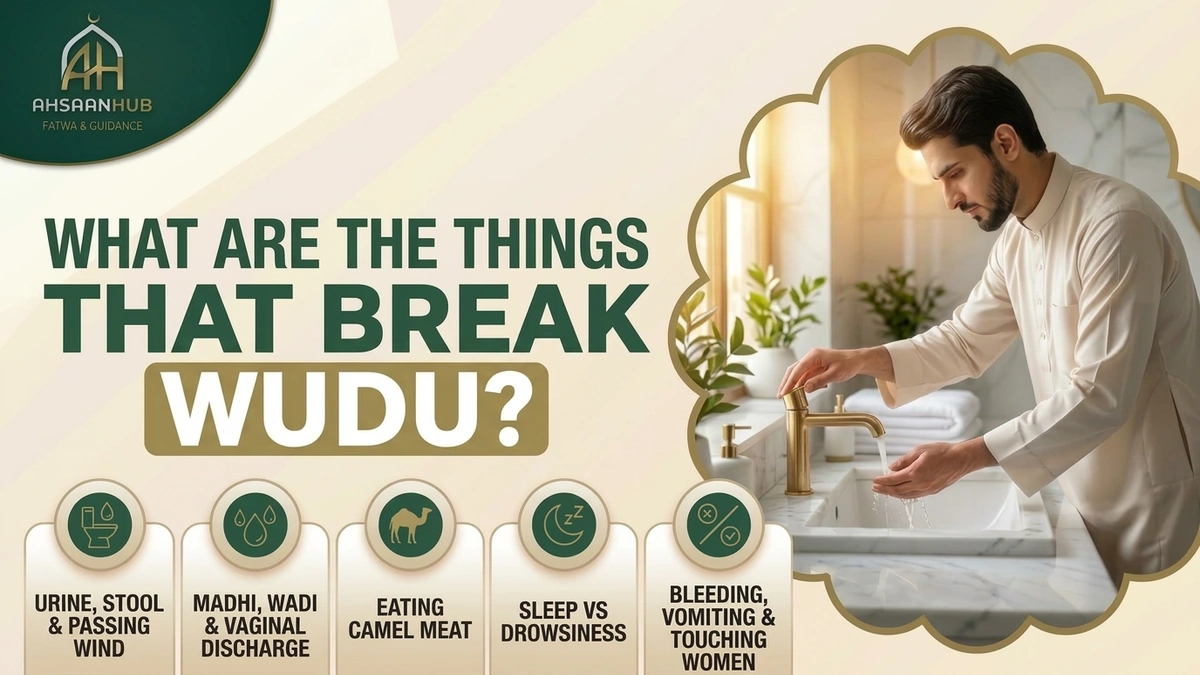
Just as it is necessary to understand the correct method of Wudu, it is equally important to know what breaks it.
The first cause that nullifies Wudu is the passing of urine or stool in any form.
Allah the Almighty says in Surah al-Ma’idah (5:6):
Or if any one of you comes from relieving himself.
The expression “coming from Gha’it” refers to answering the call of nature.
Whenever a person goes to relieve himself, his Wudu is broken.
Does Passing Wind Break Wudu?
The second cause that breaks Wudu is the passing of wind.
Abu Hurairah (RA) narrates that the Messenger of Allah (PBUH) said:
Hadith:
- Allah does not accept the prayer of any one of you when he has broken
his Wudu, until he performs Wudu again.
The word “ahdatha” in this Hadith means becoming without Wudu.
A man from Hadramaut once asked Abu Hurairah (RA): “What is hadath, O Abu Hurairah?”
He replied: passing wind, silently or audibly. This is also a cause that breaks Wudu.
(Sahih al-Bukhari: 135)
Do Madhi, Wadi, and Vaginal Discharge Break Wudu?
Among the causes that break Wudu is the discharge of certain fluids from the private parts, which are known in Islamic terminology as Madhi and Wadi:
- Discharge of Madhi: Madhi refers to the thin, sticky fluid that is emitted when a person experiences desire or arousal.
Its discharge breaks Wudu. Ali (RA) narrates that he used to
experience Madhi frequently and asked someone to inquire with the Prophet (PBUH)
on his behalf.
The Prophet (PBUH) replied that when this occurs, one should perform Wudu and wash the private area, and that is sufficient. - Discharge of Wadi: Wadi refers to the thick, whitish fluid that may appear after urination. Its discharge also breaks Wudu.
- Vaginal discharge in women: For women, apart from the regular blood of Haydh
and Nifas, any fluid discharged due to illness or a condition such as leucorrhoea also breaks Wudu.
Similarly, any discharge that occurs outside of the menstrual period breaks Wudu.
Does Touching Private Parts Without a Barrier Break Wudu?
Another cause that breaks Wudu is touching one’s private parts directly with the hand
without any covering or barrier.
Busrah bint Safwan (RA) narrates:
Hadith:
- I heard the Messenger of Allah (PBUH) say: whoever touches his private parts
should perform Wudu.
This is the established and correct position: directly touching one’s private parts
with the hand, without any barrier, breaks Wudu.
(Sunan Abi Dawud 181)
Does Eating Camel Meat Break Wudu?
Eating camel meat is also among the causes that break Wudu.
Jabir ibn Samurah (RA) narrates:
Hadith:
- A man asked the Prophet (PBUH): O Messenger of Allah, should I perform Wudu after eating mutton?
He replied: If you wish, perform Wudu, and if you wish, do not; it makes no difference.
The man then asked: Should I perform Wudu after eating camel meat?
The Prophet (PBUH) replied: Yes.
This establishes that eating camel meat breaks Wudu.
(Sahih Muslim: 360a)
Does Sleeping or Drowsiness Break Wudu?
Sleep is also among the causes that break Wudu.
Safwan ibn Assal (RA) narrates:
Hadith:
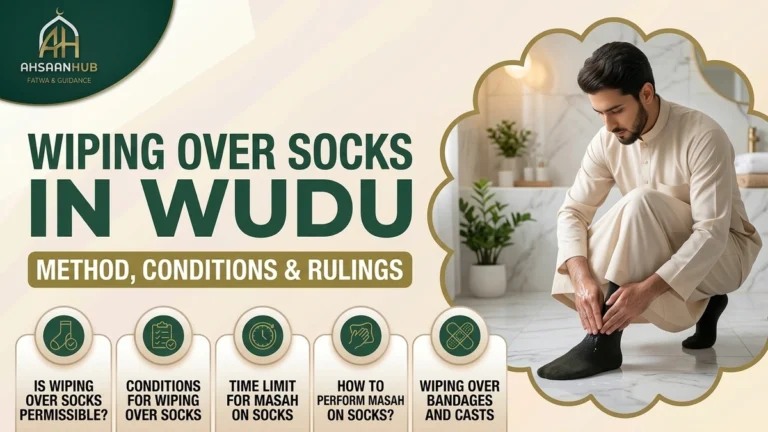
- The Messenger of Allah (PBUH) used to instruct us that when we were travelling, we could wipe over our socks for three days and three nights
and need not remove them on account of urination, defecation, or sleep.
However, in the case of Janabah (major ritual impurity), the socks must be removed, and Ghusl performed.
In this Hadith, sleep (nawm) is mentioned alongside urination and defecation as a cause
that breaks Wudu.
(Sunan Ibn Majah 478)
What Is the Difference Between Sleep and Drowsiness?
It is important to understand the distinction in Arabic between Nawm (sleep) and Sinah (drowsiness):
- Sinah (drowsiness): A person in this state becomes internally unaware but remains conscious of their surroundings.
If you approach someone who is drowsy and stand quietly near them, they will sense your presence. This is Sinah, and it does not break Wudu. - Nawm (sleep): In full sleep, a person is completely unaware of both their inner
and outer state.
They are oblivious to both what is happening around them and what is happening within their own body. This is Nawm, and it breaks Wudu.
Allah the Almighty says in Ayat al-Kursi (Quran 2:255): Neither drowsiness (Sinah) overtakes Him nor sleep (Nawm).
It is commonly said that sleeping while sitting does not break Wudu, but sleeping while lying down or reclining does.
However, there is no sound evidence to support this distinction.
The correct and established position from the Prophet (PBUH) is that full sleep breaks Wudu
regardless of the position, whether sitting, lying down, or standing, as long as it is genuine sleep (Nawm) and not merely drowsiness (Sinah).
Does Touching a Woman Break Wudu?
It is widely believed among people that touching a woman breaks Wudu. However, the correct position is that merely touching a woman does not break Wudu.
Where Allah the Almighty says in the Quran, “aw lamastum al-nisa’,” the Companions
and commentators of the Quran understood “lamastum” to refer to intercourse, not ordinary physical contact.
It is established from the Prophet (PBUH) that he would kiss one of his wives and then proceed to pray without performing a fresh Wudu.
Aisha (RA) also narrates:
Hadith:
- When the Prophet (PBUH) would pray at night, I would be lying in front of him.
When he went into Sujud, he would touch me with his hand, and I would draw my feet in. When he stood up, I would extend them again.
This clearly shows that merely touching a woman does not break Wudu.
However, if touching with desire causes a discharge such as Madhi, then the discharge
itself breaks Wudu, not the act of touching.
(Sahih al-Bukhari 513)-(Bukhari 382)
Does Bleeding from a Wound Break Wudu?
If blood exits from any part of the body, Wudu is not broken.
There are numerous narrations from the Companions of the Prophet (PBUH) showing that
they continued to pray while wounded.
Arrows struck some of them during prayer, and they remained in their Salah without interruption.
Such incidents are established from the Companions in multiple narrations.
Therefore, bleeding from any wound, regardless of its location, does not break Wudu. This is the correct and established position from the Prophet (PBUH).
Does Vomiting Break Wudu?
It is widely believed among people that vomiting, whether a small or large amount, breaks Wudu.
This is not correct. Vomiting does not break Wudu, regardless of whether it is a small amount or a full mouthful.
If a person chooses to perform Wudu after vomiting in order to feel refreshed and energised, that is a separate matter.
However, there is no authentic narration from the Prophet (PBUH) establishing that vomiting is a cause that breaks Wudu.
Jami` at-Tirmidhi 87
It is true that on one occasion the Prophet (PBUH) performed Wudu after vomiting, but that narration does not serve as evidence that vomiting breaks Wudu.
He performed Wudu on that occasion to feel refreshed, not because vomiting had nullified it.
Therefore, vomiting in any quantity and under any circumstance does not break Wudu.
📖 Next in Taharah (Purification): What Are the Rulings of Ghusl and the Causes That Make It Obligatory? →