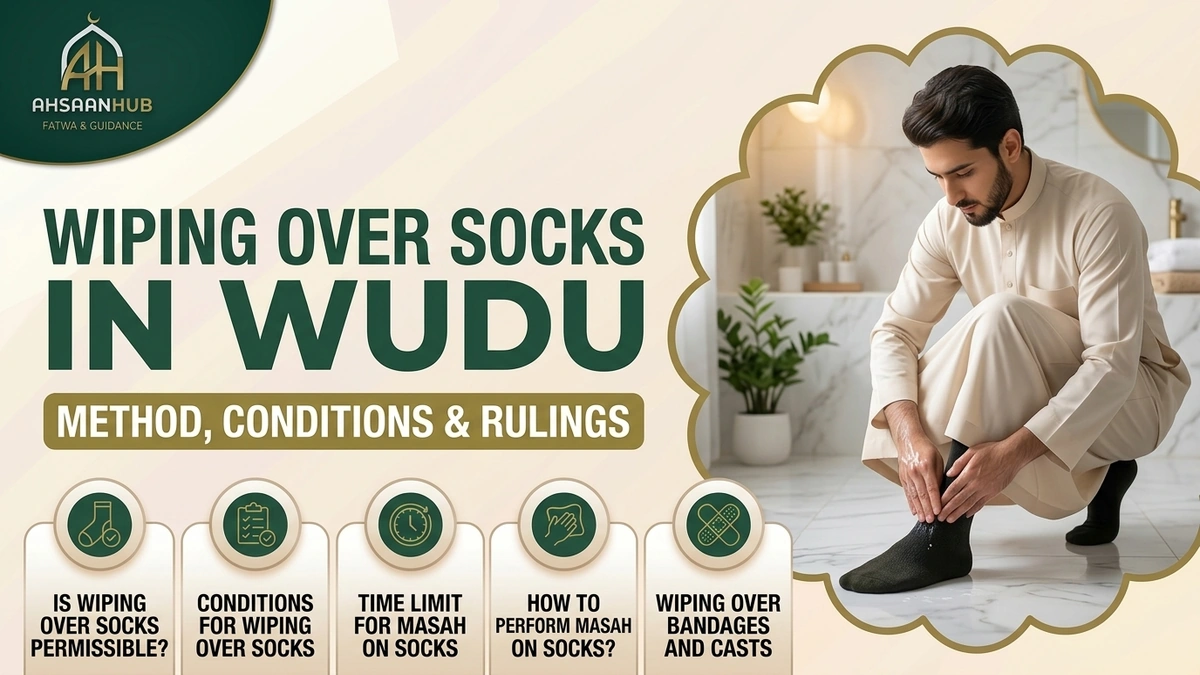
Is Wiping Over Socks Permissible?
Allah the Almighty has granted us, through the Prophet (PBUH), a concession and ease: although washing the feet is ordinarily obligatory in Wudu,
if a person is wearing socks,
it is Islamically permissible to wipe over them instead of washing the feet.
In Arabic, the leather sock that covers the foot up to and above the ankle is called a Khuff.
The word Jawrab is similarly used in Arabic, defined in the lexicon as “lifafat al-rijl,” meaning something that wraps or covers the foot.
From both a linguistic and legal standpoint, there is no fundamental difference between
Khuff and Jawrab.
Wherever the word Jawrab is used, the word Khuff also applies, and wiping over socks (jarab)
is likewise established from the Prophet (PBUH).
What Are the Conditions for Wiping Over Socks?
Permission to wipe over socks is not unconditional. The Shariah has established certain essential conditions that must all be fulfilled:
- Wearing them while in a state of Wudu: The socks must have been put on while
the person was in a complete state of Wudu. - Covering the ankles: The socks must be long enough to fully cover the feet up
to and above the ankles. - Sufficient thickness: The socks must be thick enough that the skin of the foot is not visible through them.
If they are as thin and transparent as common sheer stockings, through which the foot can clearly be seen, then the foot has not effectively been covered.
Wiping over such thin socks is not permissible. The socks must meet the definition of “lifafat al-rijl” and fully conceal the foot.
What Is the Hadith Evidence for Wiping Over Socks?
The primary evidence for the permissibility of wiping over socks
and for the condition of wearing them while in a state of Wudu is the narration of
Mughirah ibn Shu’bah (RA).
He says:
Hadith:
- I was with the Prophet (PBUH) during a journey.
When he began to perform Wudu, I bent down to remove his socks.
He told me to leave them, saying that he had put them on while in a state of Wudu.
He then wiped over them without removing them. (Sahih al-Bukhari: 206)
What Is the Time Limit for Masah on Socks?
Ali (RA) narrates that the Messenger of Allah (PBUH) set separate time limits for a resident
and a traveller (Sahih Muslim: 276a):
- For a resident: A person who is at home and not travelling is permitted to wipe over socks for one day and one night, which is twenty-four hours.
- For a traveller: A person who is away from home on a journey is permitted to wipe
over socks for three days and three nights, which is seventy-two hours.
Within this fixed period, whenever a person’s Wudu breaks, they do not need to
wash their feet when making a fresh Wudu. They may instead wipe over the socks.
When Does the Time Period of Masah Begin?
It is extremely important to understand that the twenty-four-hour or three-day period
does not begin from the moment the socks are put on.
Rather, it begins from the moment
a person performs Masah for the first time after their Wudu has broken.
To illustrate: if a person performs complete Wudu at Fajr time, puts on socks
while in a state of Wudu, and prays Fajr, then their Wudu breaks around
the time of Ishraq, and they perform Wudu again at Dhuhr and wipe over their socks
for the first time, the twenty-four-hour period for a resident and the three-day period
for a traveller will be counted from that Dhuhr Masah, not from Fajr.
How Should Masah on Socks Be Performed?
The Sunnah method is to wipe over the upper part of the sock, not the lower part.
Hadith:
- Ali (RA) said: If religion were based on human reasoning and opinion, the underside
of the sock would have been more deserving of being wiped than the upper side.
However, I saw the Messenger of Allah (PBUH) wiping over the upper side of his socks.
(Sunan Abi Dawud: 162)
There is no specific or fixed hand position required for performing Masah.
A person may wipe over the right sock with the right hand and the left sock with the left hand, or wipe over both with only the right hand.
Whichever way wet hands are passed over the upper surface of the socks, the Masah is fulfilled, provided the socks were put on while in a state of Wudu and the Masah
is being performed within the permitted time period.
Can You Wipe Over Bandages and Casts in Wudu?
The general principle in Wudu is that all limbs are washed thoroughly with water.
However, if a person has a wound or injury, the Shariah has also made provision
for ease in such situations.
If a person is injured due to an accident or blow, has sustained an injury to the hand or foot,
or has a broken bone, and a bandage or plaster cast has been applied which cannot be removed without risk of aggravating the wound or causing serious harm,
then it is permissible to wipe over the bandage.
In Arabic, this bandage or cast is called a Jabirah. In such a situation of necessity,
it is Islamically valid and sufficient to simply wet the hand and pass it over the bandage without removing it.
This completes the purification.
This concludes all the related rulings and issues pertaining to Wudu.
We ask Allah (SWT) to grant us the correct understanding of these matters and the ability
to act upon them in accordance with the Sunnah.
📖 Next Step in Wudu: Supplications After Wudu and Their Reward →