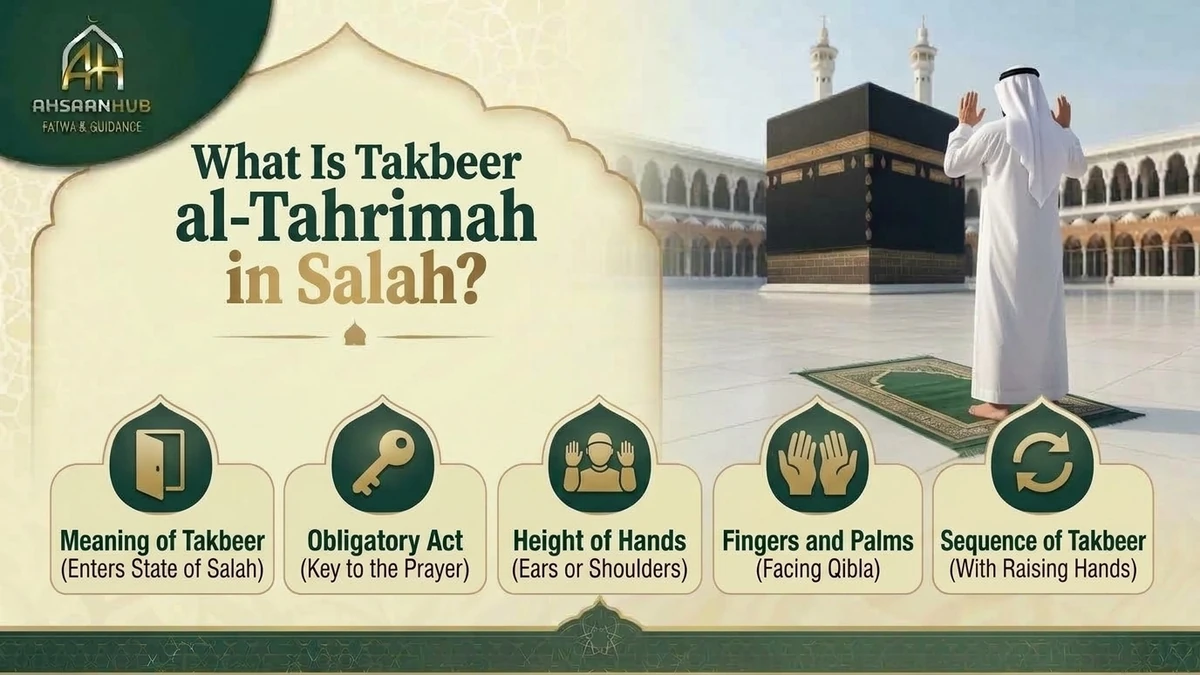
What Does Takbeer al-Tahrimah Mean?
When a person has stood properly facing the Qibla and made the intention, the first physical act is Takbeer al-Tahrimah.
Its meaning is that once a person says “Allahu Akbar,” everything that was previously permissible for them now becomes forbidden.
Speaking, eating, drinking, and all such things become prohibited from that moment.
This is why it is called Takbeer al-Tahrimah, and by saying it, a person formally enters into the state of Salah.
Is Saying the Takbeer Obligatory to Begin Salah?
This Takbeer at the beginning of Salah is among the essential and obligatory requirements
of prayer.
Abu Hurairah (RA) narrates that the Messenger of Allah (PBUH) said:
Hadith:
- When you stand for prayer, perform your Wudu thoroughly, then say, Allahu Akbar (Sahih al-Bukhari: 6251; Sahih Muslim: 397b).
Ali (RA) narrates that the Messenger of Allah (PBUH) said:
Hadith:
- The key to Salah is purification. Its Tahrim (the point at which prohibitions begin) is
the Takbeer, and its Tahlil (the point at which it ends) is the Salam (Sunan Abi Dawud: 618; Jami` at-Tirmidhi: 238).
Both the Takbeer and the Salam are integral parts of Salah and are obligatory.
A person cannot substitute Allahu Akbar with any other words or remembrance to begin the prayer. The command is specifically to say, Allahu Akbar.
How High Should the Hands Be Raised for the Takbeer?
The hands are to be raised either to the level of the ears or to the level of the shoulders.
Two methods of raising the hands during Takbeer al-Tahrimah are established
from the Prophet (PBUH):
Raising the hands to the ears: Wa’il ibn Hujr (RA) narrates that when the Prophet (PBUH) entered into Salah, he said Allahu Akbar and raised his hands to the level of his ears (Sahih Muslim: 401b; Sunan Abi Dawud: 726).
Just as a person places their hands near the ears when going into Sujud, the Prophet (PBUH) raised his hands to that level and said, Allahu Akbar.
Raising the hands to the shoulders: Abdullah ibn Umar (RA) narrates that when the Prophet (PBUH) stood for prayer, he would raise both hands until they were level with his shoulders, and then say the Takbeer (Sahih al-Bukhari: 735; Sahih Muslim: 390a).
The hands may be raised to either the level of the ears or the level of the shoulders during Salah.
How Should the Fingers and Palms Be Positioned When Raising the Hands?
When raising the hands, the following details should be kept in mind:
Fingers Position: The fingers should neither be tightly clenched nor spread wide apart.
They should be kept in their natural, relaxed state without any tension.
Abu Hurairah (RA) narrates that when the Prophet (PBUH) entered into Salah, he would raise his hands and extend his fingers, meaning he would neither clench them nor press them together, but simply leave them in their natural position (Sunan Abi Dawud: 753; Jami` at-Tirmidhi: 240).
Direction of the palms: The palms should face directly towards the Qibla.
The hands should not be raised in such a way that only the side of the little finger
faces the Qibla.
Rather, the inner surface of the palms should face straight towards the Qibla.
Duration of raising the hands: The hands should be held up briefly when raised.
They should not be flicked up and down as if swatting flies.
Rather, the hands should pause at the level of the shoulders or ears for a moment or two, Allahu Akbar should be said, and then the hands should be folded.
What Is the Sequence of Saying Allahu Akbar and Raising the Hands?
The sequence of raising the hands and saying Takbeer can be performed in any of the following ways:
- Allahu Akbar may be said simultaneously while raising the hands.
- It may be said slightly before or slightly after raising the hands.
- The hands may be brought up, and then Allahu Akbar said.
- Allahu Akbar is said, and then the hands are folded.
In accordance with the Sunnah of the Prophet (PBUH), the hands are raised in this manner, the Takbeer is said, and the person enters into Salah.