How Is the Final Tashahhud Different From the First?
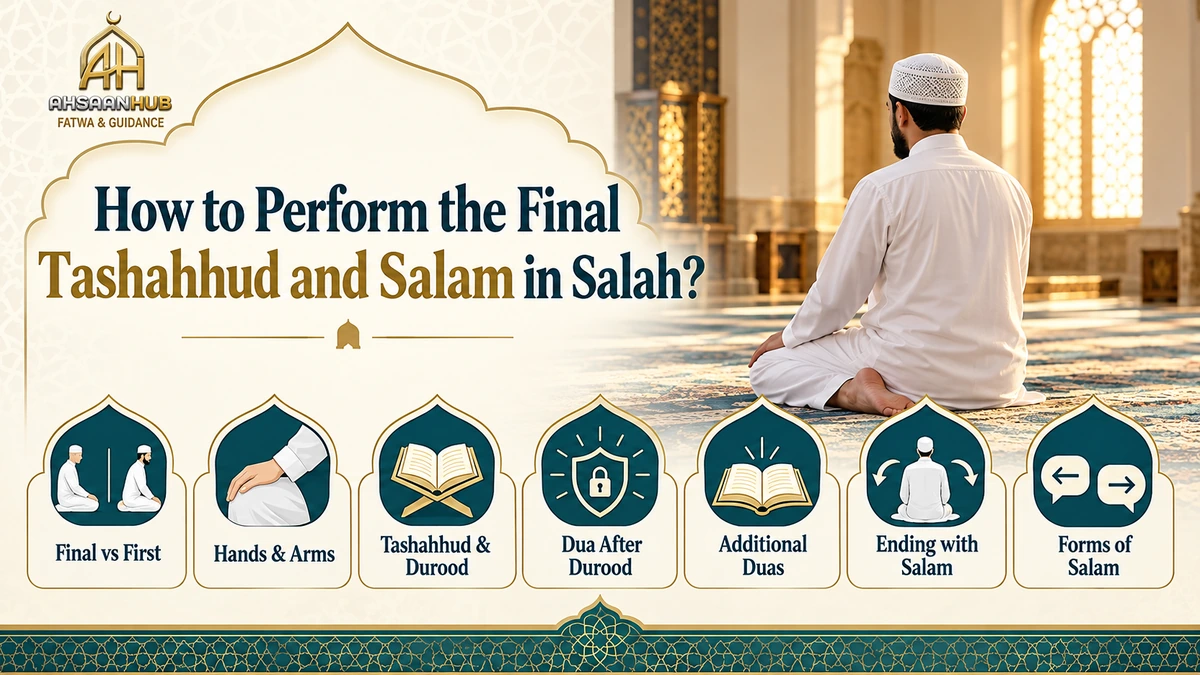
The final Tashahhud differs from the first Tashahhud in the manner of sitting.
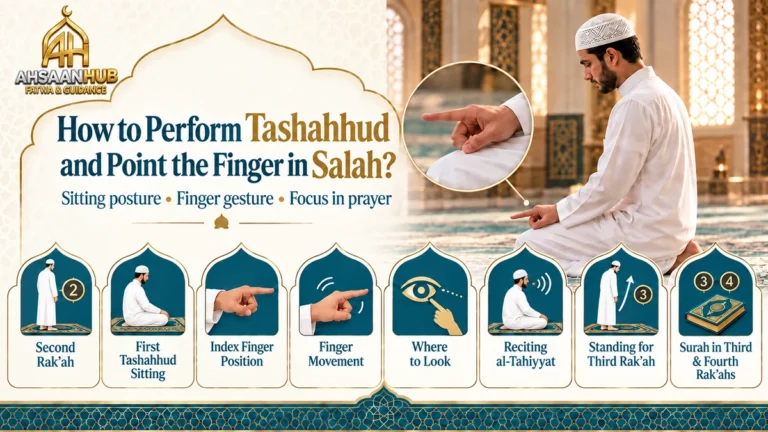
Abu Humayd al-Sa’idi (RA) narrates that when the Prophet (PBUH) sat in the final Rak’ah, he would bring his left foot forward, keep his right foot upright, and sit directly upon the ground. This manner of sitting is called Tawarruk.
(Sahih al-Bukhari: 828, Sunan Abi Dawud: 730)
Where Should You Place Your Hands During the Final Tashahhud?
During Tawarruk, the position of the arms is also important:
- The right elbow is bent slightly, and the right arm is laid along the right thigh.
- The left arm is kept straight.
Abdullah ibn al-Zubayr (RA) narrates that he observed the Prophet (PBUH) sitting in Tashahhud in such a manner that:
“وَيَتَحَامَلُ النَّبِيُّ صَلَّى اللّٰهُ عَلَيْهِ وَسَلَّمَ بِيَدِهِ الْيُسْرَىٰ عَلَىٰ فَخِذِهِ الْيُسْرَىٰ”
Wa yatahamalu an-Nabiyyu (PBUH) biyadihil-yusra ‘ala fakhdhihil-yusra.
The Prophet (PBUH) would lean with his left hand upon his left thigh, placing a slight amount of weight upon it.
(Sunan Abi Dawud: 989)
What Do You Recite in the Final Tashahhud?
After sitting in this manner, al-Tahiyyat is recited in the same way as before. After al-Tahiyyat, Durood (Salawat) upon the Prophet (PBUH) is then recited:
“اللَّهُمَّ صَلِّ عَلَى مُحَمَّدٍ وَعَلَى آلِ مُحَمَّدٍ كَمَا صَلَّيْتَ عَلَى إِبْرَاهِيمَ وَعَلَى آلِ إِبْرَاهِيمَ إِنَّكَ حَمِيدٌ مَجِيدٌ، اللَّهُمَّ بَارِكْ عَلَى مُحَمَّدٍ وَعَلَى آلِ مُحَمَّدٍ كَمَا بَارَكْتَ عَلَى إِبْرَاهِيمَ وَعَلَى آلِ إِبْرَاهِيمَ إِنَّكَ حَمِيدٌ مَجِيدٌ”
Allahumma salli ‘ala Muhammadin wa ‘ala ali Muhammadin kama sallayta ‘ala Ibrahima wa ‘ala ali Ibrahim, innaka Hamidun Majid. Allahumma barik ‘ala Muhammadin wa ‘ala ali Muhammadin kama barakta ‘ala Ibrahima wa ‘ala ali Ibrahim, innaka Hamidun Majid.
O Allah, send Your blessings upon Muhammad and upon the family of Muhammad, as You sent Your blessings upon Ibrahim and upon the family of Ibrahim.
Truly, You are Praiseworthy and Glorious. O Allah, bless Muhammad and the family of Muhammad, as You blessed Ibrahim and the family of Ibrahim.
Truly, You are Praiseworthy and Glorious.
(Sahih al-Bukhari: 3370; a similar wording is also recorded in Sahih Muslim: 406a)
Which Supplication Should Be Recited After Durood?
After reciting Durood, one should seek Allah’s protection from four things before giving Salam. Abu Hurairah (RA) narrates that the Prophet (PBUH) said:
“إِذَا فَرَغَ أَحَدُكُمْ مِنَ التَّشَهُّدِ الآخِرِ فَلْيَتَعَوَّذْ بِاللَّهِ مِنْ أَرْبَعٍ”
“When one of you completes the final Tashahhud, let him seek refuge with Allah from four things.”
(Sahih Muslim: 588b)
The supplication is recorded in Sahih Muslim as follows:
“اللَّهُمَّ إِنِّي أَعُوذُ بِكَ مِنْ عَذَابِ جَهَنَّمَ، وَمِنْ عَذَابِ الْقَبْرِ، وَمِنْ فِتْنَةِ الْمَحْيَا وَالْمَمَاتِ، وَمِنْ شَرِّ فِتْنَةِ الْمَسِيحِ الدَّجَّالِ”
Allahumma inni a‘udhu bika min ‘adhabi jahannam, wa min ‘adhabil-qabr, wa min fitnatil-mahya wal-mamat, wa min sharri fitnatil-masihid-dajjal.
“O Allah, I seek refuge in You from the punishment of Hell, from the punishment of the grave, from the trials of life and death, and from the evil of the trial of the False Messiah.”
(Sahih Muslim: 588a; a related wording is also recorded in Sahih al-Bukhari: 1377)
The speaker in this lesson considers reciting this supplication obligatory before Salam. This statement represents the legal interpretation presented in the lesson.
Can Additional Supplications Be Made Before Salam?
After seeking refuge from these four things, a person may make further supplications. Abdullah ibn Mas‘ud (RA) narrates that the Prophet (PBUH) said:
“ثُمَّ يَتَخَيَّرُ مِنَ الْمَسْأَلَةِ مَا شَاءَ”
“Then he may choose whatever supplication he wishes.”
(Sahih Muslim: 402a; Sahih al-Bukhari: 835 records a similar wording)
According to the explanation presented in this lesson, these supplications should be made in Arabic. One may recite supplications from the Quran or those narrated from the Prophet (PBUH).
The speaker notes that many people know only the supplication beginning “Rabbi-j‘alni” and limit themselves to it. He encourages learning further supplications and using this opportunity to present one’s needs before Allah.
Among the established supplications narrated from the Prophet (PBUH)—taught specifically to Abu Bakr al-Siddiq (RA) for prayer—is:
“اللَّهُمَّ إِنِّي ظَلَمْتُ نَفْسِي ظُلْمًا كَثِيرًا وَلَا يَغْفِرُ الذُّنُوبَ إِلَّا أَنْتَ فَاغْفِرْ لِي مَغْفِرَةً مِنْ عِنْدِكَ وَارْحَمْنِي إِنَّكَ أَنْتَ الْغَفُورُ الرَّحِيمُ”
Allahumma inni zalamtu nafsi zulman kathiran, wa la yaghfirudh-dhunuba illa Anta, faghfir li maghfiratan min ‘indika warhamni, innaka Antal-Ghafurur-Rahim.
O Allah, I have wronged myself greatly, and none forgives sins except You. So grant me Your forgiveness and have mercy on me. Indeed, You are the Most Forgiving, the Most Merciful.
(Sahih al-Bukhari: 834, Sahih Muslim: 2705)
This is the moment in Salah when a person should present their needs before Allah.
The prayer began with the praise and glorification of Allah, then Durood was sent upon the Prophet (PBUH), and now is the time to place one’s needs before Allah the Almighty.
A person should memorise good supplications and make full use of this precious moment.
How Do You Perform Salam at the End of Salah?
After completing the supplications, the Salam is given. Giving the Salam is an obligatory act (Fard) among the pillars of Salah. As mentioned in an earlier Hadith, the Prophet (PBUH) said:
“وَتَحْلِيلُهَا التَّسْلِيمُ”
Wa tahliluhat-taslim.
And its conclusion is the Salam.
(Sunan Abi Dawud: 61, Jami’ al-Tirmidhi: 3)
The Salam is the only act through which one exits from Salah.
How Did the Prophet Muhammad (PBUH) Perform Salam in Salah?
Abdullah ibn Mas’ud (RA) narrates that the Prophet (PBUH) would give Salam to the right and to the left in such a manner that the whiteness of his cheek would be visible to those behind him, and he would say:
“السَّلَامُ عَلَيْكُمْ وَرَحْمَةُ اللهِ”
“السَّلَامُ عَلَيْكُمْ وَرَحْمَةُ اللهِ”
(Sunan Abi Dawud: 996; a similar narration from Sa’d ibn Abi Waqqas RA is recorded in Sahih Muslim: 582)
Four variations of the Salam are established from the Prophet (PBUH):
- First method: On the right side: “As-salamu alaykum wa rahmatullahi wa barakatuh,” and on the left side: “As-salamu alaykum wa rahmatullah.”
(Sunan Abi Dawud: 997) - Second method: On both the right and left sides equally: “As-salamu alaykum wa rahmatullah” – “As-salamu alaykum wa rahmatullah.”
(Sunan Abi Dawud: 996, Sahih Muslim: 582) - Third method: On the right side: “As-salamu alaykum wa rahmatullah,” and on the left side: “As-salamu alaykum” only.
(Sunan an-Nasa’i: 1321) - Fourth method: While seated facing forward, turn only slightly to the right and say: “As-salamu alaykum.” With this, the Salah is concluded.
(Jami’ al-Tirmidhi: 296)
With the giving of Salam in this manner, the prayer of the Prophet (PBUH) is complete.
Upon giving the Salam, the person exits the prayer, after which the post-prayer adhkar (remembrances) follow.