Is Standing (Qiyam) Obligatory in Salah?
When a person has made the intention for Salah, they should know that prayer must begin in the standing position. Standing (Qiyam) is the very first command within Salah.
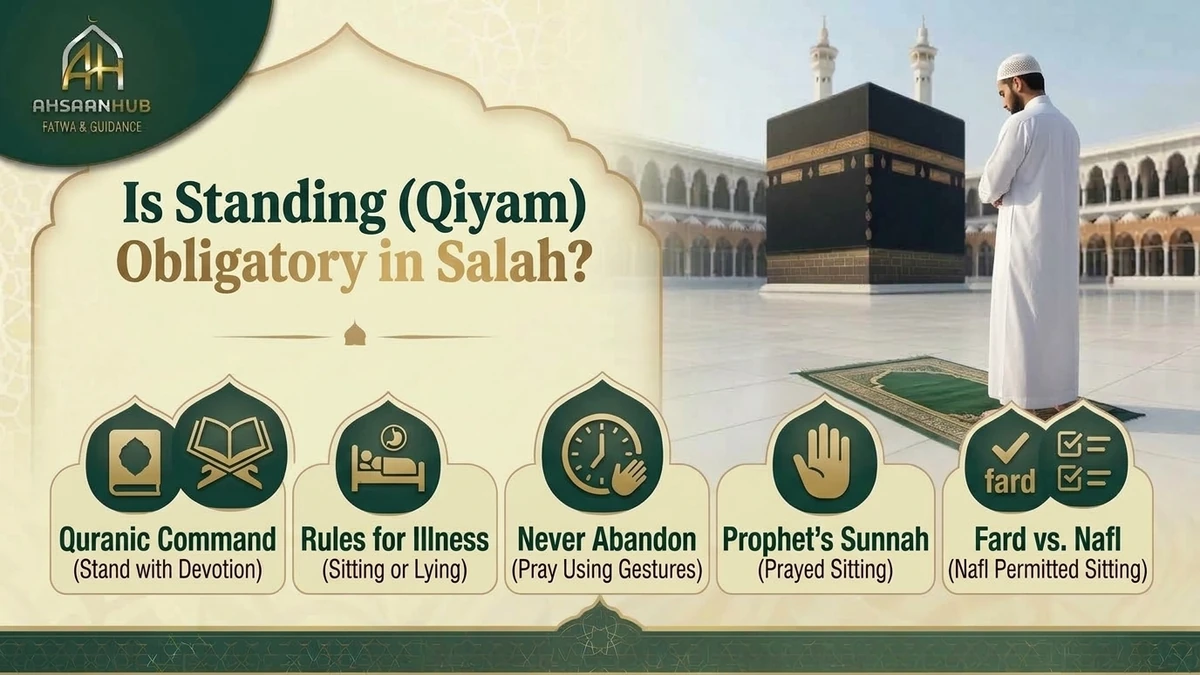
How Does the Quran Command Qiyam in Salah?
The command for Qiyam has been given by Allah the Almighty in the Quran.
In Surah al-Baqarah (2:238), Allah says:
And stand before Allah with devotion and humility.
In the very next verse (Surah al-Baqarah: 2:239), Allah says:
If you are in a state of fear, then pray while walking or while riding.
In this verse, “walking” and “riding” are both mentioned.
This indicates that under normal circumstances, the primary command within Salah is to stand and pray in the position of Qiyam.
What Are the Rules for Praying While Sitting or Lying Down?
Clear rulings on Qiyam in Salah have also been narrated from the Prophet (PBUH).
Imran ibn Husayn (RA) narrates:
Hadith:
- I asked the Prophet (PBUH) about Qiyam in Salah. He said: Pray standing. If you are unable to stand due to illness, then pray sitting.
If you are unable to sit, then pray lying on your side (Sahih al-Bukhari: 1117).
Based on this Hadith, the levels of performing Salah are as follows:
- First and foremost, Salah must be prayed standing in the position of Qiyam.
- If a person does not have the strength to stand due to illness, they should pray sitting.
- If a person does not even have the strength to sit, they should pray lying down.
Can a Person Ever Abandon Salah Due to Illness?
There is no concession in the Shariah to abandon Salah altogether:
- A person must first pray standing.
- If they cannot stand due to a genuine excuse or inability, they must pray sitting.
- If they cannot even sit, they must pray lying down, using gestures of the head or eyes to indicate the positions of prayer.
Did the Prophet (PBUH) Pray Sitting During His Final Illness?
Praying while seated during illness is also established from the blessed practice
of the Prophet (PBUH).
Aisha (RA) narrates:
Hadith:
- During his final illness, the Prophet (PBUH) prayed sitting behind Abu Bakr al-Siddiq (RA) (Sahih al-Bukhari: 683; Sahih Muslim: 418).
Therefore, the primary command in Salah is to stand and pray in the position of Qiyam. However, in a state of genuine inability, a person may pray sitting, and this concession applies even to obligatory prayers.
What Is the Difference Between Qiyam in Fard and Nafl Salah?
It is important to understand the difference between the rulings on Qiyam in obligatory (Fard) and voluntary (Nafl) prayers:
Ruling for Fard prayer: An obligatory prayer cannot be offered sitting without a valid Islamic excuse or illness.
If a person has the ability to stand but offers the Fard prayer sitting without any excuse, their prayer will not be valid.
Ruling for Nafl prayer: For voluntary prayers, the Shariah grants permission for a person to pray sitting even if they have the ability to stand.
- As narrated in the traditions, the Prophet (PBUH) would pray while seated on his mount during travel, and these prayers offered while riding were voluntary prayers
(Sahih al-Bukhari: 1000; Sahih Muslim: 700a). - In Nafl prayer, a person may sit even while having the ability to stand.
Praying while seated may reduce the reward, but the voluntary prayer itself is completely valid, and there is no sin upon the person
(Sahih al-Bukhari: 1115).