Where Should the Gaze Be Fixed During Salah?
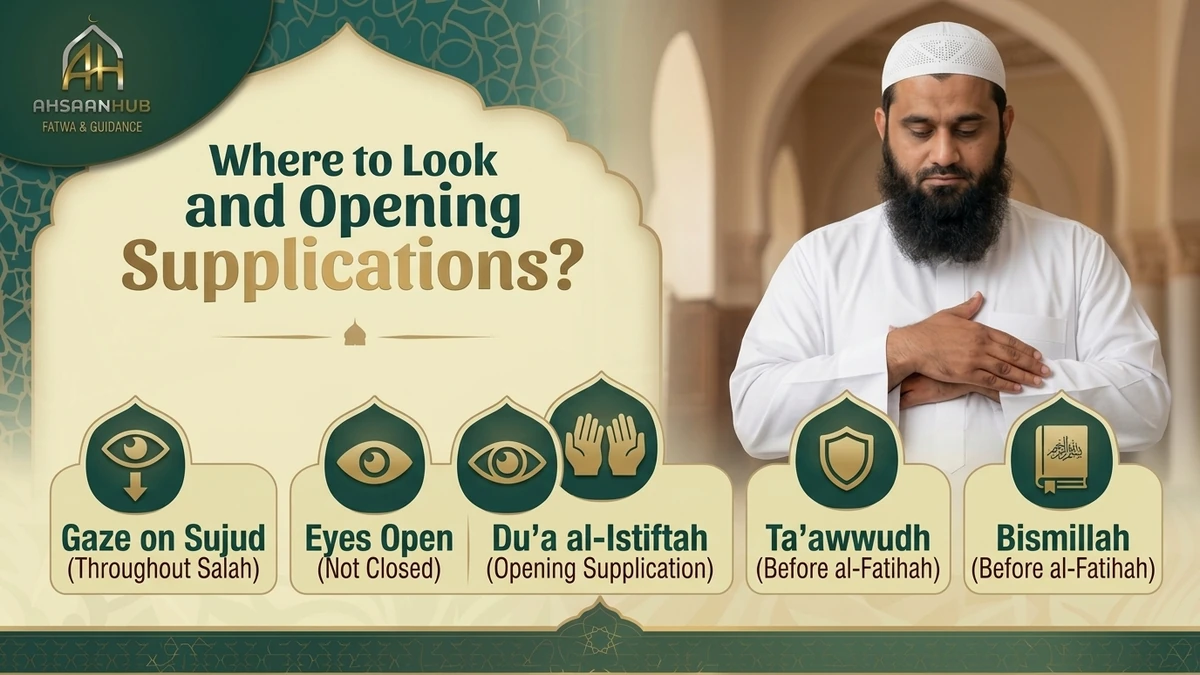
Keep this practice in mind as well: when a person enters Salah by making the intention, saying Allahu Akbar, standing in Qiyam, and folding the hands, the gaze should be fixed on the place of Sujud.
Abu Hurairah (RA) narrates that the Prophet (PBUH) used to raise his head towards the sky during prayer, until the following verse was revealed:
“الَّذِينَ هُمْ فِي صَلَاتِهِمْ خَاشِعُونَ”
(Surah al-Mu’minun 23:2)
Those who are humbly submissive in their prayers.
After this verse was revealed, the Prophet (PBUH) lowered his head.
Therefore, keeping the gaze fixed on the place of Sujud is necessary during Salah.
Throughout the entire prayer, except during the Tashahhud, whether in Qiyam, Ruku, or Sujud, the gaze must remain on the place of Sujud at all times.
Is It Permissible to Pray With Closed Eyes?
Praying with closed eyes is also not correct.
The eyes must be kept open during Salah, and the person should pray while looking at the place of Sujud with open eyes.
What Should Be Recited First After the Takbeer?
After standing in Salah, saying Allahu Akbar, folding the hands, and lowering the gaze, the first thing to be recited, without saying Bismillah or A’udhu Billah beforehand, are the supplications known as Du’a al-Istiftah (the Opening Supplication).
This is where the prayer truly begins.
Many supplications have been narrated from the Prophet (PBUH) for this occasion.
For a complete list, one may refer to books of supplications, particularly “Hisn al-Muslim” (Fortress of the Muslim), in which all such supplications have been gathered.
Which Opening Supplications (Du’a al-Istiftah) Are Authentic?
Two examples of authentic opening supplications are presented here:
The first supplication (Agreed Upon):
Abu Hurairah (RA) narrates that after saying Allahu Akbar, the Prophet (PBUH) would recite
the following supplication when beginning his prayer:
“اللَّهُمَّ بَاعِدْ بَيْنِي وَبَيْنَ خَطَايَايَ كَمَا بَاعَدْتَ بَيْنَ الْمَشْرِقِ وَالْمَغْرِبِ، اللَّهُمَّ نَقِّنِي مِنَ الْخَطَايَا كَمَا يُنَقَّى الثَّوْبُ الأَبْيَضُ مِنَ الدَّنَسِ، اللَّهُمَّ اغْسِلْنِي مِنْ خَطَايَايَ بِالْمَاءِ وَالثَّلْجِ وَالْبَرَدِ”
Allahumma ba’id bayni wa bayna khatayaya kama ba’adta baynal-mashriqi wal-maghrib. Allahumma naqqini minal-khataya kama yunaqqa al-thawb al-abyadu minad-danas. Allahumma ighsilni min khatayaya bil-ma’i wath-thalji wal-barad.
(Sahih al-Bukhari: 744; Sahih Muslim: 598a)
O Allah, distance me from my sins as You have distanced the east from the west.
O Allah, cleanse me of my sins as a white garment is cleansed of filth.
O Allah, wash away my sins with water, snow, and hail.
The second supplication:
Another supplication is also established from the Prophet (PBUH), which he would recite after saying Allahu Akbar and folding the hands:
“سُبْحَانَكَ اللَّهُمَّ وَبِحَمْدِكَ، وَتَبَارَكَ اسْمُكَ، وَتَعَالَى جَدُّكَ، وَلَا إِلَهَ غَيْرُكَ”
Subhanakallahumma wa bihamdika, wa tabarakasmuka, wa ta’ala jadduka,
wa la ilaha ghayruk.
(Sunan Abi Dawud: 775; Sunan al-Tirmidhi: 243; Sunan an-Nasa’i: 899)
Glory be to You, O Allah, and praise be to You. Blessed is Your Name, exalted is Your Majesty, and there is no god besides You.
How Should the Ta’awwudh Be Said in Salah?
After the Du’a al-Istiftah, the Ta’awwudh and the Basmalah are to be recited before
Surah al-Fatihah.
The wording of the Ta’awwudh recited specifically in Salah is slightly different from the commonly known form.
Abu Sa’id al-Khudri (RA) narrates, as recorded by Imam al-Tirmidhi:
“أَعُوذُ بِاللَّهِ السَّمِيعِ الْعَلِيمِ مِنَ الشَّيْطَانِ الرَّجِيمِ، مِنْ هَمْزِهِ وَنَفْخِهِ وَنَفْثِهِ”
A’udhu billahis-Sami’il-‘Alimi minash-Shaytanir-rajim, min hamzihi wa nafkhihi wa nafthih.
(Sunan Abi Dawud: 775; Jami` at-Tirmidhi: 242)
I seek refuge in Allah, the All-Hearing, the All-Knowing, from Shaytan the accursed, from his madness, his arrogance, and his sorcery.
What Are the Essential Words of Ta’awwudh in Salah?
These are the words established from the Prophet (PBUH) for the Ta’awwudh in Salah.
In some narrations, the wording also appears as:
“أَعُوذُ بِاللَّهِ مِنَ الشَّيْطَانِ الرَّجِيمِ، مِنْ هَمْزِهِ وَنَفْخِهِ وَنَفْثِهِ”
A’udhu billahi minash-Shaytanir-rajim, min hamzihi wa nafkhihi wa nafthih.
The concluding words “مِنْ هَمْزِهِ وَنَفْخِهِ وَنَفْثِهِ” (min hamzihi wa nafkhihi wa nafthih)
are established in all narrations concerning the Ta’awwudh in Salah.
The Ta’awwudh of Salah is not complete without these three words.
This is a common mistake among many Muslims, and even many authors of Islamic books have written only the standard A’udhu Billah without examining the narrations carefully.
After the Du’a al-Istiftah, this Ta’awwudh is to be recited first.
Both forms, the longer version with “As-Sami’il-‘Alim” and the shorter version, are established from the Prophet (PBUH).
Is It Necessary to Say Bismillah Before Surah al-Fatihah?
After reciting the Ta’awwudh, “بِسْمِ اللَّهِ الرَّحْمَنِ الرَّحِيم” (Bismillahir-Rahmanir-Rahim)
is to be recited before beginning Surah al-Fatihah.
Since a Surah is being commenced, and reciting Bismillah before the beginning of every Surah is required.