The Islamic Ruling on Physical Boundaries Between Spouses and the Most Virtuous Day for Marital Intimacy
Can I kiss my husband’s or wife’s private parts in Islam?
A widespread misconception in our society is that if a husband fully undresses his wife during intimacy, he will be sinful.
As a result, many people go through their entire lives without undressing, satisfying themselves by merely lifting a little clothing, all while the desire to see is present in their hearts.
Similarly, some people are so taken by unfounded fears that they do not even touch their wife’s breasts, out of dread that some harm may come of it.
When Islam has made the husband and wife lawful for one another through Nikah, why should such unnecessary restrictions, rooted in ignorance, be imposed?
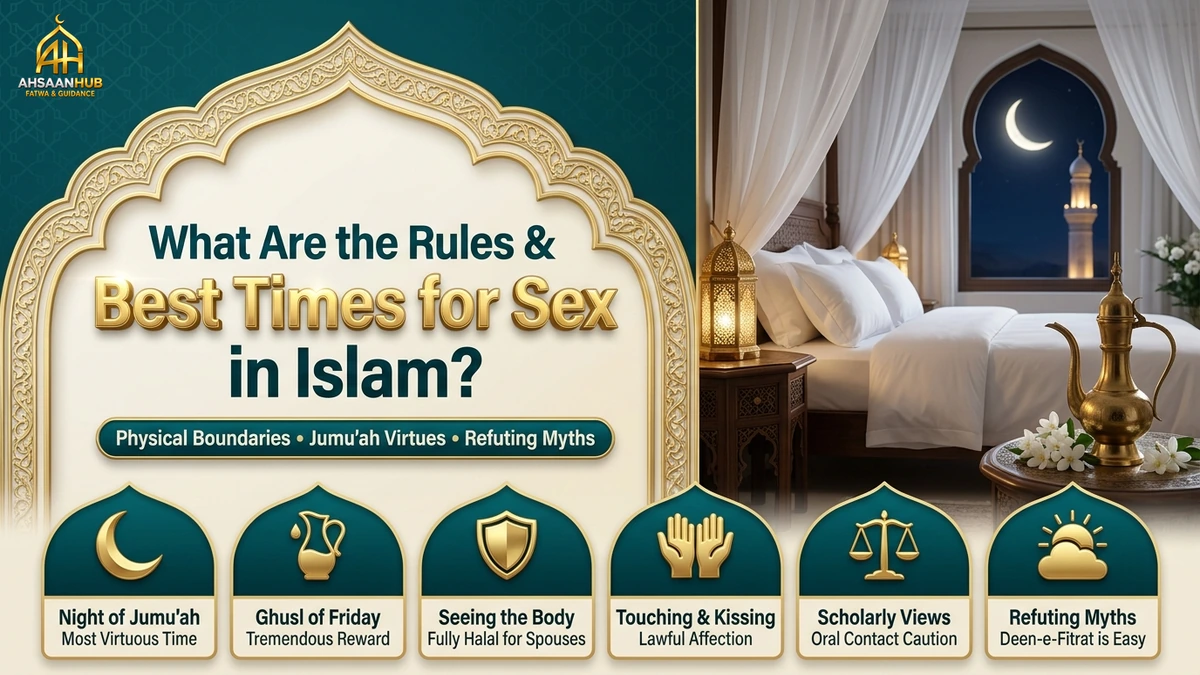
According to the Shariah, there are three clear and established principles regarding what spouses may see, touch, and kiss:
- Seeing the entire body: The husband and wife may see one another’s entire body without clothing.
Even if one wishes to look at the other’s private parts, there is no prohibition, and nothing wrong in this.
As for the fear that looking will cause children to be disobedient or corrupted, there is no authentic narration or statement from the Prophet (PBUH) or the Companions to support this. - Touching the entire body: The husband and wife may touch one another’s entire bodies.
Islam has placed no restriction specifying which part one may or may not touch. There is no Shar’i issue with touching any part of the body, including the private parts. - Kissing the body, and the scholarly difference of opinion regarding oral intimacy: The husband and wife may undoubtedly kiss any part of one another’s body, excluding the private area itself, such as the back, neck, and other parts, without any issue whatsoever.
As for kissing or engaging in oral contact with one another’s private parts, there is a difference of opinion among scholars:- First position (discouragement and dislike): The majority of scholars have said it is better not to place the mouth upon the private parts and not to kiss them, because a person uses their tongue in the remembrance of Allah, and the private area is associated with impurity, which dirties the tongue.
- Second position (permissibility): Some scholars have issued a fatwa of permissibility.
Their argument is that Allah and His Messenger (PBUH) have explicitly prohibited entry through the rear passage.
(Sunan Ibn Majah: 1923 Sahih)
Based on this, these scholars deduce through the principle of original permissibility that intimate contact outside of what is explicitly forbidden remains permissible, provided impurities are avoided.
- First position (discouragement and dislike): The majority of scholars have said it is better not to place the mouth upon the private parts and not to kiss them, because a person uses their tongue in the remembrance of Allah, and the private area is associated with impurity, which dirties the tongue.
The position of caution is to avoid placing the mouth upon the private area.
Aside from that, there is absolutely no prohibition in seeing, touching, or kissing any other part of the body.
Which Night Is Best for Sex in Islam?
If someone asks which day of the week carries special virtue for intimacy, an authentic narration records the immense reward of taking ghusl on Friday.
The Prophet (PBUH) said that whoever performs ghusl on Friday and causes
[his wife or head] to be washed, goes early on foot to the mosque for Jumu’ah prayer, sits close to the imam, and listens attentively, receives for every single step the reward of an entire year’s fasting and night prayer.
(Jami’ al-Tirmidhi: 496; Sunan Abi Dawud: 345 Sahih)
In this hadith, the word ghassala (causing to bathe) is famously interpreted by scholars such as Waki’ ibn al-Jarrah and Imam Ahmad to mean having marital intimacy with one’s wife on Friday, thereby causing her to perform ghusl as well.
While the text of the hadith specifically mentions the day of Friday (yawm al-Jumu’ah), many classical jurists extended this recommendation to the preceding Thursday night (the night of Friday) as well.
The summary is that Islam is, Alhamdulillah, a very easy and natural religion upon which a person in any part of the world and in any circumstance can act with ease.
The un-Islamic difficulties and superstitions that we have created for ourselves out of ignorance and imitation of the world must be left behind, and we must adopt instead the clear and luminous guidance of the Quran and Sunnah.