How Should the Second Rak’ah Be Performed?
When one Rak’ah is completed and a person stands for the second, the opening supplication (Du’a al-Istiftah) does not need to be repeated.
One simply begins with Bismillah, recites Surah al-Fatihah in full, adds another Surah, and then goes into Ruku by saying Allahu Akbar and performing Rafa Yadain, just as in the first Rak’ah.
After performing Ruku with composure, one rises saying “Sami’allahu liman hamidah” and completes the Qoumah, then proceeds to Sajdah.
After the first Sajdah, one sits between the two prostrations, performs the second Sajdah, and thus completes two Rak’ahs.
- If it is a two-Rak’ah prayer, one sits for Tashahhud after the second Sajdah and concludes with Salam.
- If it is a four-Rak’ah prayer, one recites the Tashahhud (al-Tahiyyat) in the first sitting and may then stand for the next Rak’ah.
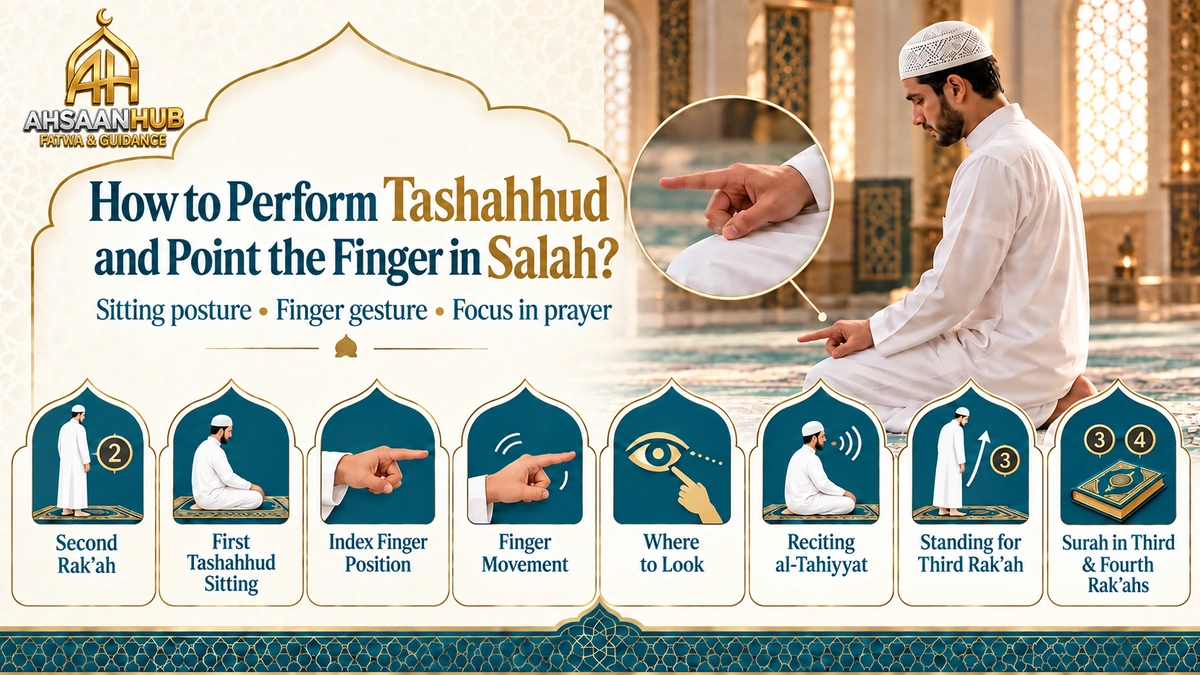
What Is the Sunnah Way to Sit in the First Tashahhud?
The sitting posture for the first Tashahhud is the one described by Abu Humayd al-Sa’idi (RA).
He narrates that when the Prophet (PBUH) sat in the middle Tashahhud, he would spread his left foot beneath him and sit upon it, keeping the right foot upright.
(Sunan Abi Dawud: 730, Sahih al-Bukhari: 828)
During this sitting, authentic narrations describe the hands as being placed comfortably on the thighs or on the knees:
- In the narration of Abdullah ibn Umar (RA), the hands are placed on the knees or thighs. (Sahih Muslim: 580)
- In the narration of Abdullah ibn al-Zubayr (RA), the left hand is placed on the left knee and the right hand on the right thigh while pointing with the index finger.
(Sahih Muslim: 579)
How Should the Index Finger Be Positioned in Tashahhud?
Once the right hand is positioned during Tashahhud, the index finger (Shahadah finger) is raised as a gesture.
Three methods are established in the Hadiths:
- The first method (the 53 configuration / ‘Aqd Thalatha wa Khamsin): Three fingers (the little finger, the ring finger, and the middle finger) are folded down, the thumb is placed at the base of the index finger, and the index finger is held straight and used to point.
- The second method: All fingers are closed into a fist, the thumb is placed over them, and the index finger is raised to point. Both of these methods are narrated from Abdullah ibn Umar (RA) in Sahih Muslim.
(Sahih Muslim: 580) - The third method: Narrated from Wa’il ibn Hujr (RA): the Prophet (PBUH) closed the two smallest fingers, formed a circle with the middle finger and the thumb, and raised the index finger to make supplication.
(Sunan an-Nasa’i: 1268, Sunan Ibn Majah: 912)
Any of these three methods may be followed when raising the finger during Tashahhud.
When and How Should the Finger Be Moved During Tashahhud?
The authentic Hadiths establish pointing with the index finger throughout the Tashahhud. The narrations do not specify lowering the finger after the Shahadah, though different scholarly views exist regarding the exact timing of raising and lowering.
Three authentic words are found in the Hadiths describing the action of the finger:
- Ashara: He pointed with the finger. (Sahih Muslim: 580)
- Nasaba: He held the finger firmly upright and straight. (Sunan an-Nasa’i: 1159)
- Harraka: He moved the finger while supplicating with it (wa kana yad’u biha).
(Sunan an-Nasa’i: 1268)
Accordingly, scholars explain that both moving the finger gently during the supplication or holding it still and upright, pointing toward the Qibla, are established from authentic narrations, and both methods are valid.
Where Should You Look During Tashahhud?
During the sitting of Tashahhud, a person should fix their gaze on the index finger being pointed.
Abdullah ibn al-Zubayr (RA) narrates that when the Prophet (PBUH) pointed with his finger, his gaze remained on that finger and did not go beyond it.
(Sunan Abi Dawud: 990, Sunan an-Nasa’i: 1275)
What Should Be Recited in the First Tashahhud?
After sitting in this manner, al-Tahiyyat is recited:
“التَّحِيَّاتُ لِلَّهِ وَالصَّلَوَاتُ وَالطَّيِّبَاتُ، السَّلَامُ عَلَيْكَ أَيُّهَا النَّبِيُّ وَرَحْمَةُ اللَّهِ وَبَرَكَاتُهُ، السَّلَامُ عَلَيْنَا وَعَلَى عِبَادِ اللَّهِ الصَّالِحِينَ، أَشْهَدُ أَنْ لَا إِلَهَ إِلَّا اللَّهُ وَأَشْهَدُ أَنَّ مُحَمَّدًا عَبْدُهُ وَرَسُولُهُ”
At-tahiyyatu lillahi was-salawatu wat-tayyibat. As-salamu ‘alayka ayyuhan-nabiyyu wa rahmatullahi wa barakatuh. As-salamu ‘alayna wa ‘ala ‘ibadillahis-salihin. Ashhadu an la ilaha illallahu wa ashhadu anna Muhammadan ‘abduhu wa rasuluh.
All greetings, prayers, and pure words are for Allah.
Peace be upon you, O Prophet, and the mercy and blessings of Allah. Peace be upon us and upon all the righteous servants of Allah.
I bear witness that there is no god but Allah, and I bear witness that Muhammad is His servant and Messenger.
(Sahih al-Bukhari: 831, Sahih Muslim: 402)
The Prophet (PBUH) taught supplications and Salawat (blessings) in prayer. While scholars hold differing opinions regarding reciting the full Salawat in the first Tashahhud, in a four-Rak’ah prayer it is widely established that one may suffice with al-Tahiyyat alone before standing for the third Rak’ah.
How Should You Stand for the Third Rak’ah?
When rising for the third Rak’ah, one rises taking support from the ground with the hands if needed, as reported in the Sunnah.
(Sahih al-Bukhari: 824)
When rising for the third Rak’ah, Rafa Yadain is performed by raising both hands to the level of the shoulders or ears.
In the narration of Abdullah ibn Umar (RA) in Sahih al-Bukhari, it is explicitly stated that when the Prophet (PBUH) rose after two Rak’ahs to stand for the third Rak’ah, he raised both hands in the same manner.
(Sahih al-Bukhari: 739)
Is It Permissible to Recite an Additional Surah in the Third and Fourth Rak’ahs?
After standing for the third Rak’ah and folding the hands, the same procedure follows as in the first Rak’ah: Bismillah is recited and then Surah al-Fatihah is read in full.
Regarding reciting an additional Surah after Surah al-Fatihah in the third and fourth Rak’ahs, the ruling is:
- If a person recites an additional Surah after Surah al-Fatihah in the third or fourth Rak’ah, it is permissible according to authentic narrations.
(Sahih Muslim: 452) - If a person suffices with Surah al-Fatihah alone and does not add another Surah, this is also authentically established from the Prophet (PBUH).
(Sahih al-Bukhari: 776, Sahih Muslim: 451)
This ruling is established in the context of both obligatory (Fard) and voluntary (Nafl) prayers.
In this manner, the third Rak’ah is completed with both prostrations, followed by
Jalsat al-Istirahat, and then one stands for the fourth Rak’ah.
The fourth Rak’ah is completed in the same manner as the third, and after its two prostrations, one sits for the final Tashahhud, which has its own specific sitting posture (Tawarruk) and concluding supplications before the Salam.