How to Pray Salah When You Are Sick?
Islam has not placed upon any person a burden beyond what he is able to bear.
If a person is ill, whatever level of ability he possesses, the Shariah requires from him only what he is capable of performing.
The fundamental pillars of the prayer taught by the Prophet (PBUH) are Qiyam (standing), Ruku (bowing), and Sajdah (prostration).
In cases of illness and physical disability, these pillars are to be performed to the best of one’s ability. The Prophet (PBUH) said to Imran ibn Husayn (RA):
“صَلِّ قَائِمًا، فَإِنْ لَمْ تَسْتَطِعْ فَقَاعِدًا، فَإِنْ لَمْ تَسْتَطِعْ فَعَلَى جَنْبٍ”
Salli qa’iman, fa-in lam tastati’ fa-qa’idan, fa-in lam tastati’ fa-‘ala janb.
Pray standing; if you are unable, then sitting; if you are unable, then on your side.
(Sahih al-Bukhari: 1117)
Based on this principle, the rulings for each pillar are as follows:
- Qiyam (Standing): A person who cannot stand fully due to illness may pray seated.
If he cannot sit either, he may pray lying down. - Ruku (Bowing): A person who cannot bow while standing may perform Ruku while seated. If he is unable to bow even while seated, he may indicate Ruku with a gesture (inclination of the head and upper body).
- Sajdah (Prostration): Similarly, a person who cannot go down to the ground for Sajdah while standing or sitting may perform Sajdah while seated.
If prostrating to the ground even while seated is not possible, he may indicate Sajdah with a gesture. - Severe Illness and Complete Incapacity: If a person is so critically ill that no limb can move, only his mind is functioning, his eyes are open, and he is fully conscious, such a patient should be laid facing the Qiblah with his head slightly elevated, and he should offer his prayer using eye movements as gestures.
It should be clearly understood that as long as a person is conscious and mentally aware, prayer is not waived under any circumstances.
In whatever condition he is able to perform it, he is obligated to pray in that condition.
How Should You Sit When Praying Seated?
When a person prays in a seated position on the floor, classical scholars recommend keeping the Sunnah posture in mind during the part of prayer that replaces Qiyam (standing).
According to Aisha (RA), the Prophet (PBUH) prayed while sitting cross-legged (mutarabbī’an, with knees apart and legs crossed beneath the body):
(Sunan an-Nasa’i: 1661, authenticated by Ibn Khuzaymah: 1238 and al-Albani; also established through the authentic practice of Abdullah ibn Umar in Musannaf Ibn Abi Shaybah: 1/269)
The majority of jurists (including the Shafi’i and Hanbali schools) consider sitting cross-legged (tarabbu’) to be recommended (mustahabb) during the recitation that replaces standing.
When it is time to move into Ruku or Sajdah, the worshipper inclines forward from this seated position.
When Tashahhud comes, he sits in the established Sunnah posture of Tashahhud (Iftirash), not cross-legged.
It is important to emphasize that this preference applies if one can comfortably sit cross-legged.
If illness, joint pain, knee surgery, or physical stiffness makes cross-legged sitting difficult or painful, the worshipper may sit in whatever manner is easiest and most comfortable, whether with legs stretched out, on a chair, or otherwise without any deficiency in the prayer.
Can You Prostrate on a Board Attached to a Chair?
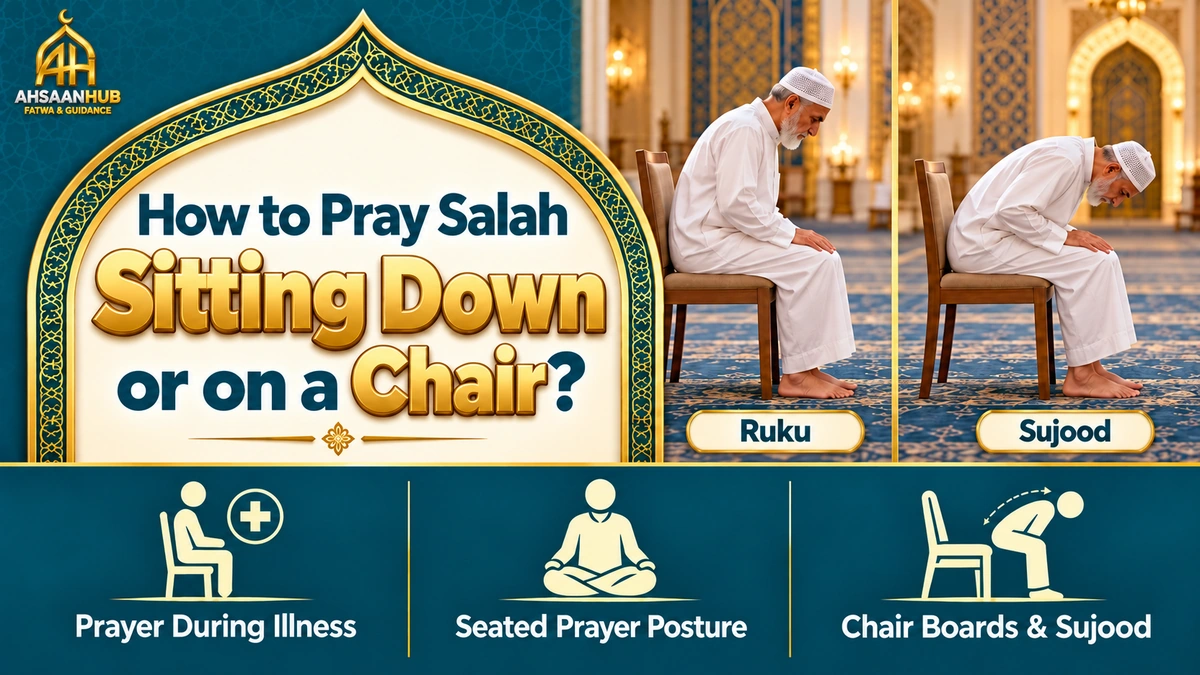
For a person performing prayer by gesture, the Shar’i principle is that he should incline as far forward as he is physically able, and the inclination for Sajdah should be noticeably deeper than the inclination for Ruku so that the two postures remain clearly distinct from one another.
If a person is praying on a chair and a table, desk, pillow, or wooden board has been attached in front of it for him to place his forehead upon, this method is not correct according to the Shariah.
Prostrating upon an artificially raised object was explicitly rejected by the Prophet (PBUH). Jabir ibn Abdullah (RA) narrated that the Messenger of Allah (PBUH) visited a sick person and saw him praying upon a cushion/pillow:
“فَأَخَذَهَا فَرَمَى بِهَا، فَأَخَذَ عُودًا لِيُصَلِّيَ عَلَيْهِ، فَأَخَذَهُ فَرَمَى بِهِ، وَقَالَ: صَلِّ عَلَى الأَرْضِ إِنِ اسْتَطَعْتَ، وَإِلاَّ فَأَوْمِ إِيمَاءً، وَاجْعَلْ سُجُودَكَ أَخْفَضَ مِنْ رُكُوعِكَ”
The Prophet (PBUH) took the pillow and cast it aside. The sick man then took a piece of wood (board) to pray upon, so the Prophet (PBUH) took it and cast it aside as well, saying: “Pray on the ground if you are able. Otherwise, indicate with gestures (in the air), and make your prostration lower than your bowing.”
(As-Sunan al-Kubra lil-Bayhaqi: 2/306, Silsilat al-Ahadith as-Sahihah: 323)
Performing Sajdah on an artificially elevated surface other than the ground is not what the Shariah intends or requires.
If a person is genuinely unable to prostrate on the ground due to illness or a legitimate excuse, he should not press his forehead against any raised object.
Instead, he should simply lean forward into the air as far as possible and indicate the Sajdah through that gesture alone.
The chairs commonly found in some mosques today that have a wooden board or shelf attached to the front on which worshippers lean and rest their foreheads are not in accordance with the Sunnah.
The authentic Sunnah method is to gesture with a forward inclination into the air, keeping Sajdah lower than Ruku, rather than resting the forehead on any elevated board.
May Allah grant us all the correct understanding of every ruling of the Deen and the ability to act upon it. Ameen.