Salah (the ritual prayer) is the second pillar of Islam and the foremost practical foundation of a believer’s faith. It serves as a direct, intimate spiritual connection between the servant and Allah the Almighty, performed five times every day.
The Prophet Muhammad (PBUH) emphasized that prayer is the very first matter for which a person will be held accountable on the Day of Resurrection, stating:
“إِنَّ أَوَّلَ مَا يُحَاسَبُ بِهِ الْعَبْدُ يَوْمَ الْقِيَامَةِ مِنْ عَمَلِهِ صَلَاتُهُ، فَإِنْ صَلُحَتْ فَقَدْ أَفْلَحَ وَأَنْجَحَ، وَإِنْ فَسَدَتْ فَقَدْ خَابَ وَخَسِرَ”
“The first thing for which a servant will be called to account on the Day of Judgment is his prayer. If it is sound, he will have succeeded and prospered; but if it is corrupt, he will have failed and lost.”
Furthermore, the Prophet (PBUH) laid down the universal standard of worship for all generations to come when he declared:
“صَلُّوا كَمَا رَأَيْتُمُونِي أُصَلِّي”
Sallu kama ra’aytumoonee usallee
“Pray as you have seen me pray.”
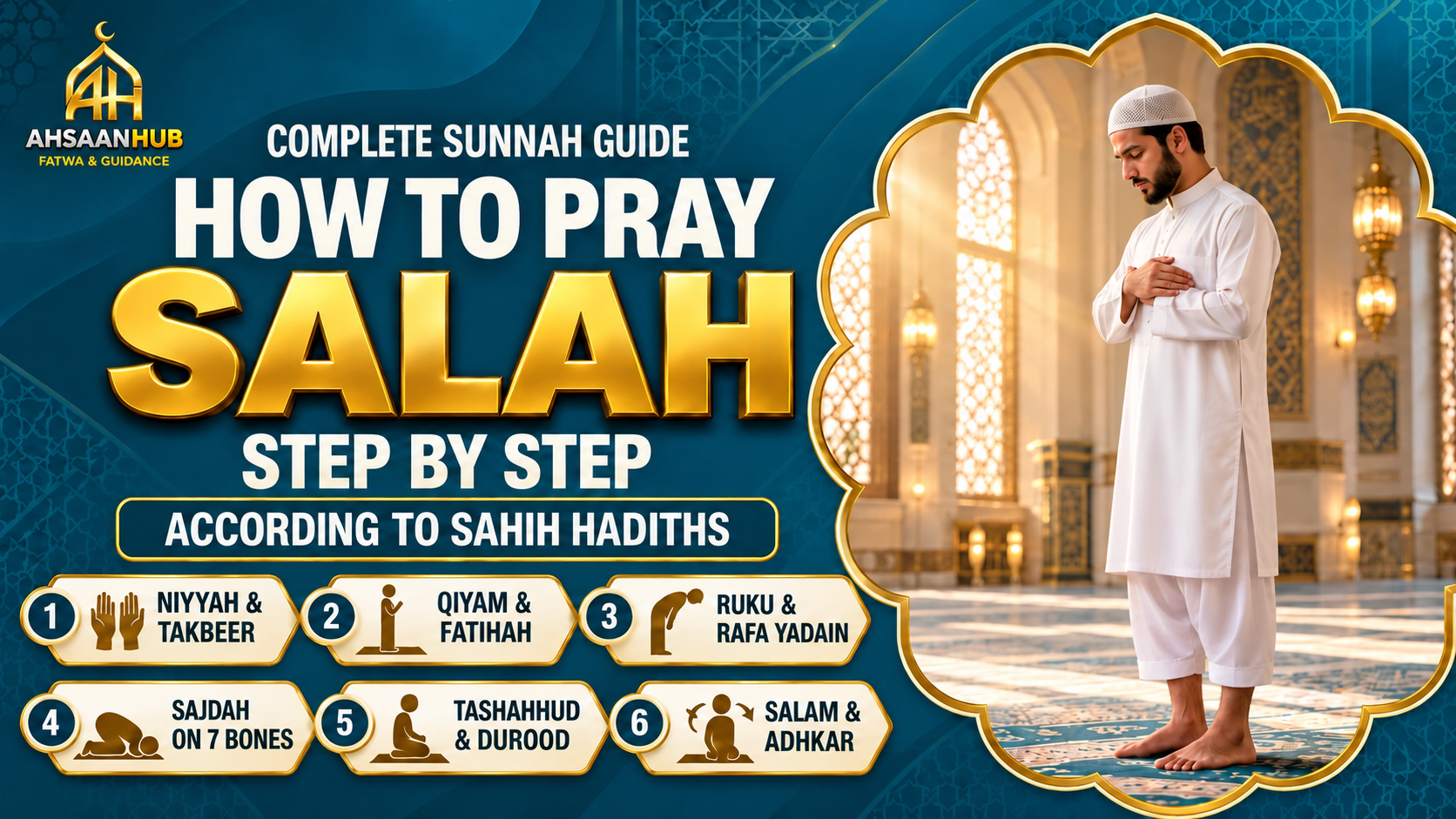
This master handbook brings together every aspect of Salah from essential prerequisites (purification, timing, facing Qibla, clothing) to a detailed, step-by-step physical breakdown of each movement and supplication, concluding with special circumstances such as congregation, travel, sickness, and forgetfulness.
📖 Detailed Guide: The Importance of Salah in Light of Sahih Hadiths
Discover the immense status of Salah in Islam, why it marks the distinction between belief and disbelief, and how regular prayer purifies sins: Read Full Guide on the Importance of Salah →
Overview: Rak’ahs and Times of the 5 Daily Prayers
Every Muslim is obligated to perform five daily prayers within their designated time windows. Here is a clear summary of the prescribed Rak’ahs (units) for each prayer:
↔️ Swipe horizontally to view all columns on mobile
| Prayer (Salah) | Sunnah (Before) | Fard (Obligatory) | Sunnah (After) | Witr / Nafl | Total Rak’ahs |
|---|---|---|---|---|---|
| Fajr (Dawn) | 2 (Mu’akkadah) | 2 | – | – | 4 |
| Dhuhr (Noon) | 4 (Mu’akkadah) | 4 | 2 (Mu’akkadah) | 2 Nafl | 12 |
| Asr (Afternoon) | 4 (Ghayr Mu’akkadah) | 4 | – | – | 8 |
| Maghrib (Sunset) | – | 3 | 2 (Mu’akkadah) | 2 Nafl | 7 |
| Isha (Night) | 4 (Ghayr Mu’akkadah) | 4 | 2 (Mu’akkadah) | 3 Witr + 2 Nafl | 15 (or 17) |
📖 Detailed Guide: How Many Rak’ahs Are in 5 Daily Prayers?
Learn the full breakdown of Fard, Sunnah Mu’akkadah, and optional Nafl prayers for every daily prayer: Read Full Rak’ah Breakdown →
📖 Detailed Guide: What Are the Exact Times of the 5 Daily Prayers?
Understand the celestial signs taught by Jibreel (AS) for Subh Sadiq, Zawal, Asr shadows, sunset, and twilight limits: Read Full Prayer Times Guide →
Part 1: Essential Prerequisites Before Starting Salah (Shurut as-Salah)
Before entering the physical prayer, specific mandatory conditions (Shurut) must be satisfied. If any of these prerequisites is missing without a valid Shar’i excuse, the prayer is invalid.
1. Purification (Taharah) from Minor and Major Impurities
A person must be in a state of ritual cleanliness. Minor impurity requires Wudu (ablution), major ritual impurity requires Ghusl (full ritual bath), and when water is unavailable or cannot be used due to illness, Tayammum (dry ablution) replaces them.
📖 Detailed Guide: How to Perform Wudu Step by Step: Complete Sunnah Guide
Explore our complete handbook covering intention, washing order, wiping over socks, and authentic supplications: Read Master Wudu Guide →
📖 Detailed Guide: Sunnah Method of Performing Ghusl According to Sahih Hadiths
Learn the obligatory steps and Sunnah sequence for full ritual purification after major impurity: Read Complete Ghusl Guide →
📖 Detailed Guide: How to Perform Tayammum: Rulings and Practical Method
Understand when dry ablution with clean earth is permissible and how to perform it properly: Read Full Tayammum Guide →
2. Clothing and Covering the Sattr (Awrah)
In Salah, a person stands directly before Allah the Almighty. Proper attire and covering the Awrah are mandatory:
- For Men: The minimum obligatory Awrah extends from the navel to the knee. In addition, the Sunnah requires that the shoulders must not remain uncovered in prayer (Sahih al-Bukhari: 359), and clothes should be clean, respectable, and not hanging below the ankles out of arrogance.
- For Women: The entire body must be completely covered with loose, non-transparent clothing, leaving only the face and hands visible. Hair, ears, neck, and feet must not be exposed.
📖 Detailed Guide: Rules of Clothing and Sattr in Salah
Read the comprehensive fiqh rulings regarding proper modesty, tight clothing, transparent fabrics, and prayer attire: Read Clothing & Sattr Guide →
3. Facing the Qiblah (Istiqlal al-Qiblah)
Turning toward the Holy Ka’bah in Makkah al-Mukarramah is a direct Quranic command: “Turn your face toward the Sacred Mosque, and wherever you may be, turn your faces toward it”
(Surah al-Baqarah 2:144).
Except when unable (such as severe fear or illness), facing the Qiblah is obligatory.
📖 Detailed Guide: Rules and Rulings of Facing the Qiblah in Salah
Learn how to determine the Qiblah direction, what to do when travelling or uncertain, and how slight deviations are handled: Read Qiblah Rulings →
4. Placing a Sutrah (Protective Barrier) in Front
The Messenger of Allah (PBUH) instructed worshippers never to pray in an open, unprotected area without placing an object (such as a wall, pillar, stick, or bag) directly in front of them: “When one of you prays, let him pray toward a Sutrah and come close to it, and not let anyone pass in front of him” (Sunan Abi Dawud: 698).
📖 Detailed Guide: What Is the Importance of Sutrah in Salah?
Discover the minimum height of a Sutrah, rulings on someone passing in front of a worshipper, and how the Imam’s Sutrah suffices the congregation: Read Sutrah Rulings →
5. The Adhan and Iqamah (Call to Prayer)
Announcing the prayer time through the Adhan and initiating the congregation with the Iqamah is an established communal Sunnah that drives away Shaytan and
unites Muslims in worship.
📖 Detailed Guide: How to Give Adhan, Iqamah, and Respond to the Adhan
Learn the precise wording of the Adhan and Iqamah, how to repeat the words after the Mu’adhin, and authentic supplications after the call: Read Adhan & Iqamah Guide →
Part 2: Step-by-Step Practical Method of Salah (From Takbeer to Salam)
Once all prerequisites are in place, stand upright facing the Qiblah, leave a moderate space between your feet, and follow this authentic Sunnah sequence:
Step 1: The Intention (Niyyah)
The intention resides in the heart. You make a firm internal determination that you are praying a specific prayer (e.g., Fard of Dhuhr) for Allah alone.
The Prophet (PBUH) affirmed: “Actions are judged only by intentions” (Sahih al-Bukhari: 1). Articulating verbal formulas aloud or reciting formulated oaths was never practiced by the Prophet (PBUH) or his Companions.
📖 Detailed Guide: Ruling and Method of Niyyah for Salah
Understand the distinction between internal intention and verbal pronunciation according to the authentic Sunnah: Read Full Niyyah Guide →
Step 2: Takbeer al-Tahrimah & Raising the Hands (Rafa al-Yadain)
To enter the sacred sanctuary of Salah, raise both hands up to shoulder level or earlobes, with fingers naturally spread and palms facing the Qiblah, and proclaim:
“اللَّهُ أَكْبَرُ”
“Allahu Akbar” (Allah is the Greatest)
This is termed Takbeer al-Tahrimah because uttering it immediately renders worldly activities (eating, drinking, speaking, laughing) strictly forbidden for the duration of the prayer.
📖 Detailed Guide: What Is Takbeer al-Tahrimah and How Is It Performed?
Learn the precise hand level, timing of the Takbeer, and what invalidates prayer upon entry: Read Takbeer al-Tahrimah Guide →
Step 3: Standing in Qiyam and Folding the Hands on the Chest
Standing upright during obligatory prayers is a non-negotiable pillar (Rukn) for anyone physically capable (Sahih al-Bukhari: 1117).
Once entering Qiyam, place your right hand over your left hand, wrist, and forearm, resting them firmly upon your chest or upper torso, as established in the authentic Hadiths of Wa’il ibn Hujr and Sahl ibn Sa’d (RA):
“كَانَ النَّاسُ يُؤْمَرُونَ أَنْ يَضَعَ الرَّجُلُ الْيَدَ الْيُمْنَى عَلَى ذِرَاعِهِ الْيُسْرَى فِي الصَّلَاةِ”
“The people were commanded that a man should place his right hand over his left forearm in prayer.”
📖 Detailed Guide: Method and Ruling of Qiyam (Standing) in Salah
Understand the obligation of standing upright, foot alignment, and concessions for those unable to stand: Read Qiyam Guide →
📖 Detailed Guide: Where Should the Hands Be Placed in Salah?
Detailed analysis of Hadiths regarding placing the hands upon the chest versus below the navel: Read Hand Placement Rulings →
Step 4: Looking at the Place of Sajdah & Opening Supplication (Du’a al-Istiftah)
Fix your gaze humbly upon the spot on the floor where your forehead will touch during Sajdah. Looking up at the sky or glancing around is strictly prohibited in prayer
(Sahih al-Bukhari: 750).
Next, recite one of the authentic opening supplications (Du’a al-Istiftah) silently. Among the most popular and authentic is:
“سُبْحَانَكَ اللَّهُمَّ وَبِحَمْدِكَ، وَتَبَارَكَ اسْمُكَ، وَتَعَالَى جَدُّكَ، وَلَا إِلَهَ غَيْرُكَ”
Subhanak-Allahumma wa bihamdika, wa tabarakasmuka, wa ta’ala jadduka, wa la ilaha ghayruk.“Glory be to You, O Allah, and all praise is Yours. Blessed is Your name, exalted is Your majesty, and there is no deity worthy of worship besides You.”
📖 Detailed Guide: Where to Look in Salah & Authentic Opening Supplications
Discover the full collection of opening supplications taught by the Prophet (PBUH), including the famous supplication reported by Abu Hurairah in Bukhari & Muslim: Read Opening Supplications Guide →
Step 5: Ta’awwudh, Basmalah, Surah al-Fatihah, and Additional Quran Recitation
Seek refuge in Allah from Shaytan and recite the Basmalah silently:
“أَعُوذُ بِاللَّهِ مِنَ الشَّيْطَانِ الرَّجِيمِ • بِسْمِ اللَّهِ الرَّحْمَنِ الرَّحِيمِ”
A’oodhu billahi minash-shaytanir-rajeem • Bismillahir-Rahmanir-Raheem.
Reciting Surah al-Fatihah is an indispensable pillar of every Rak’ah. The Prophet (PBUH) declared without exception:
“لَا صَلَاةَ لِمَنْ لَمْ يَقْرَأْ بِفَاتِحَةِ الْكِتَابِ”
“There is no prayer for the one who does not recite the Opening of the Book (Surah al-Fatihah).”
Upon completing Surah al-Fatihah, say “Ameen” (O Allah, accept our supplication). When praying behind an Imam in loud prayers (Fajr, Maghrib, Isha), the congregation says “Ameen” aloud in unison with the Imam (Sahih al-Bukhari: 780).
In the first two Rak’ahs, recite another Surah or a passage from anywhere in the Quran following Surah al-Fatihah.
📖 Detailed Guide: Is It Compulsory to Recite Surah al-Fatihah Behind the Imam?
Detailed analysis of scholarly opinions on reciting al-Fatihah in silent versus loud congregational prayers: Read Fatihah Behind Imam Rulings →
📖 Detailed Guide: Should You Say Ameen Loudly After Surah al-Fatihah?
Explore the authentic Sunnah proofs regarding saying Ameen aloud in loud prayers and its immense virtues: Read Saying Ameen Guide →
📖 Detailed Guide: Method of Reciting the Quran in Salah
Discover the Sunnah length of recitation for each of the five daily prayers and proper pauses between verses: Read Quran Recitation in Salah Guide →
Step 6: Ruku (Bowing) and Rafa al-Yadain
After pausing briefly in silence, raise both hands to shoulder or ear level (Rafa al-Yadain) saying “Allahu Akbar”, and bow forward into Ruku.
Physical Form of Sunnah Ruku: Grasp your knees firmly with fingers spread wide as if clutching them.
Keep your elbows away from your flanks, straighten your back completely so that if water were poured on it, it would settle level, and keep your head aligned with your spine without drooping or tilting upwards
(Sunan Abi Dawud: 859).
While stationary in Ruku, recite at least three times with calmness (Itminan):
“سُبْحَانَ رَبِّيَ الْعَظِيمِ”
Subhana Rabbiyal-‘Azeem
“Glory be to my Lord, the Almighty.”
📖 Detailed Guide: Method of Ruku and Rafa al-Yadain in Salah
Understand the complete physical mechanics of Ruku, the places where Rafa al-Yadain is Sunnah, and additional authentic supplications in Ruku: Read Full Ruku Guide →
Step 7: Rising from Ruku (Qawmah) & Standing with Tranquility
Rise from Ruku back to an upright standing posture while raising your hands to shoulder level and saying:
“سَمِعَ اللَّهُ لِمَنْ حَمِدَهُ”
Sami’ Allahu liman hamidah
“Allah hears the one who praises Him.”
Once fully standing straight and stationary, say:
“رَبَّنَا وَلَكَ الْحَمْدُ، حَمْدًا كَثِيرًا طَيِّبًا مُبَارَكًا فِيهِ”
Rabbana wa lakal-hamd, hamdan katheeran tayyiban mubarakan feeh.
“Our Lord, to You belongs all praise plentiful, pure, and blessed praise.”
Standing upright with complete calmness (Itminan) is mandatory.
The Prophet (PBUH) warned that Allah does not look at the prayer of a person who does not straighten his back between Ruku and Sajdah
(Sunan Ibn Majah: 870).
📖 Detailed Guide: What Is Qoumah and How Should You Stand After Ruku?
Discover the essential rulings of tranquility (I’tidal) in Qawmah and the angels competing to write the praise: Read Qawmah Guide →
Step 8: Descending for Sajdah (Prostration) on Seven Bones
Say “Allahu Akbar” and descend for prostration. In accordance with the authentic Sunnah of the Prophet (PBUH), place your hands upon the ground before your knees
(Sunan Abi Dawud: 840).
The Seven Obligatory Limbs of Sajdah: The Messenger of Allah (PBUH) commanded:
“أُمِرْتُ أَنْ أَسْجُدَ عَلَى سَبْعَةِ أَعْظُمٍ: عَلَى الْجَبْهَةِ – وَأَشَارَ بِيَدِهِ عَلَى أَنْفِهِ – وَالْيَدَيْنِ، وَالرُّكْبَتَيْنِ، وَأَطْرَافِ الْقَدَمَيْنِ”
“I have been commanded to prostrate on seven bones: the forehead and he pointed to his nose the two hands, the two knees, and the ends of the two feet.”
Sunnah Posture in Sajdah: Place your palms level with your shoulders or ears, with fingers closed together pointing toward the Qiblah. Keep your forearms elevated off the ground (do not lay them flat like a dog).
Keep your abdomen away from your thighs and your thighs away from your calves, and tuck your toes facing the Qiblah.
While in Sajdah, recite at least three times:
“سُبْحَانَ رَبِّيَ الأَعْلَى”
Subhana Rabbiyal-A’la
“Glory be to my Lord, the Most High.”
📖 Detailed Guide: How to Perform Sajdah in Salah: Step-by-Step Sunnah Guide
Detailed guide on hands before knees, proper alignment of the seven limbs, toe placement, and making personal Dua in Sajdah: Read Full Sajdah Guide →
Step 9: Sitting Between the Two Sujood (Jalsah) & Rising for the Next Rak’ah
Raise your head saying “Allahu Akbar” and sit upright in the posture of Iftirash: lay your left foot flat beneath you to sit on it, and keep your right foot upright with its toes bent facing the Qiblah
(Sahih al-Bukhari: 828).
Rest your hands on your thighs or knees and recite with tranquility:
“رَبِّ اغْفِرْ لِي، رَبِّ اغْفِرْ لِي”
Rabbighfir lee, Rabbighfir lee.
“O my Lord, forgive me; O my Lord, forgive me.”
Next, say “Allahu Akbar” and perform the second Sajdah exactly as the first.
Upon rising from the second Sajdah, pause for a moment in a brief sitting of rest
(Jalsat al-Istirahah), then push up with your hands supported on the ground to stand for the next Rak’ah
(Sahih al-Bukhari: 824).
📖 Detailed Guide: How to Sit Between Two Sujood and Stand for the Next Rak’ah
Learn the authentic Sunnah methods of Iftirash and Iq’a, supplications between prostrations, and rising with fists/hands: Read Sitting Between Sujood Guide →
Step 10: The First Tashahhud (in 3 or 4-Rak’ah Prayers) & Pointing the Finger
In prayers with three or four Rak’ahs (Dhuhr, Asr, Maghrib, Isha), sit after completing the second Rak’ah in Iftirash (sitting on the left foot with the right foot upright).
Hand Placement and Pointing the Index Finger: Place your left hand open on your left knee. Clench the fingers of your right hand, make a circle with your thumb and middle finger, and point your right index finger toward the Qiblah, fixing your gaze upon it and moving it while supplicating
(Sunan an-Nasa’i: 1270, Sunan Abi Dawud: 989).
Recite the Tashahhud (Attahiyyat) taught by Abdullah ibn Mas’ud (RA):
“التَّحِيَّاتُ لِلَّهِ وَالصَّلَوَاتُ وَالطَّيِّبَاتُ، السَّلَامُ عَلَيْكَ أَيُّهَا النَّبِيُّ وَرَحْمَةُ اللَّهِ وَبَرَكَاتُهُ، السَّلَامُ عَلَيْنَا وَعَلَى عِبَادِ اللَّهِ الصَّالِحِينَ، أَشْهَدُ أَنْ لَا إِلَهَ إِلَّا اللَّهُ وَأَشْهَدُ أَنَّ مُحَمَّدًا عَبْدُهُ وَرَسُولُهُ”
“All compliments, prayers, and pure words are due to Allah. Peace be upon you, O Prophet, and the mercy of Allah and His blessings. Peace be upon the righteous servants of Allah and upon us. I bear witness that none has the right to be worshipped except Allah, and I bear witness that Muhammad is His servant and His Messenger.”
📖 Detailed Guide: How to Perform Tashahhud and Point the Finger in Salah
Discover the exact hand position, continuous moving vs raising once, and how the gaze remains on the index finger throughout: Read Tashahhud & Finger Pointing Guide →
Step 11: The Final Tashahhud (Tawarruk), Durood Ibrahim, and Supplications
In the final Rak’ah of every prayer, the Sunnah posture for sitting is Tawarruk: rest your left hip directly upon the ground, slide your left foot under your right shank, and keep your right foot upright
(Sahih al-Bukhari: 828).
After reciting Attahiyyat, send blessings upon the Prophet (PBUH) by reciting Durood Ibrahim:
“اللَّهُمَّ صَلِّ عَلَى مُحَمَّدٍ وَعَلَى آلِ مُحَمَّدٍ كَمَا صَلَّيْتَ عَلَى إِبْرَاهِيمَ وَعَلَى آلِ إِبْرَاهِيمَ إِنَّكَ حَمِيدٌ مَجِيدٌ، اللَّهُمَّ بَارِكْ عَلَى مُحَمَّدٍ وَعَلَى آلِ مُحَمَّدٍ كَمَا بَارَكْتَ عَلَى إِبْرَاهِيمَ وَعَلَى آلِ إِبْرَاهِيمَ إِنَّكَ حَمِيدٌ مَجِيدٌ”
Before giving the Salam, the Prophet (PBUH) emphatically commanded seeking refuge from four major trials:
“اللَّهُمَّ إِنِّي أَعُوذُ بِكَ مِنْ عَذَابِ جَهَنَّمَ، وَمِنْ عَذَابِ الْقَبْرِ، وَمِنْ فِتْنَةِ الْمَحْيَا وَالْمَمَاتِ، وَمِنْ شَرِّ فِتْنَةِ الْمَسِيحِ الدَّجَّالِ”
“O Allah, I seek refuge in You from the torment of Hellfire, from the punishment of the grave, from the trials of life and death, and from the evil trial of the False Messiah (Dajjal).”
📖 Detailed Guide: How to Perform the Final Tashahhud, Tawarruk, and Salam
Detailed guide on Tawarruk vs Iftirash, authentic supplications before Salam, and common mistakes in the final sitting: Read Final Tashahhud Guide →
Step 12: Concluding with the Tasleem (Salam)
Conclude your prayer by turning your head to the right and saying:
“السَّلَامُ عَلَيْكُمْ وَرَحْمَةُ اللَّهِ”
As-Salamu ‘alaykum wa Rahmatullah
“May the peace and mercy of Allah be upon you.”
Then turn your head to the left and repeat the exact same greeting
(Sahih Muslim: 582, Sunan Abi Dawud: 996).
Turn far enough that the whiteness of your cheek can be seen from behind.
Step 13: Authentic Adhkar (Supplications) After Salah
Upon completing the Salam, engage immediately in the Sunnah remembrances taught by the Prophet (PBUH):
- Say “Astaghfirullah” (I seek the forgiveness of Allah) three times
(Sahih Muslim: 591). - Recite: “Allahumma Antas-Salam wa minkas-salam, tabarakta ya Dhal-Jalali wal-Ikram.”
- Recite Ayat al-Kursi (Surah al-Baqarah 2:255), as whoever recites it after every obligatory prayer, nothing stands between him and entering Paradise except death
(Sunan an-Nasa’i al-Kubra: 9848). - Perform the Tasbeeh Fatimi: Say SubhanAllah 33 times, Alhamdulillah 33 times, Allahu Akbar 33 times, and conclude with the Tahleel to make 100 (Sahih Muslim: 597).
📖 Detailed Guide: Authentic Adhkar and Supplications to Say After Salah
Discover the full authentic collection of morning, evening, and post-prayer Adhkar with Arabic text and English translations: Read Post-Salah Adhkar Guide →
Part 3: Special Situations and Modified Prayers in Islam
Islam is a religion of ease and divine wisdom. In various human situations travel, sickness, congregation, or unintentional mistakes the Shariah provides specific concessions and modifications.
1. Congregational Prayer (Salah al-Jama’ah)
Offering the five daily prayers in congregation at the mosque carries 27 times greater reward than praying alone at home (Sahih al-Bukhari: 645).
Muslims must straighten their rows shoulder-to-shoulder and ankle-to-ankle, follow the Imam without preceding him, and maintain communal brotherhood.
📖 Detailed Guide: How to Pray Salah in Congregation and What Are the Rules?
Learn the rules of following the Imam, joining a late prayer (Masbooq), row alignment, and women praying in congregation: Read Congregational Prayer Guide →
2. The Witr Prayer According to the Sunnah
The Witr prayer is an emphatic Sunnah (Sunnah Mu’akkadah) offered during the night between Isha and the dawn of Fajr.
The Prophet (PBUH) never omitted Witr, whether resident at home or traveling on a journey.
It may be prayed as 1, 3, or 5 Rak’ahs, accompanied by Du’a al-Qunoot.
📖 Detailed Guide: How to Pray Witr According to the Sunnah
Discover the authentic methods of praying Witr, reciting Du’a al-Qunoot before or after Ruku, and its immense status: Read Complete Witr Guide →
3. Prayer During Travel (Qasr and Jam’ in Safar)
When traveling beyond the Shar’i distance (approx. 77 km / 48 miles), Allah grants a divine concession to shorten four-Rak’ah obligatory prayers (Dhuhr, Asr, and Isha) down to
two Rak’ahs (Qasr): “And when you travel through the land, there is no blame upon you that you shorten the prayer”
(Surah an-Nisa 4:101).
In addition, combining Dhuhr with Asr, and Maghrib with Isha (Jam’), is permissible when needed during travel.
📖 Detailed Guide: How to Perform Namaz in Safar (Qasr and Travel Prayer Rulings)
Comprehensive guide covering travel distance, duration of stay, joining prayers, and praying behind a resident Imam: Read Full Travel Prayer Guide →
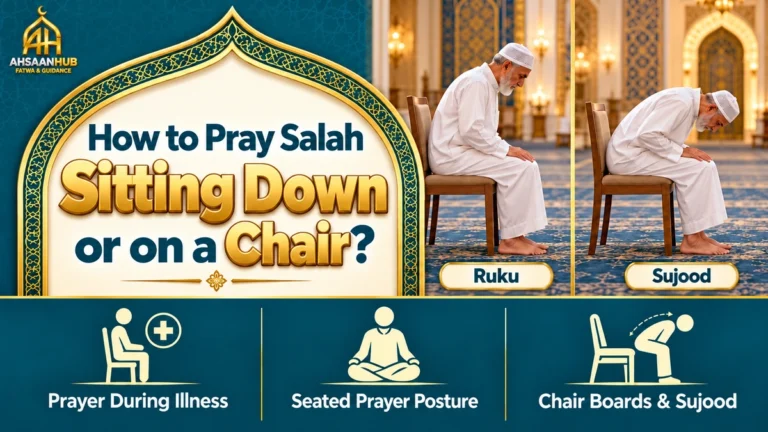
4. Prayer for the Sick and Those Praying on a Chair
If physical illness, severe injury, or disability prevents a person from standing or prostrating on the ground, the Shariah demands only what is within their capacity: “Pray standing; if you are unable, then sitting; if you are unable, then on your side”
(Sahih al-Bukhari: 1117).
Those praying on chairs should indicate Ruku and Sajdah by leaning forward into the air, making the gesture for Sajdah noticeably deeper than Ruku.
Attaching wooden boards or pillows to rest the forehead upon is strictly forbidden by the Sunnah.
📖 Detailed Guide: How to Pray Salah Sitting Down or on a Chair
Learn the authentic Sunnah method of seated prayer, cross-legged posture, gesturing in the air, and rulings on mosque chairs: Read Chair & Sickness Prayer Guide →
5. Sajdah Sahw (Prostrations of Forgetfulness)
Human forgetfulness is natural. If a worshipper unintentionally adds an extra Rak’ah, omits an obligatory duty (like the first Tashahhud), or experiences doubt regarding whether they prayed three or four Rak’ahs, the deficiency is repaired by offering two prostrations of forgetfulness (Sajdah Sahw) before or after the Salam.
📖 Detailed Guide: How to Perform Sajdah Sahw in Salah
Discover the exact reasons that necessitate Sajdah Sahw, when to perform it before vs after Salam, and how to resolve doubts in Rak’ahs: Read Sajdah Sahw Guide →
Frequently Asked Questions (FAQ) About Salah
Q1: What are the obligatory pillars (Arkan) without which Salah is invalid?
The essential pillars include: (1) Takbeer al-Tahrimah, (2) Qiyam (standing) in obligatory prayers, (3) Reciting Surah al-Fatihah, (4) Ruku (bowing), (5) Straightening up from Ruku (Qawmah), (6) Sajdah (prostrating on seven limbs), (7) Sitting between the two Sujood, (8) The final Tashahhud, (9) The final sitting, (10) The Tasleem (Salam), and (11) Maintaining calmness and tranquility (Tuma’neenah) in every posture.
Q2: What invalidates (breaks) the prayer?
Salah is broken by: breaking Wudu (passing wind, bleeding, etc.), speaking intentionally, excessive continuous physical movement unrelated to prayer, eating or drinking, laughing aloud, turning the chest away from the Qiblah, or uncovering the Awrah.
Q3: Is reciting Surah al-Fatihah mandatory behind the Imam in loud prayers?
According to the strongest Hadith evidence (Sahih al-Bukhari: 756), reciting Surah al-Fatihah is mandatory for every worshipper, whether praying alone or behind an Imam, during both silent and loud prayers. One should recite it quietly during the pauses of the Imam or while listening attentively.
Q4: What should you do if you arrive at the mosque while the Imam is already in Ruku?
If you join the congregation, pronounce Takbeer al-Tahrimah while standing, and immediately bow down into Ruku with the Imam before he rises, you have caught that entire Rak’ah.
May Allah accept our prayers, grant us reverence (Khushoo’) in our worship, and enable us to follow the authentic Sunnah of His Beloved Messenger (PBUH). Ameen.