Is Washing the Arms Including the Elbows Obligatory in Wudu?
After washing the face and running wet fingers
through the beard (khilal), the next step is to wash both arms completely.
Allah the Almighty commands in Surah al-Maidah (5:6):
- Ya ayyuhalladhina amanu idha qumtum ilas-salati faghsilu wujuhakum wa aydiyakum
ilal-marafiq (Quran 5:6)
O you who believe, when you stand up for prayer, wash your faces and your forearms up to the elbows
How Should Water Be Poured Over the Arms According to the Sunnah?
After washing the face, the arms must be washed thoroughly.
The practical method according to the Sunnah is as follows:
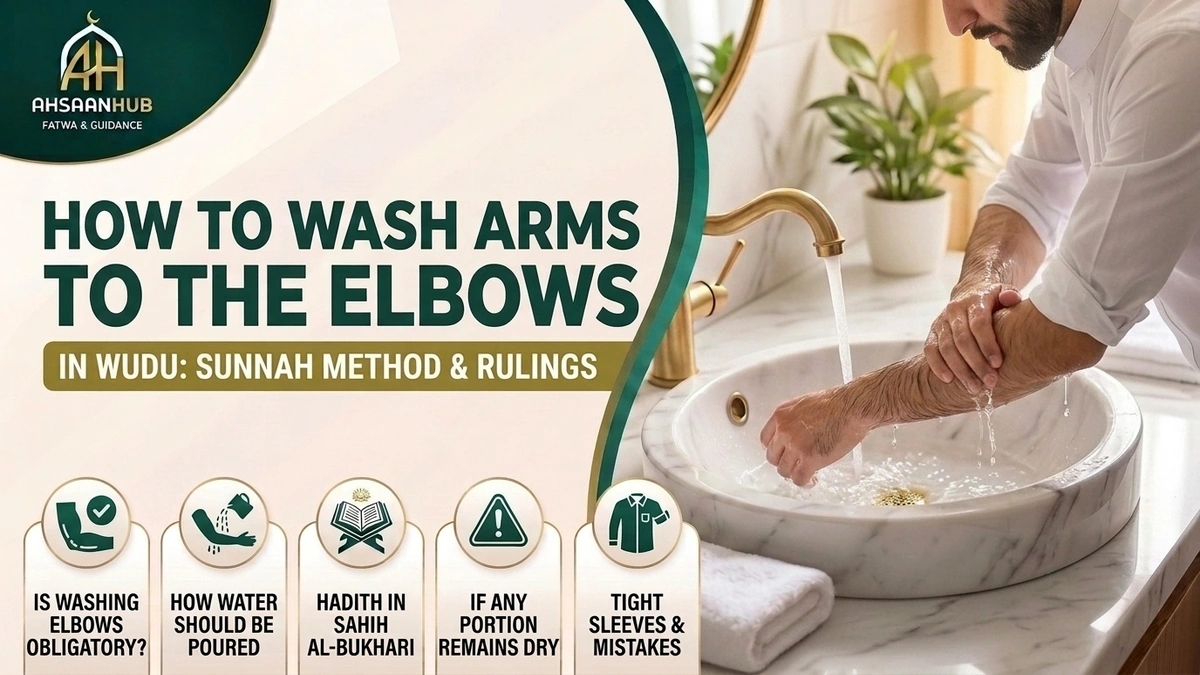
Take a handful of water in the right hand, pour it over the right arm from above,
and rub it thoroughly with the left hand so that no area remains untouched or dry.
Do the same for the left arm: take water in the right hand,
pour it over the left arm, and rub it completely with the other hand
to ensure no spot is missed.
In addition, perform khilal between the fingers of both hands by interlacing them so that
water reaches every single part.
What Is the Hadith in Sahih al-Bukhari Concerning Washing the Arms?
Abdullah ibn Abbas (RA) demonstrated the
Wudu of the Prophet (ﷺ), as recorded by Imam al-Bukhari:
- “Thumma akhadha ghurfatan min ma’in faghasala biha yadahu al-yumna, thumma akhadha ghurfatan min ma’in faghasala biha yadahu al-yusra”
(Sahih al-Bukhari: 140)
Then he took a handful of water and washed his right arm with it, and then
he took another handful of water and washed his left arm with it.
Is Wudu Valid if Any Portion of the Elbow Remains Dry?
When washing the arms, it is essential to pay close attention to thoroughness.
The entire arm must be washed from the fingertips all the way through
the elbows, and not even a space the width of a single hair should be left dry.
The elbows are an obligatory part of this wash.
The Quran uses the phrase ilal-marafiq, which means washing the arms including the elbows.
If even an area as small as a single hair is left dry, the Wudu is not valid.
How Did the Prophet (ﷺ) Wash His Arms When His Sleeves Were Tight?
If the sleeves of a garment are tight, they must be pushed or pulled back.
In every circumstance, water must reach the entire arm.
Mughirah ibn Shu’bah (RA) described how the Prophet (ﷺ) managed this situation:
- “Wa ghasala wajhahu, fadhahaba yukhriju yadayhi min kummPassing… fayhi fakanā dayyiqayn, fa-akhrajahuma min tahtu faghasalahuma”
(Sahih al-Bukhari: 2918)
He washed his face, then attempted to draw his arms out through
the sleeves of his cloak, but the sleeves were too tight.
Therefore, he brought his arms out from beneath the lower hem of the cloak
and washed both of them.
What Is a Common Wudu Mistake Regarding Tight Clothing and Women’s Attire?
A frequent mistake occurs when people wear clothes with narrow or tight sleeves, which is especially common among women.
Instead of pulling the sleeve back completely past the elbow, some people merely wash as far up the forearm as their wet hand can easily reach and consider their Wudu complete.
This practice is incorrect. Unless both arms are washed thoroughly, including the elbows, the Wudu remains incomplete and invalid.
📖 Next Step in Wudu: How to Wipe the Head and Ears in Wudu: Sunnah Methods and Key Rulings →