The Obligation of Ghusl When Private Parts Meet, the Step-by-Step Sunnah Method, and the Two Occasions When Intimacy Is Forbidden
Is Ghusl Required After Penetration Without Ejaculation?
An important jurisprudential question is this: if husband and wife come together and their private parts meet, but no ejaculation occurs, and the husband had to withdraw before that
for some reason, or the private part did not fully enter but only the tip came into contact with the wife’s private area, and at that moment a child woke up, a guest arrived, or some emergency occurred in the home, and the spouses had to separate, does ghusl become obligatory in this situation as well?
Regarding this, Sahih Muslim contains a narration related by Aisha (RA) in which the Messenger of Allah (PBUH) said:
«إِذَا جَلَسَ بَيْنَ شُعَبِهَا الْأَرْبَعِ وَمَسَّ الْخِتَانُ الْخِتَانَ فَقَدْ وَجَبَ الْغُسْلُ» Idhā jalasa bayna shuʿabihā al-arbaʿi wa massa al-khitānu al-khitāna faqad wajaba al-ghusl.
When he sits between her four limbs and the circumcised part meets the circumcised part, ghusl has become obligatory.
(Sahih Muslim: 349; Darussalam: 785)
The khitan refers to the front portion of the private organ from which the foreskin is removed at circumcision.
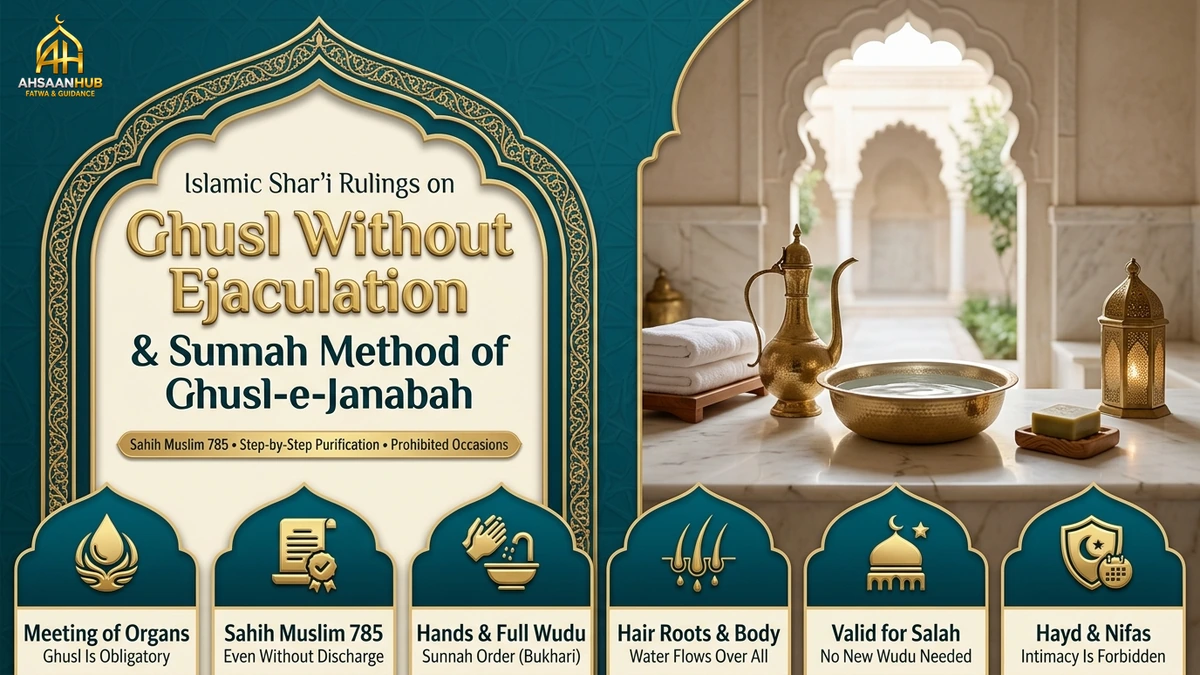
Therefore, when the front portion of the man’s private organ (the glans) enters inside the woman’s private area, and the circumcised parts meet, ghusl becomes obligatory.
It makes no difference whether ejaculation occurred or not, whether semen was discharged or not. Both the husband and the wife are obligated to perform ghusl.
How to Perform Ghusl-e-Janabah According to the Sunnah?
When ghusl becomes obligatory upon the husband and wife, the simple, easy, and prophetically established Sunnah method of performing ghusl
(Sunan Ibn Majah: 613; Sahih al-Bukhari: 257, 260)
consists of the following steps:
- Ensuring privacy: When going for ghusl, bathe in a place away from people’s sight where no one can see you.
(Sunan Ibn Majah: 613) - Washing both hands: Upon entering the bathroom, first wash both hands thoroughly. (Sahih al-Bukhari: 257)
- Washing the private area: Then pour water from the right hand onto the left hand and use the left hand to wash the private area and clean away any impurity in that region, since it was the act of intercourse that made the ghusl obligatory.
- Performing complete wudu: After washing the private area, perform a full and complete wudu exactly as one performs it for prayer.
(Sahih al-Bukhari: 260) - Ensuring water reaches the roots of the hair: After completing wudu, pour water over the head three times and rub the hair with the hands so that water reaches the scalp and the roots of the hair.
(Sahih al-Bukhari: 248) - Pouring water over the entire body: Then pour water first over the right side of the body, then over the left side, allowing water to flow over the entire body. (Sahih al-Bukhari: 168) After this, one may use as much additional water as desired, apply soap or shampoo, and use them freely.
- Washing both feet at the end: Upon finishing the ghusl and stepping out, pour water over both feet one final time and wash them.
Scholars note the wisdom in this: during the ghusl, water splashes from the floor onto the feet, or water that has run off the body may have landed back on them, so washing the feet at the end removes that water.
The ruling on wudu after ghusl: If you have performed ghusl following this Sunnah method, there is no need to perform a separate wudu for prayer, because the Prophet (PBUH) did not perform a separate wudu after ghusl.
(Sunan Abi Dawud: 250; Jami` at-Tirmidhi: 107)
In fact, an obligatory ghusl for janabah suffices for prayer even if one did not perform the individual wudu steps, provided water has reached the entire body along with rinsing the mouth and nose, though performing wudu within ghusl remains the complete Sunnah.
(Hashiyat al-Sawi ala al-Sharh al-Saghir: 1/173–174)
When Is Marital Intimacy Prohibited in Islam?
As has been explained in detail, intercourse with one’s wife at the place from which children are born is halal and permissible for the husband.
However, the Shariah has designated two conditions and two occasions, even at this lawful place, during which a husband may not perform this otherwise halal act and is obligated to refrain from and stay away from intercourse with his wife.
This is because during these two occasions the woman is in a state of a form of physical illness and discomfort:
- First occasion: the state of menstruation (hayd): When the wife is in a state of menstruation, that is, the monthly menstrual cycle (MC) blood that comes to her every month, having intercourse during this time is absolutely forbidden and haram.
(Surah Al-Baqarah 2:222) - Second occasion: the state of post-natal bleeding (nifas): When the wife is in a state of nifas.
(Fatawa al-Lajnah al-Da’imah: 5/471)
Nifas refers to the blood that comes to a woman after the birth of a child, known in English as postpartum bleeding.
This blood may come to different women for different durations, for example, seven days, ten days, twenty days, thirty days, or up to a normal maximum of forty days. For however many days this bleeding continues within this period, intercourse remains prohibited.
However, if bleeding continues beyond forty days without stopping, scholars clarify that it is considered irregular bleeding (istihadah); she takes ghusl, resumes prayer, and marital intimacy becomes permissible.