How Should You Transition Into Sajdah?
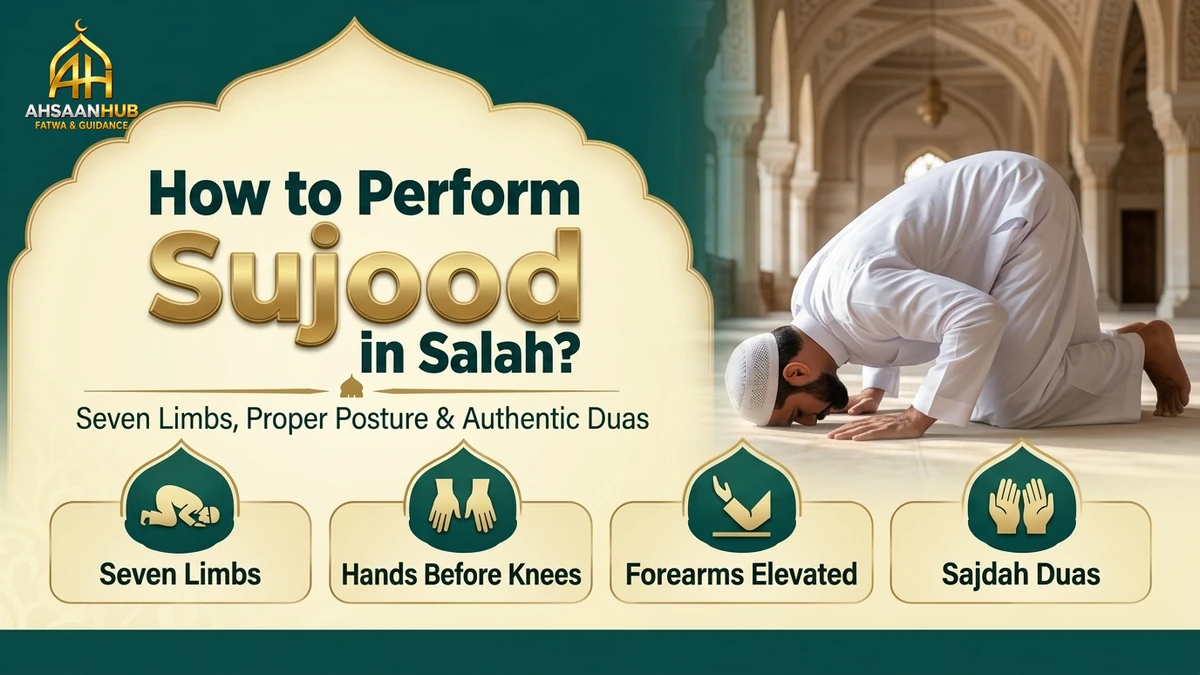
In light of authentic Hadiths of the Prophet (PBUH), when descending for prostration (Sajdah), the hands should be placed on the ground before the knees.
Abu Hurairah (RA) narrates that the Messenger of Allah (PBUH) said:
When one of you prostrates, he should not kneel as a camel kneels, but let him place his hands down before his knees.
(Sunan Abi Dawud: 840, Sunan an-Nasa’i: 1091)
Therefore, the hands are placed on the ground first, followed immediately by the knees.
Which Seven Limbs Are Required for Sajdah?
In the authentic Hadiths of the Prophet (PBUH), prostration must be performed upon seven specific physical parts.
Abdullah ibn Abbas (RA) narrates that the Messenger of Allah (PBUH) said:
I have been commanded to prostrate upon seven bones: the forehead, and he pointed to his nose with his hand, the two hands, the two knees, and the toes of both feet.
(Sahih al-Bukhari: 812, Sahih Muslim: 490)
These seven limbs are:
- The forehead and the nose (counted together as one limb)
- Both hands (making three)
- Both knees (making five)
- The toes of both feet (making seven)
Placing all seven of these body parts firmly upon the ground during prostration is the established Sunnah of the Prophet (PBUH).
What Is the Correct Posture for the Hands and Arms in Sajdah?
During prostration, the hands can be placed on the ground level with the ears
or level with the shoulders. (Sunan Abi Dawud: 734, Sunan an-Nasa’i: 889)
- Position of the fingers: The fingers of both hands should be joined closely together, pointing straight toward the Qibla, with no gaps left between them. (Sahih Ibn Khuzaymah: 642, Sunan al-Bayhaqi: 2/112)
- Separation of the arms: The arms should be kept well away from the torso and ribs. A person should spread them as far as possible, except when praying in congregation, where one must be mindful of adjacent worshippers. (Sahih al-Bukhari: 390, Sahih Muslim: 495)
- Lifting the forearms: Both forearms must be elevated entirely off the floor, rather than laid flat on the ground. (Sahih al-Bukhari: 822, Sahih Muslim: 493)
What Is the Correct Posture for the Stomach, Thighs, and Feet in Sajdah?
The lower body should maintain a balanced and raised posture during Sajdah:
- Stomach and thighs: The stomach should be kept separated and elevated away from the thighs, ensuring that they do not press against each other.
- Toes: The toes should be bent and pressed firmly against the ground so that they face directly toward the Qibla. (Sahih al-Bukhari: 828)
- Heels: The feet should be kept together, with the heels joined, touching one another. (Sahih Ibn Khuzaymah: 654, Mustadrak al-Hakim: 980)
Is the Method of Sajdah Different for Men and Women?
The Prophet (PBUH) is the universal role model for all humanity, and following his guidance is incumbent upon every Muslim man and woman equally.
There is no difference between men and women in the performance of Salah or the method of Sajdah. The exact manner in which a man is instructed to prostrate is the identical manner in which a woman should prostrate. (Sahih al-Bukhari: 631)
Which dua to recite in sajdah?
Various authentic supplications are established from the Prophet (PBUH) during prostration:
The first supplication:
The most well-known supplication narrated in Sahih Muslim:
“سُبْحَانَ رَبِّيَ الْأَعْلَى”
Subhana Rabbiyal-A’la.
Glory be to my Lord, the Most High.
(Sahih Muslim: 772, Sunan Abi Dawud: 871)
It is the recommended Sunnah to recite this supplication three times, and one may recite it more frequently if desired.
The second supplication:
“سُبْحَانَكَ اللَّهُمَّ رَبَّنَا وَبِحَمْدِكَ اللَّهُمَّ اغْفِرْ لِي”
Subhanakallahumma Rabbana wa bihamdika Allahummaghfir li.
Glory be to You, O Allah, our Lord, and praise be to You. O Allah, forgive me.
(Sahih al-Bukhari: 794, Sahih Muslim: 484)
The third supplication:
“سُبُّوحٌ قُدُّوسٌ رَبُّ الْمَلَائِكَةِ وَالرُّوحِ”
Subbuhun Quddusun Rabbul-mala’ikati war-Ruh.
Most Perfect, Most Holy, Lord of the angels and the Spirit.
(Sahih Muslim: 487)
The fourth supplication:
“سُبْحَانَ ذِي الْجَبَرُوتِ وَالْمَلَكُوتِ وَالْكِبْرِيَاءِ وَالْعَظَمَةِ”
Subhana Dhil-jabaruti wal-malakuti wal-kibriya’i wal-‘azamah.
Glory be to the Possessor of all power, dominion, grandeur, and supreme majesty.
(Sunan Abi Dawud: 873, Sunan an-Nasa’i: 1049)
The fifth supplication:
“اللَّهُمَّ اغْفِرْ لِي ذَنْبِي كُلَّهُ دِقَّهُ وَجِلَّهُ وَأَوَّلَهُ وَآخِرَهُ وَعَلَانِيَتَهُ وَسِرَّهُ”
Allahummaghfir li dhanbi kullahu, diqqahu wa jillahu, wa awwalahu wa akhirahu, wa ‘alaniyatahu wa sirrah.
O Allah, forgive all my sins, the minor and the major, the first and the last, the open and the secret.
(Sahih Muslim: 483)
The sixth supplication:
“اللَّهُمَّ لَكَ سَجَدْتُ، وَبِكَ آمَنْتُ، وَلَكَ أَسْلَمْتُ، سَجَدَ وَجْهِي لِلَّذِي خَلَقَهُ، وَصَوَّرَهُ، وَشَقَّ سَمْعَهُ وَبَصَرَهُ، تَبَارَكَ اللَّهُ أَحْسَنُ الْخَالِقِينَ”
Allahumma laka sajadtu, wa bika amantu, wa laka aslamtu, sajada wajhiya lilladhi khalaqahu, wa sawwarahu, wa shaqqa sam’ahu wa basarahu, tabarakallahu ahsanul-khaliqin.
O Allah, to You I have prostrated, in You I have believed, and to You I have submitted. My face has prostrated to the One Who created it, shaped it, and brought forth its hearing and sight. Blessed is Allah, the Best of creators.
(Sahih Muslim: 771)
The seventh supplication:
“اللَّهُمَّ إِنِّي أَعُوذُ بِرِضَاكَ مِنْ سَخَطِكَ، وَبِمُعَافَاتِكَ مِنْ عُقُوبَتِكَ، وَأَعُوذُ بِكَ مِنْكَ لَا أُحْصِي ثَنَاءً عَلَيْكَ، أَنْتَ كَمَا أَثْنَيْتَ عَلَى نَفْسِكَ”
Allahumma inni a’udhu biridaka min sakhatika, wa bimu’afatika min ‘uqubatika, wa a’udhu bika minka, la uhsi thana’an ‘alayka, Anta kama athnayta ‘ala nafsik.
O Allah, I seek refuge in Your pleasure from Your wrath, and in Your forgiveness from Your punishment. I seek refuge in You from You. I cannot enumerate Your praise; You are as You have praised Yourself.
(Sahih Muslim: 486)
A person may repeat any one of these supplications or combine multiple supplications in a single prostration.
Can Quranic Verses Be Recited During Sajdah?
Reciting the Holy Quran while in Ruku or Sajdah is expressly prohibited. (Sahih Muslim: 479)
It is forbidden to recite Quranic verses during prostration. Similarly, supplications taken directly from the Quran should not be recited as Quranic recitation during Sajdah.
Can Personal Supplications Be Made in Sajdah?
The Prophet (PBUH) stated that the servant is closest to his Lord during prostration, so one should supplicate abundantly in that posture.
Abu Hurairah (RA) narrates that the Messenger of Allah (PBUH) said:
The closest a servant comes to his Lord is when he is in prostration, so make abundant supplication.
After reciting the prescribed glorifications (Tasbeeh), a person is encouraged to make supplications established in Arabic from the Prophet (PBUH) while in prostration.