What Is Qoumah and How Should It Be Performed?
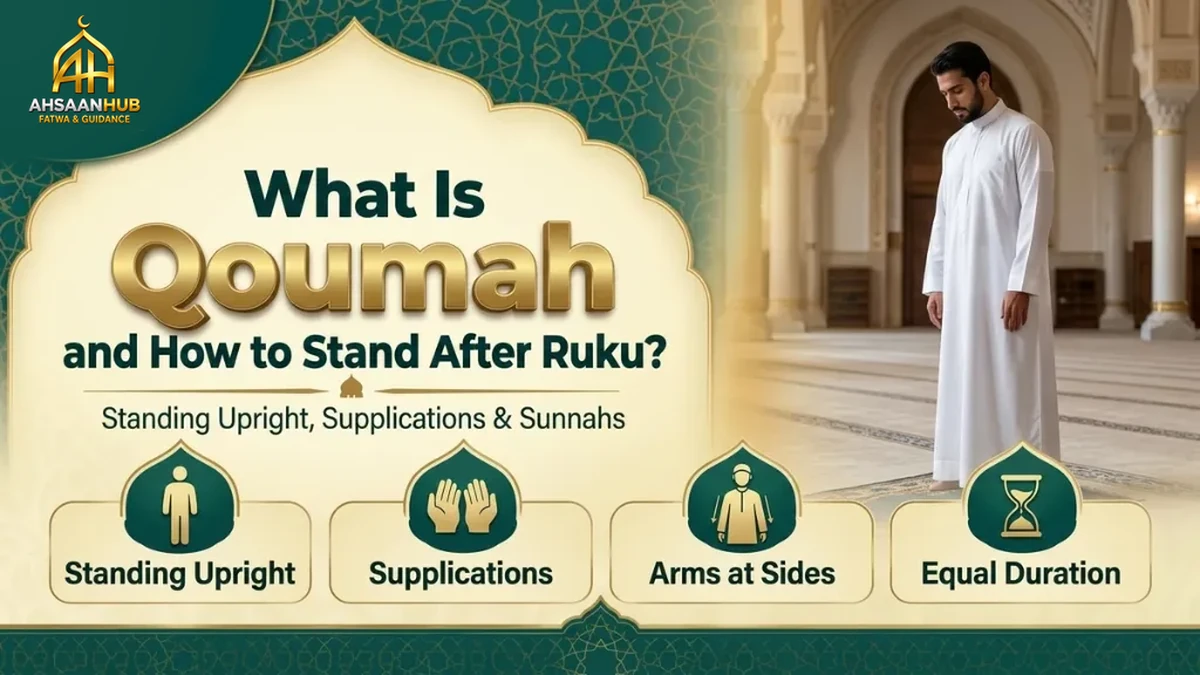
After completing Ruku, the act of standing upright before going into prostration is known as Qoumah.
During Qoumah, one must stand with complete composure and tranquility (Itminan).
Just as in Ruku, a person must stand completely still and fully straighten the back.
It is invalid to merely lift the head slightly and drop immediately into Sujud. Standing straight and reciting the prescribed supplications with composure is an essential part of Salah.
(Sunan Abi Dawud: 855, Jami’ al-Tirmidhi: 265)
What do you say when standing up from Ruku?
After saying “Sami’allahu liman hamidah” while rising from Ruku, several authentic supplications have been narrated from the Prophet (PBUH) to be recited while standing:
The first supplication after Ruku:
“رَبَّنَا لَكَ الْحَمْدُ”
Rabbana laka al-hamd.
Our Lord, to You belongs all praise.
(Sahih al-Bukhari: 789)
The second supplication after Ruku:
“رَبَّنَا وَلَكَ الْحَمْدُ”
Rabbana wa laka al-hamd.
Our Lord, and to You belongs all praise.
(Sahih al-Bukhari: 795)
The third supplication after Ruku:
“اللَّهُمَّ رَبَّنَا لَكَ الْحَمْدُ”
Allahumma Rabbana laka al-hamd.
O Allah, our Lord, to You belongs all praise.
(Sahih al-Bukhari: 796)
The fourth supplication after Ruku:
“اللَّهُمَّ رَبَّنَا وَلَكَ الْحَمْدُ”
Allahumma Rabbana wa laka al-hamd.
O Allah, our Lord, and to You belongs all praise.
(Sahih al-Bukhari: 795)
The fifth supplication after Ruku:
“رَبَّنَا وَلَكَ الْحَمْدُ حَمْدًا كَثِيرًا طَيِّبًا مُبَارَكًا فِيهِ”
Rabbana wa laka al-hamd, hamdan kathiran tayyiban mubarakan fih.
Our Lord, and to You belongs all praise, abundant, good, and blessed praise.
(Sahih al-Bukhari: 799)
The sixth supplication after Ruku:
“اللَّهُمَّ رَبَّنَا لَكَ الْحَمْدُ مِلْءَ السَّمَاوَاتِ وَمِلْءَ الْأَرْضِ وَمِلْءَ مَا بَيْنَهُمَا وَمِلْءَ مَا شِئْتَ مِنْ شَيْءٍ بَعْدُ”
Allahumma Rabbana laka al-hamd, mil’as-samawati wa mil’al-ardi wa mil’a ma baynahuma wa mil’a ma shi’ta min shay’in ba’d.
O Allah, our Lord, to You belongs all praise, filling the heavens, filling the earth, filling whatever is between them, and filling whatever else You will thereafter.
(Sahih Muslim: 476)
The seventh supplication after Ruku:
“رَبَّنَا لَكَ الْحَمْدُ مِلْءَ السَّمَاوَاتِ وَمِلْءَ الْأَرْضِ وَمِلْءَ مَا شِئْتَ مِنْ شَيْءٍ بَعْدُ، أَهْلَ الثَّنَاءِ وَالْمَجْدِ، أَحَقُّ مَا قَالَ الْعَبْدُ، وَكُلُّنَا لَكَ عَبْدٌ، اللَّهُمَّ لَا مَانِعَ لِمَا أَعْطَيْتَ، وَلَا مُعْطِيَ لِمَا مَنَعْتَ، وَلَا يَنْفَعُ ذَا الْجَدِّ مِنْكَ الْجَدُّ”
Rabbana laka al-hamd, mil’as-samawati wa mil’al-ardi wa mil’a ma shi’ta min shay’in ba’d, ahlat-thana’i wal-majd, ahaqqu ma qalal-‘abd, wa kulluna laka ‘abd. Allahumma la mani’a lima a’tayt, wa la mu’tiya lima mana’t, wa la yanfa’u dhal-jaddi minkal-jadd.
Our Lord, to You belongs praise filling the heavens, filling the earth, and filling whatever else You will thereafter.
You are the Lord of praise and glory, the truest words a servant can utter, and all of us are Your servants.
O Allah, none can withhold what You give, none can grant what You withhold, and no fortune can benefit the fortunate against Your will.
(Sahih Muslim: 477)
All of these supplications are authentically established from the Prophet (PBUH), and any of them may be recited during Qoumah.
Do Both the Imam and the Follower Say Sami’allahu Liman Hamidah?
Both the Imam and the person following the Imam (Muqtadi), as well as someone praying alone, may recite both “Sami’allahu liman hamidah” and “Rabbana laka al-hamd.”
It is an inaccurate distinction to say that the Imam only recites “Sami’allahu liman hamidah” while the followers only recite “Rabbana laka al-hamd.”
In the narration addressing this, the purpose is simply to explain the order: “Sami’allahu liman hamidah” is said first, followed by “Rabbana laka al-hamd.”
Both statements are established from the Prophet (PBUH) while leading the prayer, and he taught the prayer without separating these roles between the Imam and the congregation. Therefore, both can recite both phrases without hesitation.
Should Hands Be Folded or Kept at the Sides After Ruku?
Regarding whether the hands should be refolded on the chest or left straight at the sides (Sadl) during Qoumah, the authentic Hadiths do not provide an explicit ruling specifying one over the other.
- Some scholars and worshippers fold their hands on the chest after rising from Ruku.
- Others leave their hands hanging naturally at their sides.
Both actions are permissible, and a person may choose whichever method they find easier, as neither is conclusively mandated over the other.
How Long Should the Standing After Ruku Be?
The duration of Qoumah should correspond to the duration of the other postures in prayer.
Bara’ ibn ‘Azib (RA) narrates:
The Ruku of the Prophet (PBUH), his Sujud, his sitting between the two prostrations, and his standing after Ruku were all nearly equal in duration.
(Sahih al-Bukhari: 792, Sahih Muslim: 471)
This means that if one performs a long Ruku, one should also remain standing in Qoumah for a similar duration, rather than rushing directly into prostration.
All of these core actions were performed with proportional balance and composure by the Prophet (PBUH).