How Should You Transition From Recitation to Ruku?
Once a person has completed the Quranic recitation and the standing posture (Qiyam)
is finished, the next step is to transition into Ruku.
The practical method for this transition is to pause briefly in silence after concluding the recitation.
For example, when concluding a Surah with the verse “wa lam yakun lahu kufuwan ahad,” do not join the word “ahad” directly with the Takbeer by saying “ahadAllahu Akbar.”
Instead, pause for a moment, and after a brief pause of a few seconds, say Allahu Akbar and proceed into Ruku.
Is It Sunnah to Raise Hands (Rafa Yadain) Before Ruku?
According to authentic Hadiths, when saying Allahu Akbar to go into Ruku, the hands should be raised to the level of the shoulders or the ears.
In the narration of Abdullah ibn Umar (RA), it is recorded that just as the Prophet (PBUH)
raised his hands while saying Allahu Akbar at the start of prayer, he also raised them
in the same manner when about to bow into Ruku.
(Sahih al-Bukhari: 735, Sahih Muslim: 390)
The narration of Malik ibn al-Huwayrith (RA) similarly states that the Prophet (PBUH) raised his hands to the level of his shoulders when saying Allahu Akbar at the beginning of the prayer, and likewise raised them when saying Allahu Akbar to go into Ruku.
(Sahih al-Bukhari: 737, Sahih Muslim: 391)
This action is known as Rafa Yadain, and it has been narrated by numerous Companions.
This practice remained consistent throughout the entire life of the Prophet (PBUH).
There is no authentic, clear narration indicating that he performed this action initially and later abandoned it.
This practice was never abrogated, and there exists no authentic narration showing it to be repealed.
Therefore, in the prayer of the Prophet (PBUH), the hands are raised to the level of the shoulders or ears both when bowing into Ruku and when rising from it.
What Is the Correct Posture for Ruku in Salah?
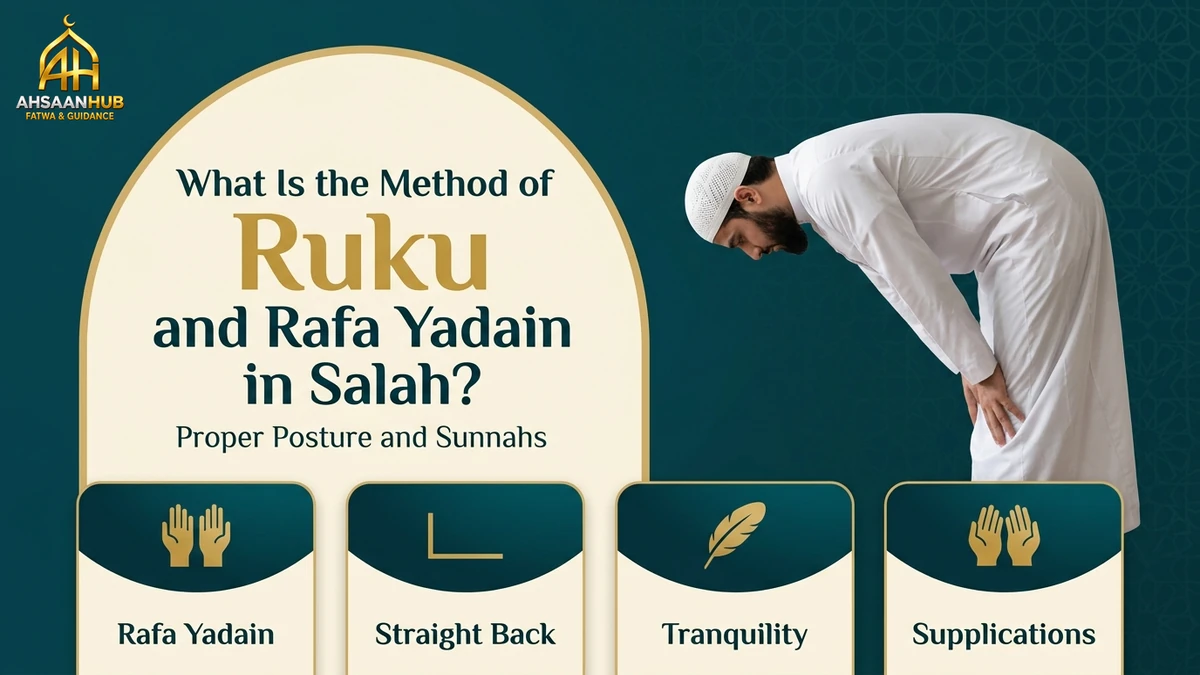
When saying Allahu Akbar and raising the hands to the level of the shoulders or ears, one should simultaneously bow into Ruku. While bowing into Ruku, keep the following essential points in mind:
- Grasping the knees: Bow in such a way that both hands firmly grasp the knees.
- Position of the fingers: The fingers of both hands should be kept spread apart on the knees during Ruku.
- Alignment of the back and head: The back and head should remain level with each other. The head should neither droop downward nor be tilted upward.
- Straightness of the arms: The arms supporting the posture should not be bent at the elbows, but held completely straight. The Prophet (PBUH) kept his arms as straight as a taut bowstring.
Abu Humayd al-Sa’idi (RA) described the prayer of the Prophet (PBUH):
When the Prophet (PBUH) went into Ruku, he placed both hands on his knees, spread his fingers, and made his back and head level.
He neither drooped his head nor raised it up. He held his knees firmly and kept his arms straight like a taut bowstring.
(Sunan Abi Dawud: 730–731, Sahih al-Bukhari: 828)
Is Tranquility (Itminan) Obligatory in Ruku?
Tranquility (Itminan) is an essential requirement in every action of Salah.
When going into Ruku, one must remain in that position with complete calm and composure.
In the narration of Rifa’ah ibn Rafi’ (RA), when the Prophet (PBUH) was teaching a man how to pray properly, he instructed him to maintain composure in Ruku until every joint rested properly in place.
(Sunan Abi Dawud: 857, Sahih al-Bukhari: 793)
Maintaining composure in Ruku is an integral part of Salah. Merely pecking down quickly like a crow is completely invalid; Ruku must be performed with calm and stillness.
Which Supplications Should Be Recited in Ruku?
After attaining tranquility in Ruku while fully bowed, the supplications of Ruku should be recited.
Several authentic supplications are established from the Prophet (PBUH):
The first supplication for Ruku:
The well-known supplication narrated by Imam Muslim to be recited in Ruku:
“سُبْحَانَ رَبِّيَ الْعَظِيمِ”
Subhana Rabbiyal-‘Azim.
Glory be to my Lord, the Most Magnificent.
(Sahih Muslim: 772, Sunan Abi Dawud: 871)
It is the Sunnah to recite this supplication three times, and one may recite it more frequently if desired.
The second supplication for Ruku:
In an agreed-upon narration, it is established that the Prophet (PBUH) recited this
supplication in both Ruku and Sujud:
“سُبْحَانَكَ اللَّهُمَّ رَبَّنَا وَبِحَمْدِكَ، اللَّهُمَّ اغْفِرْ لِي”
Subhanakallahumma Rabbana wa bihamdika, Allahummaghfir li.
Glory be to You, O Allah, our Lord, and praise be to You. O Allah, forgive me.
(Sahih al-Bukhari: 794, Sahih Muslim: 484a)
The third supplication for Ruku:
Narrated in Sahih Muslim:
“سُبُّوحٌ قُدُّوسٌ رَبُّ الْمَلَائِكَةِ وَالرُّوحِ”
Subbuhun Quddusun, Rabbul-mala’ikati war-Ruh.
Most Perfect, Most Holy, Lord of the angels and the Spirit.
(Sahih Muslim: 487a)
The fourth supplication for Ruku:
Narrated in Sunan Abi Dawud and Sunan an-Nasa’i:
“سُبْحَانَ ذِي الْجَبَرُوتِ وَالْمَلَكُوتِ وَالْكِبْرِيَاءِ وَالْعَظَمَةِ”
Subhana Dhil-jabaruti wal-malakuti wal-kibriya’i wal-‘azamah.
Glory be to the Possessor of all power, dominion, grandeur, and supreme majesty.
(Sunan Abi Dawud: 873, Sunan an-Nasa’i: 1049)
The fifth supplication for Ruku:
Narrated in Sahih Muslim:
“اللَّهُمَّ لَكَ رَكَعْتُ، وَبِكَ آمَنْتُ، وَلَكَ أَسْلَمْتُ، خَشَعَ لَكَ سَمْعِي، وَبَصَرِي، وَمُخِّي، وَعَظْمِي، وَعَصَبِي”
Allahumma laka raka’tu, wa bika amantu, wa laka aslamtu, khasha’a laka sam’i, wa basari, wa mukhkhi, wa ‘azmi, wa ‘asabi.
O Allah, to You I have bowed, in You I have believed, and to You I have submitted.
My hearing, my sight, my marrow, my bones, and my sinews are all humbled before You.
(Sahih Muslim: 771a)
All these supplications are authentic from the Prophet (PBUH), and any one of them may be recited.
None of these supplications have a prescribed number of repetitions except for “Subhana Rabbiyal-‘Azim.” The remaining supplications may be recited even once.
However, because tranquility in Ruku is required, reciting them multiple times is completely acceptable.
It is also not required to restrict the repetitions to an odd number such as three, five, or seven; one may recite them as many times as desired.
What Should You Say and Do While Rising From Ruku?
After reciting these supplications, one should rise from Ruku.
While rising from Ruku, recite:
“سَمِعَ اللَّهُ لِمَنْ حَمِدَهُ”
Sami’allahu liman hamidah.
Allah hears whoever praises Him.
(Sahih al-Bukhari: 735, Sahih Muslim: 390)
In the narration of Rifa’ah ibn Rafi’ (RA), it is mentioned that the Prophet (PBUH) recited “Sami’allahu liman hamidah” as he rose from Ruku until he stood completely upright.
When rising from Ruku and reciting this phrase, the Prophet (PBUH) raised his hands once again.
Malik ibn al-Huwayrith (RA) narrates that when the Prophet (PBUH) rose from Ruku and said “Sami’allahu liman hamidah,” he raised both hands in the same manner.
The hands should be raised to the level of the shoulders or ears after Ruku as well.
(Sahih al-Bukhari: 737, Sahih Muslim: 391)