Is Facing the Qibla Obligatory in Salah?
When beginning Salah, the first thing a person must do is turn towards the Qibla.
Allah the Almighty commands in the Quran
(Surah al-Baqarah: 144):
Turn your face towards the Sacred Mosque, and wherever you may be, turn your faces
towards it.
Abu Hurairah (RA) narrates that the Messenger of Allah (PBUH) said:
Hadith:
- When you stand for prayer, perform your Wudu thoroughly, then face the Qibla and say, Allahu Akbar.
- (Agreed upon: Sahih al-Bukhari: 6251 and Sahih Muslim: 397b)
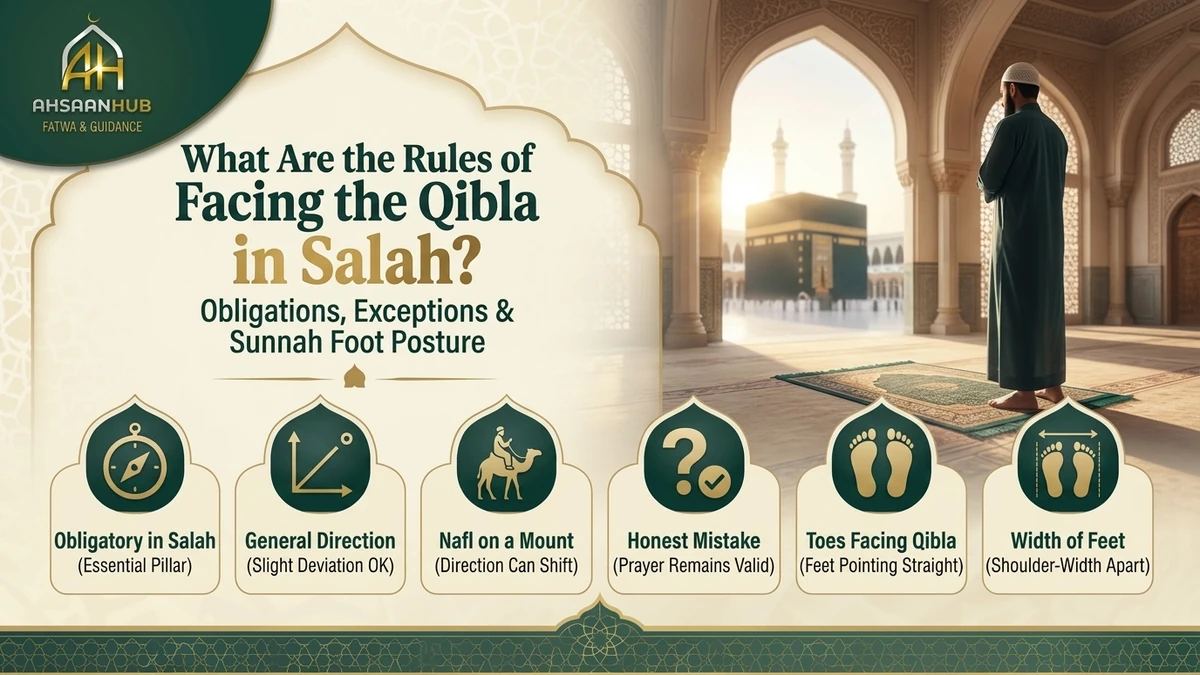
Facing the Qibla is therefore an essential, obligatory, and fundamental pillar of Salah.
This command has been given by Allah the Almighty as well as by the Prophet (PBUH).
What Does the Hadith “Between East and West Is the Qibla” Mean?
Abu Hurairah (RA) narrates that the Prophet (PBUH) said:
Hadith:
- Whatever is between the east and the west is the Qibla.
- (Sunan al-Tirmidhi: 342)
The meaning of this Hadith is as follows:
- When the Prophet (PBUH) was living in Madinah, which is located to the north of Makkah, the Qibla was to the south.
On this occasion, the Prophet (PBUH) explained to the people of Madinah that the direction falling between east and west constitutes the Qibla. - This means that while remaining within the general direction of the Qibla, if a person’s orientation shifts very slightly to one side or the other, it does not affect the validity
of the prayer.
What matters is maintaining the correct general direction. - Allah the Almighty also says: “Turn your faces towards it,” meaning towards that direction. The reason for this ease is that the Qibla may be thousands of miles away
from a person.
If someone standing thousands of miles away were even a single centimetre off to one side, by the time that line extends to the Ka’bah, the deviation would be enormous.
Therefore, Allah has not placed any undue hardship upon anyone. The command is simply to face the direction in which the Qibla lies.
Facing the direction of the Qibla in obligatory prayers is therefore mandatory, and
deliberately turning away from the Qibla during an obligatory prayer is not permissible.
Can Nafl Prayers Be Offered on a Ride Without Facing the Qibla?
It should be kept in mind that for voluntary (Nafl) prayers, as opposed to obligatory prayers, a person is granted the following concession:
- At the start of the prayer, the rider should turn the mount towards the Qibla and begin with the Takbir.
- After that, if the direction of the mount shifts away from the Qibla during the rest of
the prayer, the prayer remains perfectly valid, because the Prophet (PBUH) used to offer voluntary prayers while riding his mount.
Anas (RA) narrates:
Hadith:
- When the Messenger of Allah (PBUH) was travelling and wished to offer a
voluntary prayer, he would turn his camel towards the Qibla and say the Takbir.
He would then continue praying in whichever direction his mount turned. - (Sunan Abi Dawud: 1225)
This establishes that voluntary prayers may be offered while travelling on a mount.
It is sufficient to face the Qibla at the beginning, and there is no harm if the direction changes afterwards.
What If You Pray in the Wrong Direction by Mistake?
If a person is at a location where they do not know the direction of the Qibla:
- They should make every effort to determine the correct direction by asking others, investigating, and doing their best.
- If after completing the prayer they discover that the Qibla was actually in a different direction, their prayer is still accepted and considered fulfilled.
- Because the person made a genuine and sincere effort to determine the direction, the prayer is completely valid and does not need to be repeated (Sahih al-Bukhari: 403).
- This principle is grounded in the Sunnah: when the Companions at Masjid Quba were informed mid-prayer that the Qibla had changed towards the Ka’bah, they adjusted their direction immediately without repeating what they had already offered.
Imam al-Bukhari titled a dedicated chapter on this narration, affirming that one who prays in the wrong direction by mistake does not need to repeat the prayer. - However, deliberately turning away from the Qibla during an obligatory prayer is not permissible.
How Should the Feet and Toes Be Positioned Towards the Qibla?
Regarding facing the Qibla, it is also important to understand that just as a person turns their face towards the Qibla, they should also make an effort to keep both feet pointing straight towards the Qibla.
- Directing toes to the Qibla: The Sunnah practice of facing the toes towards the Qibla is explicitly established in the detailed description of the Prophet’s (PBUH) prayer narrated by Abu Humayd al-Sa’idi (RA) (Sahih al-Bukhari: 828).
- Proper alignment: Jurists explain that the feet should be kept naturally straight so that the toes point directly towards the Qibla, rather than turning the heels inward and splaying the toes outward.
How Far Apart Should the Feet Be in Salah?
When standing for Salah, classical scholars and contemporary jurists recommend a balanced, natural stance based on sound Sunnah principles:
- Congregational row alignment: In congregational prayer (Jama’ah), the Companions would align their feet and shoulders together to straighten the rows
(Sahih al-Bukhari: 725). - Avoid extremes: The feet should neither be pressed tightly together nor spread excessively wider than the shoulders.
- The balanced Sunnah stance: For individual prayer, the feet should be opened moderately to roughly match the width of the shoulders, with the toes pointing straight towards the Qibla, maintaining natural stability and Khushu’ (humility).