Is Niyyah Obligatory Before Starting Salah?
When a person stands to pray and turns to face the Qibla, the first thing they must do is
make their intention (Niyyah).
The Prophet (PBUH) said:
Hadith:
- All actions are judged by their intentions (Sahih al-Bukhari: 1; Sahih Muslim: 1907a).
If there is an intention, the act is valid. If there is no intention, the act has no standing.
Before Salah as well, a person must form the intention that they are about to offer prayer.
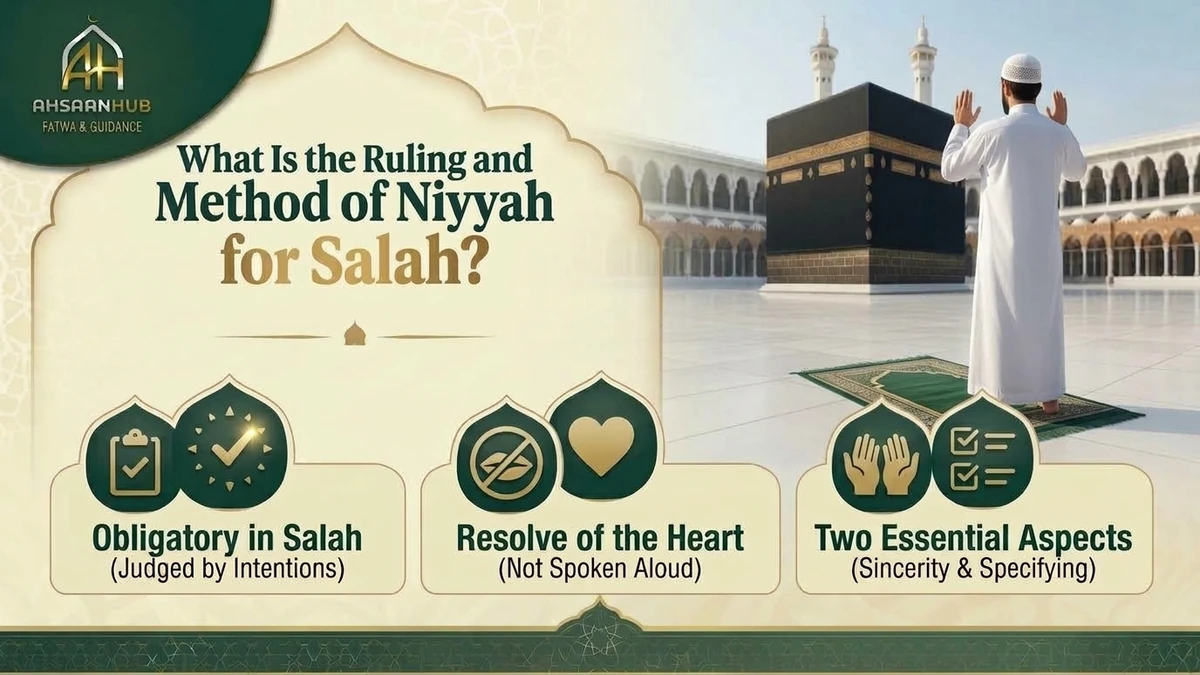
Should the Niyyah for Salah Be Spoken Aloud?
There are no specific words that must be uttered on the tongue for the intention.
It is not required to verbally announce to Allah that one is praying a particular prayer, at a particular place, facing the Qibla.
Speaking any such words aloud is not established from the Prophet (PBUH).
Simply resolving in the heart that one is praying for the sake of Allah is what constitutes Niyyah. Niyyah is “Iradat al-Qalb,” meaning the resolve of the heart.
That alone is the intention.
If a person utters words on the tongue, they are adding something to the act of worship that
is not established from the Prophet (PBUH), and there is a concern that this practice may lead to innovation (Bid’ah) (Sahih al-Bukhari: 2697; Sahih Muslim: 1718a).
Therefore, the intention should be made purely in the heart: that I am offering this prayer.
This internal resolve alone is what Niyyah means.
What Are the Two Essential Aspects of Niyyah in Salah?
Two fundamental aspects must be kept in mind when forming the intention for Salah:
The first aspect (Ikhlas / Sincerity): A person must firmly resolve in their intention that they are praying this Salah purely for the sake of Allah the Almighty.
The purpose is not to show off to anyone or to gain any worldly benefit.
The prayer is not being offered to please any other person, but solely to fulfil the command
of Allah.
This quality is called Ikhlas (sincerity) (Surah al-Bayyinah: 5).
The second aspect (Specifying the prayer): A person must also clarify in their mind which prayer they are about to offer.
They should consciously think about whether they are praying an obligatory (Fard) prayer or a voluntary (Sunnah or Nafl) prayer.
Similarly, they must identify which specific prayer it is: Fajr, Dhuhr, Asr, Maghrib, or Isha.
Specifying the prayer is essential because outwardly the method of all prayers appears identical.
The distinction between them is created solely through the intention.
Therefore, it is necessary to differentiate in the Niyyah which prayer is being offered and whether it is obligatory or voluntary.
This distinction must be made through the intention.