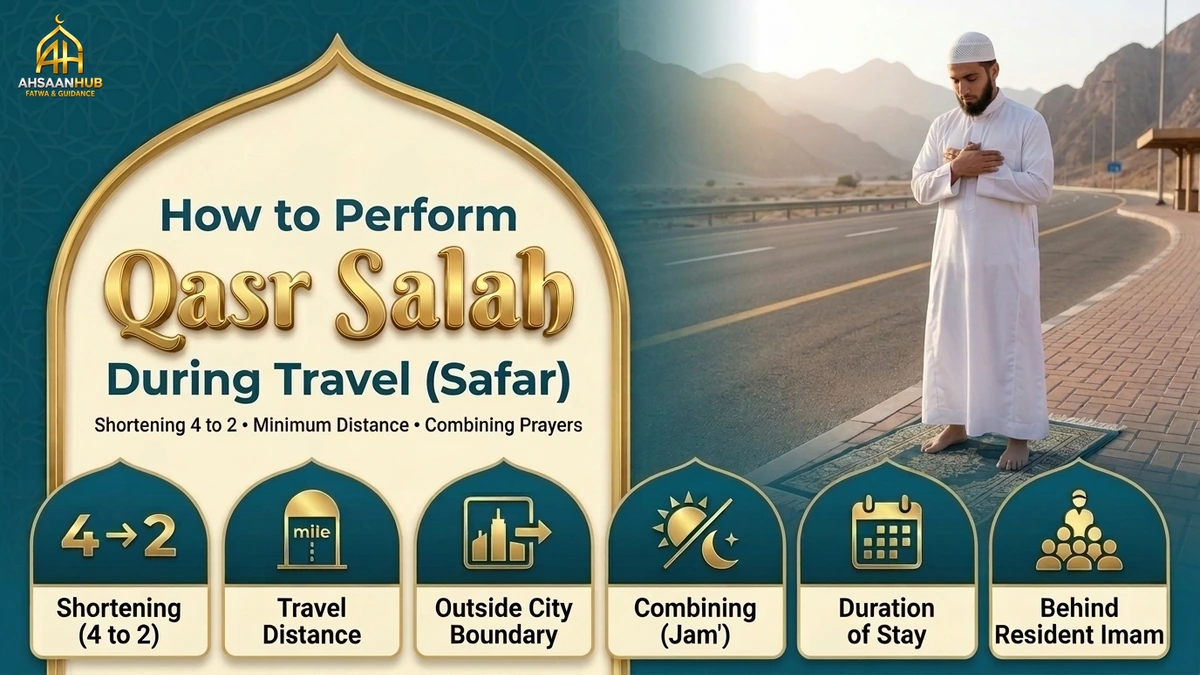
What Are the Rules for Praying Qasr?
Allah (SWT) has granted ease and concession to the person who is travelling. In Surah al-Nisa, Allah (SWT) says:
“وَإِذَا ضَرَبْتُمْ فِي الْأَرْضِ فَلَيْسَ عَلَيْكُمْ جُنَاحٌ أَن تَقْصُرُوا مِنَ الصَّلَاةِ”
Wa idha darabtum fil-ardi fa-laysa ‘alaykum junahun an taqsuru minas-salah.
And when you travel through the land, there is no blame upon you for shortening the prayer.
(Surah an-Nisa 4:101)
The method of Qasr is as follows:
| Prayer | Full Rak’ahs | Qasr Rak’ahs |
|---|---|---|
| Dhuhr | 4 Fard | 2 Fard |
| Asr | 4 Fard | 2 Fard |
| Isha | 4 Fard | 2 Fard |
| Maghrib | 3 Fard | No Qasr; prayed in full |
| Fajr | 2 Fard | No Qasr; prayed in full |
As for the Sunnah Mu’akkadah prayers during travel, it is better to leave them, though there is no harm if they are prayed on occasion.
However, the Witr prayer is one that the Prophet (PBUH) would regularly perform even during travel, and he (PBUH) was also consistent in praying the two Sunnah of Fajr during his journeys.
(Sahih al-Bukhari: 1000; Sahih al-Bukhari: 1103)
What is the minimum distance for qasr prayer?
During travel, the concession of Qasr begins from the moment a person exits the boundaries of his own city.
The following words are narrated from the Prophet (PBUH):
“إِذَا خَرَجَ مِنَ الْمَدِينَةِ”
Idha kharaja minal-madinah.
When he (PBUH) left Madinah, meaning it was only after departing from
Madinah al-Munawwarah that the Prophet (PBUH) would shorten his prayer.
(Sahih al-Bukhari: 1089)
Performing Qasr while still within the city of Madinah is not established from the Prophet (PBUH).
Therefore, even if a person travels for five hours entirely within his own city, no matter how large it may be, he cannot pray Qasr within its boundaries.
Qasr begins only after he exits the city with the intention of travelling a distance that can be considered a journey.
As for the minimum distance that makes Qasr permissible, there is considerable disagreement among scholars.
A narration that can be relied upon mentions that the Prophet (PBUH) would shorten his prayer when travelling three miles or three Farsakhs, the uncertainty between these two figures being due to the narrator’s doubt.
(Sahih Muslim: 691)
The calculation is as follows:
- One Farsakh equals three miles, and three Farsakhs therefore equal nine miles.
- One mile is approximately 1,600 metres.
- On this basis, three Farsakhs (nine miles) equal approximately 14.5 to 15 kilometres.
Therefore, when a person intends to travel approximately 15 kilometres or more, he may begin performing Qasr upon leaving his city.
However, Shariah has not fixed a definitive, precise limit for this, and many scholarly opinions exist.
The correct and concise position is that whatever journey can genuinely be called a safar (travel) in common understanding, Qasr is permissible for it.
For How Many Days Can You Pray Qasr?
It should also be understood how many days a person may continue to pray Qasr at his destination:
- If a person has arrived at his destination and does not plan to return soon, meaning the stay is long, even if the number of days has not been fixed, he should begin praying the full prayer from the very first day.
- If a person intends to return soon and the situation is uncertain, not knowing whether work will finish today, tomorrow, or the day after, then fixing a specific number of days is difficult, and he may continue to pray Qasr.
From the Hadiths, it is established that the Prophet (PBUH) spent 20 days in Tabuk while continuing to pray Qasr throughout, and spent 17, 18, or 19 days in
Makkah al-Mukarramah also praying Qasr throughout.
(For Tabuk: Sunan Abi Dawud: 1235; for Makkah: Sahih al-Bukhari: 1080; Sahih al-Bukhari: 4298)
No fixed number of days can therefore be declared as the limit.
These narrations of the Prophet (PBUH) themselves serve as the basis.
The sound conclusion in this Matter is that as long as a person genuinely considers himself a traveller, he is permitted to pray Qasr, and once he considers himself settled as a resident, he should return to praying the full prayer.
Which Prayers Can Be Combined When Traveling?
Another concession established by the Prophet (PBUH) during travel is that a person may combine two prayers and offer them together at one time, combining Dhuhr and Asr, and similarly combining Maghrib and Isha.
A Companion narrates in Sahih Muslim:
“فَكَانَ يَجْمَعُ بَيْنَ الظُّهْرِ وَالْعَصْرِ، وَالْمَغْرِبِ وَالْعِشَاءِ”
Fa-kana yajma’u baynaz-zuhri wal-‘asr, wal-maghribi wal-‘isha’.
We set out on a journey with the Messenger of Allah (PBUH), and he would combine Dhuhr with Asr, and Maghrib with Isha during travel.
(Sahih Muslim: 706a)
Therefore, during travel, a person has been granted permission by the Messenger of Allah (PBUH) to combine within the time spans of the two respective prayers:
- Dhuhr and Asr may be prayed together, either bringing Asr forward to Dhuhr’s time or delaying Dhuhr to Asr’s time.
- Maghrib and Isha may be prayed together, either bringing Isha forward to Maghrib’s time or delaying Maghrib to Isha’s time.
Can You Pray Qasr Behind a Resident Imam?
Among the rulings of travel prayer, this point should also be remembered: if a travelling person prays in congregation behind a resident (Muqim) Imam, he does not perform Qasr.
In this case, he must pray the full prayer, four Rak’ahs together with the Imam.
(Sahih Muslim: 688a; Sunan an-Nasa’i: 1444; Musnad Ahmad: 1862)
May Allah grant us all the proper understanding of these rulings and the ability to act upon them. Ameen.