What Are the Benefits of Praying in the Mosque, and How Should You Enter?
The Prophet (PBUH) has described great virtue for praying in congregation. When a person leaves his home and walks to the mosque to offer prayer, this prayer carries far greater reward and merit than one offered alone at home.
(Sahih al-Bukhari: 645; Sahih Muslim: 650)
When going to the mosque for prayer, one should walk with full calmness and dignity.
There should be no rushing or hurrying; rather, one should arrive at the mosque with tranquillity and composure.
(Sahih al-Bukhari: 636; Sahih Muslim: 602)
Upon entering the mosque, the Sunnah is to step in with the right foot first and to recite the established supplication for entering:
“بِسْمِ اللَّهِ، وَالصَّلَاةُ وَالسَّلَامُ عَلَىٰ رَسُولِ اللَّهِ، اللَّهُمَّ افْتَحْ لِي أَبْوَابَ رَحْمَتِكَ”
Bismillah, was-salatu was-salamu ‘ala Rasulillah, Allahumma-ftah li abwaba rahmatik.
In the name of Allah, and peace and blessings be upon the Messenger of Allah.
O Allah, open for me the doors of Your mercy.
(Sahih Muslim: 713; Sunan Abi Dawud: 465; Sunan Ibn Majah: 771)
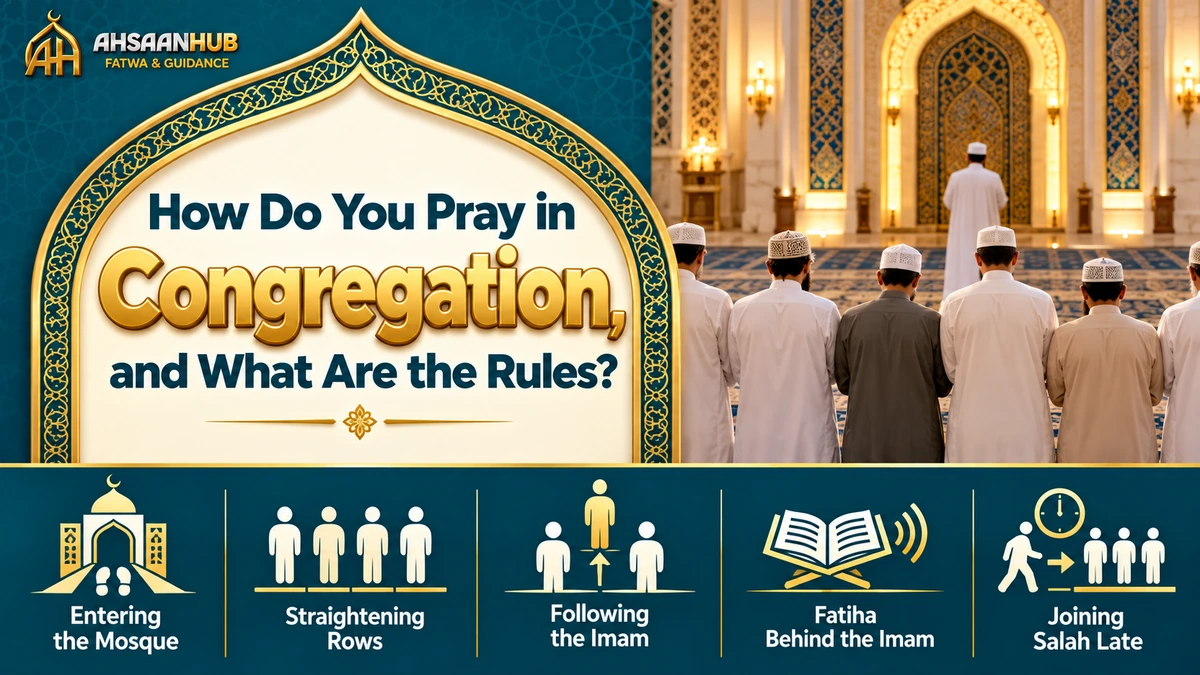
How to Straighten Rows in Salah?
Upon arriving at the mosque and standing for the congregational prayer, special care must be given to the straightening of the rows.
Within the row, every worshipper’s shoulder must be touching the shoulder of the next person, and feet must be touching feet. All feet should face the Qiblah exactly, aligned level with one another.
(Sahih al-Bukhari: 725)
Anas (RA) narrates that the Messenger of Allah (PBUH) said:
“سَوُّوا صُفُوفَكُمْ فَإِنَّ تَسْوِيَةَ الصُّفُوفِ مِنْ تَمَامِ الصَّلَاةِ”
Sawwu sufufakum, fa-inna taswiyatas-sufufi min tamami-s-salah.
Straighten your rows, for straightening the rows is part of the completion of prayer (and in Bukhari: “from the perfection of prayer”).
(Sahih Muslim: 433; Sahih al-Bukhari: 723)
In another narration, the Prophet (PBUH) said:
“رُصُّوا صُفُوفَكُمْ، وَقَارِبُوا بَيْنَهَا، وَحَاذُوا بِالأَعْنَاقِ، فَوَالَّذِي نَفْسِي بِيَدِهِ إِنِّي لَأَرَى الشَّيْطَانَ يَدْخُلُ مِنْ خَلَلِ الصَّفِّ كَأَنَّهَا الْحَذَفُ”
Russu sufufakum, wa qaribu baynaha, wa hadu bil-a’naq.Fawalladhi nafsi bi-yadihi inni la-ara ash-shaytana yadkhulu min khalalis-saffi ka-annahul-hazaf.
Close your rows together, draw near to one another, and align your necks.
By the One in whose hand is my soul, I see Shaytan entering through the gaps in the row like a small black sheep (Hazaf).
(Sunan Abi Dawud: 667; Sunan an-Nasa’i: 815)
Shoulders must be kept level, and feet must be kept joined together.
Only after the row has been properly straightened should the prayer behind the Imam begin.
This ruling for straightening the rows applies equally to men and to women praying in congregation in their designated areas; they too must align their rows, standing foot to foot and shoulder to shoulder.
How to Follow the Imam in Salah?
Once a worshipper enters the prayer behind the Imam, complete obedience to the Imam becomes obligatory. It is established from the Prophet (PBUH) that the Imam is appointed so that he is fully followed:
(Sahih al-Bukhari: 689; Sahih Muslim: 411)
- When the Imam says Allahu Akbar, the Muqtadi should also say Allahu Akbar immediately after.
- When the Imam goes into Ruku, the Muqtadi should follow into Ruku right after.
- When the Imam rises from Ruku, the Muqtadi should rise right after.
While the Muqtadi should move immediately after the Imam, one must be extremely careful never to move ahead of the Imam, for a severe warning has been narrated from the Messenger of Allah (PBUH) against this.
Abu Hurairah (RA) narrates that the Messenger of Allah (PBUH) said: the person who lifts his head before the Imam should fear that Allah may transform his face into the face of a donkey, or make his head the head of a donkey.
(Sahih al-Bukhari: 691; Sahih Muslim: 427)
Therefore, one must never precede the Imam in any posture of the prayer. The correct method is:
- When the Imam goes into Ruku and bends fully, only then should the Muqtadi behind begin to bow into Ruku.
- When the Imam says Sami’allahu liman hamidah and stands upright, only then should the Muqtadi begin to rise.
- When the Imam says Allahu Akbar and goes fully into Sajdah, only then should those behind go into Sajdah.
- When the Imam says Allahu Akbar, rises from Sajdah, and sits composedly, only then should the Muqtadi rise and sit.
This is the correct and Sunnah method of following the Imam in accordance with the established practice of the Messenger of Allah (PBUH).
What Are the Rules for Recitation in Loud and Silent Prayers?
Among the five prayers, three Maghrib, Isha, and Fajr are such that when prayed in congregation behind an Imam, the Imam recites aloud (Jahri recitation), meaning
Surah al-Fatihah and the additional Surah are read in a raised voice.
When a Muqtadi is praying behind the Imam, reciting Surah al-Fatihah remains compulsory for him in every Rak’ah, because prayer is not valid without Surah al-Fatihah.
(Sahih al-Bukhari: 756; Sahih Muslim: 394a)
However, in those Rak’ahs where the Imam is reciting aloud, the Muqtadi should recite Surah al-Fatihah quietly behind the Imam.
As for the silent prayers Dhuhr and Asr, the Imam recites quietly in these.
However, if on occasion the Imam reads one word, half a verse, or a full verse in a slightly raised voice in order to teach the congregation or to let them know what is being recited, there is no harm in that, as this practice is established from the Messenger of Allah (PBUH).
(Sahih al-Bukhari: 759; Sahih Muslim: 451)
What Should You Do If You Join Salah Late?
If the Imam has already begun the prayer and a person arrives wishing to join the congregation, the Sunnah method is to proceed with calmness and dignity,
stand straight in the row, say Takbeer al-Tahrimah (Allahu Akbar), and immediately join whichever posture the Imam is currently in:
(Sahih al-Bukhari: 636)
- If the Imam is in Ruku: the latecomer stands straight in the row, says Allahu Akbar, and goes directly into Ruku.
- If the Imam is in Sajdah: the latecomer stands straight, says Allahu Akbar to enter the prayer, and then goes directly into Sajdah without folding the hands because he must join from wherever the Imam has reached.
- If the Imam is seated in Tashahhud, the latecomer sits down and joins the Imam in that position.
Whichever posture the Imam is in, the prayer is begun from that point. The Rak’ahs completed alongside the Imam are counted, and the remaining Rak’ahs are made up afterward.
For example, if a person prayed two Rak’ahs with the Imam and two Rak’ahs remain, he stays seated after the Imam completes those two.
When the Imam finishes and gives both Salams fully, As-salamu ‘alaykum wa rahmatullah, As-salamu ‘alaykum wa rahmatullah, only then does the latecomer stand to complete his remaining Rak’ahs.
The Rak’ah he begins after standing will count as his third Rak’ah.
He then prays his fourth Rak’ah, and at the end he sits in the final Tashahhud, recites Durood and the supplications, and gives Salam.
This is the method by which the latecomer should complete his remaining prayer.
May Allah grant us all the proper understanding of these rulings of Salah and the ability to act upon them. Ameen.