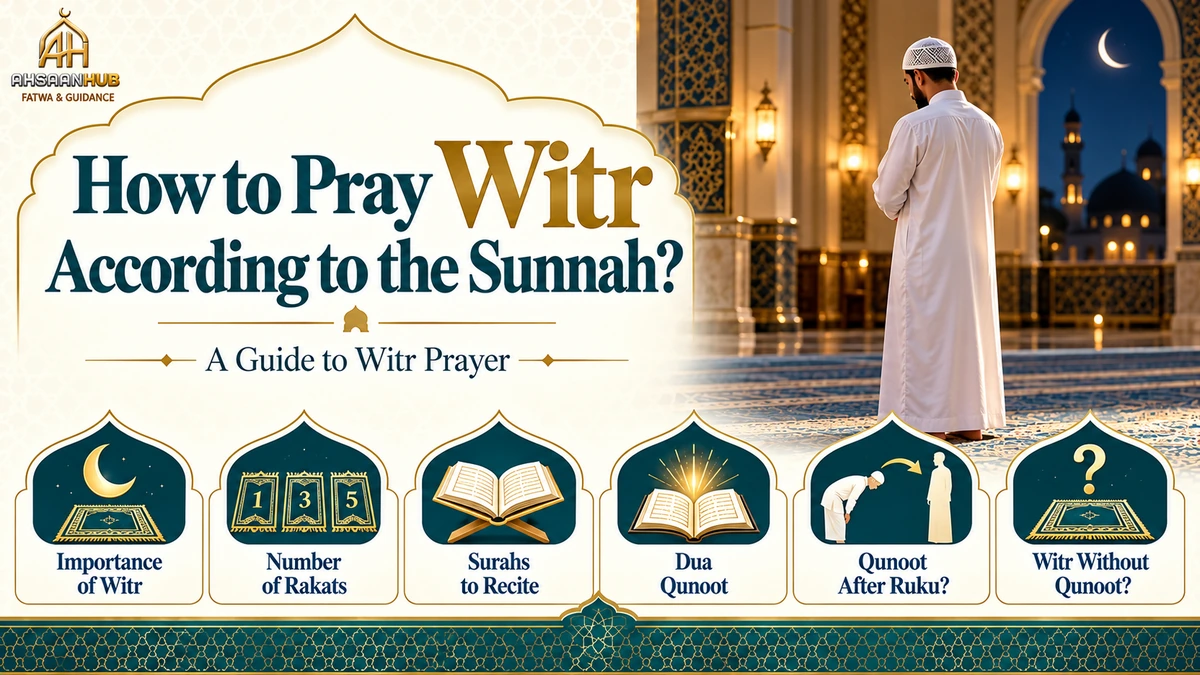
What Is the Status and Importance of Witr Prayer?
Among the prayers beyond the obligatory Fard, one is called the Witr prayer. It may be performed from after the Fard of Isha all the way until the Adhan of Fajr.
It should be kept in mind that Witr is not a compulsory part of the Isha prayer. It is, in reality, a part of the night prayer, that is, Tahajjud.
It is commonly prayed right after Isha so that it is not missed due to its great importance. However, the original and preferred practice is that the later Witr is delayed, the better it is.
Witr prayer is not among the Fard prayers; rather, it is among the firmly established Sunnah (Sunnah Mu’akkadah) of the Prophet (PBUH).
Yet its emphasis is so strong that the Prophet (PBUH) never abandoned it, whether he was travelling or at home. The Messenger of Allah (PBUH) said regarding Witr:
“اجْعَلُوا آخِرَ صَلَاتِكُم بِاللَّيْلِ وِتْرًا”
Ij’alu akhira salatikum bil-layli witran.
Make Witr your last prayer of the night.
(Sahih al-Bukhari: 998; Sahih Muslim: 751)
Therefore, a person should strive to make Witr the last prayer before sleeping.
If one regularly wakes for Tahajjud and voluntary night prayers, Witr should be made the last prayer of the night before Fajr.
Jabir (RA) narrates that the Messenger of Allah (PBUH) said: whoever fears that he will not be able to wake up in the latter part of the night, let him pray Witr at the beginning of the night. And whoever is hopeful and eager that he will wake in the last portion of the night, let him pray Witr at the end of the night.
(Sahih Muslim: 755)
How Many Rak’ahs Are in the Witr Prayer?
The minimum number of Rak’ahs for Witr is one. From the Prophet (PBUH), praying Witr in one, three, five, seven, nine, and eleven Rak’ahs is all authentically established.
| Number of Rak’ahs | Status in Sunnah |
|---|---|
| 1 | ✓ Minimum Valid Witr |
| 3 | ✓ Authentically Established (Most Common) |
| 5 | ✓ Authentically Established |
| 7 | ✓ Authentically Established |
| 9 | ✓ Authentically Established |
| 11 | ✓ Authentically Established |
For three, five, seven, or nine Rak’ahs, the following Sunnah methods apply:
- Method for Three Rak’ahs: The preferred way is to pray two Rak’ahs and give Salam, then pray one Rak’ah separately.
If one wishes to pray all three together under a single Salam, that is also permissible, but on the condition that there is no middle Tashahhud after the second Rak’ah.
After the second Sajdah, one stands directly for the third Rak’ah, and Tashahhud is only observed at the very end of the third Rak’ah.
- Method for Five, Seven, or Nine Rak’ahs: One method is to pray two Rak’ahs at a time with a separate Salam after each pair, and then pray one final Rak’ah alone at the end.
The other method is to pray all the Rak’ahs continuously, sitting in Tashahhud only once, either before the final Rak’ah or only at the very end, and then give Salam.
Abu Hurairah (RA) narrates that the Messenger of Allah (PBUH) said:
“لَا تُوتِرُوا بِثَلَاثٍ تُشَبِّهُوا بِصَلَاةِ الْمَغْرِبِ”
La tūtiru bi-thalāthin tushabbihu bi-salatil-maghrib.
Do not pray Witr as three Rak’ahs in a way that makes it resemble the Maghrib prayer.
(Al-Mustadrak ‘ala al-Sahihayn: 1139; As-Sunan al-Kubra by al-Bayhaqi: 3/31)
Therefore, to avoid resembling Maghrib, the three Rak’ahs of Witr should not be performed with two Tashahhuds like Maghrib.
The better option is to pray two Rak’ahs with Salam and then one Rak’ah separately, or to pray all three continuously with a single Tashahhud at the end only.
Which Surahs Should Be Recited in Witr Prayer?
Imam al-Tirmidhi and Imam an-Nasa’i have narrated from Ibn Abbas (RA) the established Sunnah recitation for the three Rak’ahs of Witr:
- First Rak’ah: Recite Surah al-A’la (Sabbih-isma Rabbik-al-A’la) after Surah al-Fatihah
- Second Rak’ah: Recite Surah al-Kafirun (Qul ya ayyuhal-kafirun) after Surah al-Fatihah
- Third Rak’ah: Recite Surah al-Ikhlas (Qul Huwallahu Ahad), or Surah al-Ikhlas together with Surah al-Falaq and Surah an-Nas
(Jami’ al-Tirmidhi: 462; Sunan an-Nasa’i: 1729)
If a person recites other Surahs instead, there is no harm in that and the prayer is completely valid.
What Is Dua Qunoot and How Should It Be Recited?
In the final Rak’ah of Witr, after completing the recitation and before going into Ruku, it is established from the Prophet (PBUH) and the Sahabah to recite Dua Qunoot.
1. The Supplication Taught by the Prophet (PBUH):
Al-Hasan ibn Ali (RA) said: The Messenger of Allah (PBUH) taught me these words to recite in Witr:
“اللَّهُمَّ اهْدِنِي فِيمَنْ هَدَيْتَ، وَعَافِنِي فِيمَنْ عَافَيْتَ، وَتَوَلَّنِي فِيمَنْ تَوَلَّيْتَ، وَبَارِكْ لِي فِيمَا أَعْطَيْتَ، وَقِنِي شَرَّ مَا قَضَيْتَ، فَإِنَّكَ تَقْضِي وَلَا يُقْضَىٰ عَلَيْكَ، وَإِنَّهُ لَا يَذِلُّ مَنْ وَالَيْتَ، وَلَا يَعِزُّ مَنْ عَادَيْتَ، تَبَارَكْتَ رَبَّنَا وَتَعَالَيْتَ”
Allahumma-hdini fiman hadayt, wa ‘afini fiman ‘afayt, wa tawallani fiman tawallayt, wa barik li fima a’tayt, wa qini sharra ma qadayt, fa-innaka taqdi wa la yuqda ‘alayk, wa innahu la yadhillu man walayt, wa la ya’izzu man ‘adayt, tabarakta Rabbana wa ta’alayt.
O Allah, guide me among those whom You have guided, grant me well-being among those whom You have granted well-being, take me under Your care among those whom You have taken under Your care, bless for me what You have given me, and protect me from the evil of what You have decreed.
For indeed You decree and none can decree against You. He whom You befriend is never humiliated, and he whom You take as an enemy is never honoured. Blessed are You, our Lord, and Exalted.
(Sunan Abi Dawud: 1425; Jami’ al-Tirmidhi: 464; Sunan an-Nasa’i: 1745; Sunan Ibn Majah: 1178)
2. The Supplication Established from Umar ibn al-Khattab (RA) and the Companions:
It is also authentically narrated that Umar ibn al-Khattab (RA) and other Companions recited the following supplication in the Qunoot of Witr:
“اللَّهُمَّ إِنَّا نَسْتَعِينُكَ وَنَسْتَغْفِرُكَ، وَنُثْنِي عَلَيْكَ الْخَيْرَ وَلَا نَكْفُرُكَ، وَنُؤْمِنُ بِكَ وَنَخْضَعُ لَكَ، وَنَخْلَعُ مَنْ يَكْفُرُكَ. اللَّهُمَّ إِيَّاكَ نَعْبُدُ، وَلَكَ نُصَلِّي وَنَسْجُدُ، وَإِلَيْكَ نَسْعَى وَنَحْفِدُ، نَرْجُو رَحْمَتَكَ وَنَخْشَى عَذَابَكَ، إِنَّ عَذَابَكَ بِالْكَافِرِينَ مُلْحِقٌ”
Allahumma inna nasta’inuka wa nastaghfiruk, wa nuthni ‘alaykal-khayra wa la nakfuruk, wa nu’minu bika wa nakhda’u lak, wa nakhla’u man yakfuruk. Allahumma iyyaka na’bud, wa laka nusalli wa nasjud, wa ilayka nas’a wa nahfid, narju rahmataka wa nakhsha ‘adhabak, inna ‘adhabaka bil-kafirina mulhiq.
O Allah, we seek Your help and Your forgiveness, we praise You for all good and are not ungrateful to You, we believe in You and humble ourselves before You, and we disown and forsake whoever disbelieves in You. O Allah, You alone we worship, to You we pray and prostrate, towards You we strive and hasten, we hope for Your mercy and fear Your punishment; indeed, Your punishment will surely encompass the disbelievers.
(As-Sunan al-Kubra by al-Bayhaqi: 2/498; graded Sahih by al-Nawawi & al-Albani in Irwa’ al-Ghalil: 429)
Both supplications are authentic and widely recognized by Islamic scholars. A person may recite either of them, or combine them, in the Qunoot of Witr.
This dua is to be recited quietly and without raising the hands, immediately after the recitation. After completing it, one says Allahu Akbar with Rafa Yadain and proceeds into Ruku.
Can Dua Qunoot Be Recited After Ruku?
It is also permissible to make supplication while standing in Qawmah after the Ruku of the final Rak’ah.
However, when supplication is made after Ruku, it falls under the ruling of Qunoot al-Nazilah, the supplication offered during times of calamity, in which a person may ask for whatever they wish.
The authentic Sunnah Qunoot of Witr is the one recited before Ruku, as established from Ubayy ibn Ka’b (RA) and Abdullah ibn Mas’ud (RA), and that is what is more preferred and virtuous. Reciting it after Ruku is, however, also permissible.
Is Witr Prayer Valid Without Dua Qunoot?
If a person does not recite Dua Qunoot, his Witr prayer is still valid and complete. The Prophet (PBUH) recited this dua in his Witr at times and on other occasions did not recite it.
Even if a person intentionally omits it, his Witr prayer will be counted as correct according to the majority of scholars.
The word Witr itself means an odd number: 1, 3, 5, 7, 9, or 11. Therefore, praying an odd number of Rak’ahs fulfils the obligation of Witr regardless of whether the Qunoot is recited or not.
However, the better and more rewarding practice is to recite the Sunnah Dua Qunoot with consistency and care.
May Allah grant us all the understanding and ability to act upon the Sunnah of His Prophet (PBUH). Ameen.