When Is Sajdah Sahw Required in Salah?
If a person makes an omission or error during the performance of Salah, that deficiency is compensated at the end by performing two additional prostrations.
It should be clearly understood that if a person forgets something in the recitation, for example, he forgets a portion of a verse, or recites a supplication out of order, no Sajdah Sahw is required for that.
However, if a person forgets to recite Surah al-Fatihah entirely, that Rak’ah does not count at all, because Salah is not valid without Surah al-Fatihah.
(Sahih al-Bukhari: 756; Sahih Muslim: 394a)
Other than that, forgetting any supplication or dhikr may reduce the reward, but it does not necessitate Sajdah Sahw.
Sajdah Sahw is required when an error or omission occurs in the physical performance of the prayer itself, that is, in the actions and number of Rak’ahs as established from the Prophet (PBUH).
How Do You Perform Sajdah Sahw in Salah?
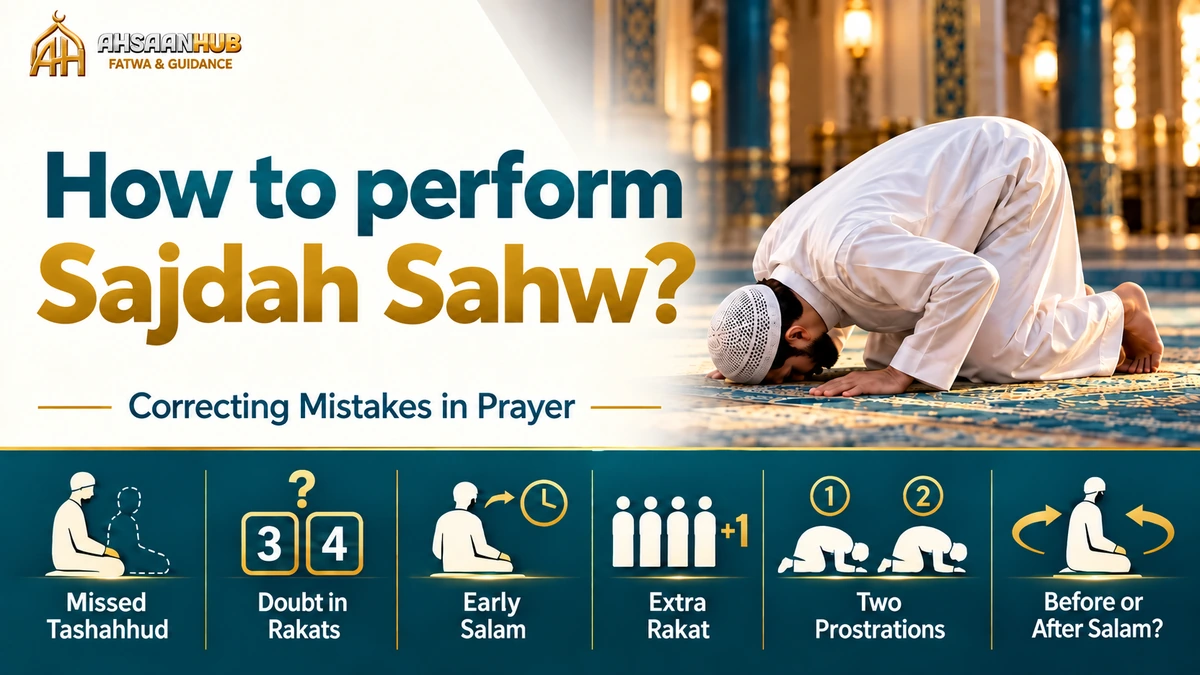
The method of Sajdah Sahw is as follows: when the prayer has been completed, and a person is seated in the final Tashahhud having recited Durood and the supplications with only the Salam remaining, two prostrations are performed before giving Salam:
- Say Allahu Akbar and perform the first Sajdah.
- Rise from the Sajdah and sit in a composed and calm manner.
- Then go into the second Sajdah.
- After the second Sajdah, give Salam.
This is the method of Sajdah Sahw established from the Prophet (PBUH).
(Sahih al-Bukhari: 829; Sahih Muslim: 570)
It is equally established and permissible to first give Salam to complete the prayer, and then perform the two prostrations separately after the Salam.
(Sahih al-Bukhari: 482; Sahih Muslim: 573; Sunan Abi Dawud: 1038)
What Are the Authentic Hadiths Regarding Sajdah Sahw?
Six distinct incidents are narrated from the Prophet (PBUH) in which he performed Sajdah Sahw on various occasions. A summary of these narrations is as follows:
- First Incident (Forgetting the Middle Tashahhud): The Prophet (PBUH) forgot the middle Tashahhud and stood directly for the third Rak’ah. At the end of the prayer, before giving Salam, he performed two prostrations while seated and then gave Salam.
(Sahih al-Bukhari: 829; Sahih Muslim: 570) - Second Incident (Doubt with a Predominant Belief): If a person has doubt about the number of Rak’ahs but has a predominant inclination toward what is correct, he should strive to base it upon what he believes to be correct, complete the prayer accordingly, give Salam, and then perform two prostrations after the Salam.
(Sahih al-Bukhari: 401; Sahih Muslim: 572) - Third Incident (Doubt with Equal Possibility): If doubt arises without certainty about whether one prayed three or four Rak’ahs, he should cast aside the doubt, build upon what is certain (the lesser number), complete the remaining prayer, and perform two prostrations before giving Salam.
(Sahih Muslim: 571; Sunan Abi Dawud: 1024) - Fourth Incident (Giving Salam After Two Rak’ahs in a Four-Rak’ah Prayer): The Prophet (PBUH) mistakenly gave Salam after only two Rak’ahs. When Dhul-Yadayn and the Companions reminded him, he stood up, completed the remaining two Rak’ahs, gave Salam, and then performed two prostrations after the Salam.
(Sahih al-Bukhari: 482; Sahih Muslim: 573) - Fifth Incident (Giving Salam After Three Rak’ahs in a Four-Rak’ah Prayer): The Prophet (PBUH) gave Salam after three Rak’ahs. When reminded by Imran bin Husain (RA), he stood up, completed the remaining one Rak’ah, gave Salam, and then performed two prostrations after the Salam, followed by another Salam.
(Sahih Muslim: 574) - Sixth Incident (Praying Five Rak’ahs in a Four-Rak’ah Prayer): On one occasion the Prophet (PBUH) prayed five Rak’ahs in a four-Rak’ah prayer. When informed afterward, he performed two prostrations while remaining seated after the Salam, and then gave Salam.
(Sahih al-Bukhari: 1226; Sahih Muslim: 572)
The essential ruling derived from all of these narrations is as follows:
- If fewer Rak’ahs were prayed than required, the remaining Rak’ahs must be completed and then two prostrations performed.
- If more Rak’ahs were prayed than required, only two prostrations need to be performed upon realising the error.
These two prostrations may be performed after reciting Durood and the supplications in the final Tashahhud, before giving Salam, or they may be performed after giving Salam.
Both methods are authentically established from the Prophet (PBUH). This act of correction is what is termed Sajdah Sahw in Islamic law.
May Allah grant us all the understanding and ability to act upon the Sunnah of His Prophet (PBUH). Ameen.