Wudu (ritual ablution) is one of the most fundamental acts of worship in Islam.
It is not merely a physical washing of the limbs, but a profound spiritual purification
and a non-negotiable prerequisite for the validity of Prayer (Salah).
The Prophet Muhammad (PBUH) emphasized the central status of Wudu, declaring:
“The prayer of none of you will be accepted if he is in a state of impurity until
(Sahih al-Bukhari: 135)
he performs ablution (Wudu).”
The Quran explicitly commands this practice in Surah Al-Ma’idah:
“O you who have believed, when you rise to [perform] prayer, wash your faces
(Surah Al-Ma’idah 5:6)
and your forearms to the elbows and wipe over your heads and wash your feet to the ankles…”
This comprehensive handbook provides an authoritative, step-by-step master guide to performing Wudu exactly as established in the authentic Sunnah and documented by prominent scholar of Hadith, including Dr Muhammad Rafiq.
Whether you are learning Wudu for the first time or perfecting your practice to follow
the Sunnah with precision, this complete guide walks you through every requirement, Sunnah etiquette, and related ruling.
The Spiritual Virtues and Blessings of Wudu
In addition to fulfilling a divine command, performing Wudu carries
immense spiritual rewards. As water washes over each limb, minor sins committed
by that limb are forgiven:
- Forgiveness of Sins: The Prophet (PBUH) said: “When a Muslim servant performs
Wudu and washes his face, every sin he looked at with his eyes departs from his face
with the water or with the last drop of water… until he emerges cleansed of all sins.”
(Sahih Muslim: 244). - Radiance on the Day of Resurrection: On the Day of Judgment, the followers of Prophet Muhammad (PBUH) will be recognized by the bright light radiating from
their faces, hands, and feet due to their traces of Wudu
(Sahih al-Bukhari: 136). - Half of Faith: The Messenger of Allah (PBUH) affirmed that “Purity is half of faith”
(Sahih Muslim: 223).
Prerequisites and Sunnah Etiquette Before Wudu
Before commencing the actual washing of the Wudu limbs, the Sunnah teaches specific preparatory manners that ensure personal hygiene and optimal spiritual readiness.
1. Toilet Etiquette and Istinja (Cleansing After Relieving Oneself)
If a person has relieved themselves (urinated or defecated), they must first perform Istinja (cleansing the private parts with water).
Guarding oneself against urine splashes is of paramount importance, as carelessness in this regard is explicitly warned against in authentic narrations (Sahih al-Bukhari: 218).
📖 Detailed Guide: Toilet Etiquette & Istinja
Explore the authentic Sunnah manners for entering the restroom, istinja, and guarding against contamination in our comprehensive guide: Read Full Toilet Etiquette Rulings →
2. The Sunnah of Using the Miswak (Tooth-Stick)
Cleaning the teeth with a Miswak (natural tooth-stick from the Arak tree) before beginning Wudu is an emphatic Sunnah beloved to the Prophet (PBUH). He stated:
“Were it not that I might overburden my Ummah, I would have commanded
(Sahih al-Bukhari: 887; Sunan an-Nasa’i: 7)
them to use the Miswak before every prayer (and with every ablution).”
📖 Detailed Guide: Importance & Rulings of Miswak
Learn the proper method of holding the Miswak, its spiritual virtues, and modern alternatives (toothbrushes) in our detailed guide: Read Complete Miswak Rulings →
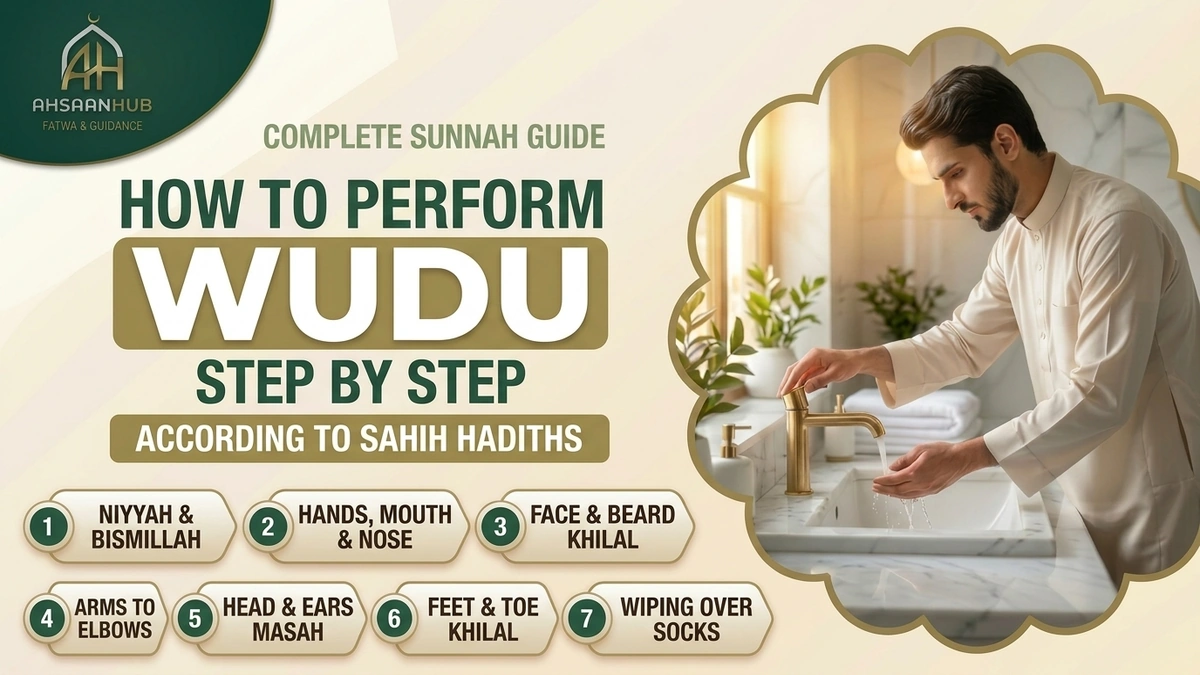
The 7 Step-by-Step Actions of Sunnah Wudu
The following seven steps reflect the complete, authentic method of Wudu demonstrated
by the Messenger of Allah (PBUH), as detailed in the famous Hadith of Humran, the freed slave of Uthman ibn Affan (RA)
(Sahih al-Bukhari: 159).
Step 1: Intention (Niyyah) in the Heart & Saying Bismillah
The Intention: Every act of worship in Islam requires an intention in the heart
to fulfill Allah’s command and purify oneself for prayer
(Sahih al-Bukhari: 1)
The place of intention is strictly within the heart; uttering verbal formulas aloud
(e.g., reciting formulated sentences) has no authentic basis in the Sunnah.
Saying Bismillah: Before starting, pronounce “Bismillah” (In the name of Allah).
The Prophet (PBUH) instructed: “There is no Wudu for the one who does not mention the name of Allah upon it”
(Sunan Abi Dawud: 101).
📖 Detailed Guide: Niyyah & Opening Dua Guide
Read the detailed rulings on silent vs verbal intention, what to do if you forgot Bismillah, and authentic opening supplications: Read Full Guide on Niyyah & Dua →
Step 2: Washing Hands, Rinsing Mouth & Sniffing Water into Nose
Washing the Hands: Wash both hands thoroughly up to the wrists three times, beginning with the right hand, ensuring water reaches between the fingers (Khilal of the fingers).
Madmadah (Rinsing the Mouth) & Istinshaq (Rinsing the Nose): The authentic Sunnah method is to take a single handful of water in the right hand, use half of it to rinse the mouth, and sniff the remaining half into the nostrils with a gentle inhalation.
Then, blow the water out of the nose using the left hand (Istinthar). Repeat this three times (Sahih al-Bukhari: 191; Sahih Muslim: 235).
📖 Detailed Guide: Hands, Mouth & Nose Method
Discover the detailed Hadith proofs regarding the single-handful method, performing istinshaq while fasting, and proper hand washing: Read Rinsing Mouth & Nose Details →
Step 3: Washing the Entire Face and Beard Khilal
Wash the entire face three times. The anatomical boundary of the face in Islamic jurisprudence is:
- Vertically: From the normal hairline at the top of the forehead down to the bottom
of the chin or beard. - Horizontally: From one earlobe to the other earlobe.
Beard Khilal: For men with thick beards, the Prophet (PBUH) would take a handful of water beneath the chin and run his wet fingers through his beard (Khilal), stating:
“Thus did my Lord command me” (Sunan Abi Dawud: 145).
📖 Detailed Guide: Washing the Face & Beard Khilal
Learn the precise fiqh rulings for thin vs thick beards, cosmetic creams, and water coverage: Read Full Face Washing Guide →
Step 4: Washing the Arms to the Elbows
Wash the right forearm thoroughly from the fingertips up to and including the elbow three times, ensuring no dry spots remain around the elbow joint.
Then wash the left arm in the exact same manner three times (Sahih Muslim: 246).
Important Note: Many people mistakenly start washing from the wrist to the elbow because they already washed their hands in Step 2. However, the Quran specifies: “wash your forearms to the elbows” (5:6), meaning the entire limb from the fingertips through the wrists and up to the elbows must be washed at this stage.
📖 Detailed Guide: Washing Arms to Elbows Rulings
Understand why washing from fingertips is obligatory, rulings on tight rings/bracelets, and common mistakes to avoid: Read Washing Arms to Elbows Rulings →
Step 5: Wiping Over the Head and Ears (Masah)
Wet both hands with fresh water, shake off excess droplets, and wipe over the head once. The Sunnah method is:
- Place both palms at the front of the head (forehead hairline).
- Draw both hands backwards over the hair to the nape of the neck.
- Bring both hands forward again to where you started
(Sahih al-Bukhari: 185). - Immediately use the index fingers to wipe the inner contours of both ears and the thumbs to wipe the outer back of the ears with the same water, as the Prophet (PBUH) taught: “The ears are part of the head” (Jami` at-Tirmidhi: 37; Sunan Ibn Majah: 444).
Note on Wiping the Neck: Wiping the back of the neck (Masah al-Raqabah) is not established by any authentic Sahih Hadith, and leading Hadith scholars have clarified that doing so is an unsupported addition.
📖 Detailed Guide: Head & Ears Masah Sunnah Method
Read the scholarly analysis on wiping over turbans, headscarves (hijab), and authentic methods: Read Full Head & Ears Wiping Rulings →
Step 6: Washing the Feet to the Ankles & Toe Khilal
Wash the right foot thoroughly up to and including the ankle bones three times, using the little finger of the left hand to pass between the toes (Khilal of the toes)
(Jami` at-Tirmidhi: 53; Sunan Abi Dawud: 148). Then repeat the identical process for the left foot.
Pay special attention to the back of the heels and Achilles tendon. The Prophet (PBUH) saw people in haste leaving their heels dry and warned loudly:
“Woe to the heels from the Hellfire! Complete the ablution thoroughly!”
(Sahih al-Bukhari: 163; Sahih Muslim: 241)
📖 Detailed Guide: Washing Feet & Toe Khilal
Review the critical rulings on preventing dry spots, heel care, and toe interlacing: Read Full Foot Washing Guidelines →
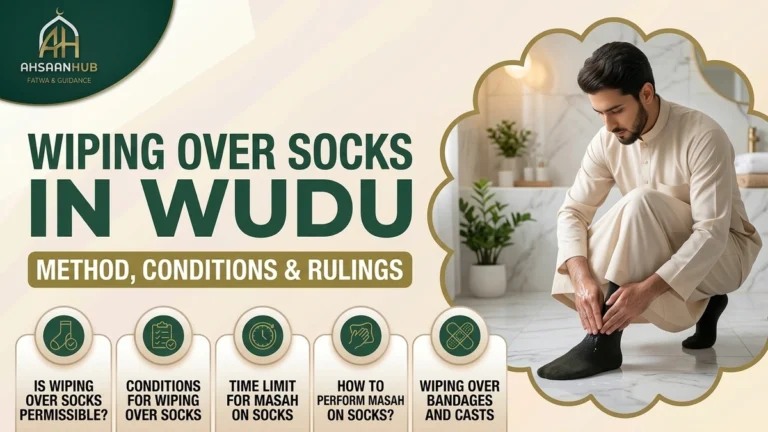
Step 7: Special Dispensation Wiping Over Socks (Masah ‘ala al-Khuffayn)
Islam provides a beautiful ease for Muslims: if you put on socks while in a complete state of Wudu, you are not required to remove them and wash your feet every time your Wudu breaks. Instead, you may simply wipe over the upper surface of your socks.
- Time Limits: 24 hours (1 day and 1 night) for a resident; 72 hours (3 days and 3 nights) for a traveler (Sahih Muslim: 276a).
- Method: Pass wet hands over the top (upper surface) of the socks, not the underside, as Ali (RA) affirmed: “If religion were based on human opinion, the underside of the sock would have been more deserving of being wiped than the upper side. However, I saw the Messenger of Allah (PBUH) wiping over the upper side of his socks”
(Sunan Abi Dawud: 162).
📖 Detailed Guide: Wiping Over Socks Rulings
Explore conditions for modern cotton socks, when the time period starts, and rulings on bandages and casts (Jabirah): Read Complete Wiping Over Socks Guide →
Supplications (Duas) After Completing Wudu
Upon completing the final step of Wudu, turn toward the Qiblah (if feasible) and recite the authentic Sunnah supplications:
أَشْهَدُ أَنْ لَا إِلَهَ إِلَّا اللَّهُ وَحْدَهُ لَا شَرِيكَ لَهُ وَأَشْهَدُ أَنَّ مُحَمَّدًا عَبْدُهُ وَرَسُولُهُ
“Ash-hadu alla ilaha illallahu wahdahu la shareeka lahu, wa ash-hadu anna Muhammadan ‘abduhu wa rasooluhu.”
(Sahih Muslim: 234)
(“I bear witness that none has the right to be worshipped except Allah alone, without partner, and I bear witness that Muhammad is His servant and messenger.”)
The Prophet (PBUH) promised that whoever recites this after performing Wudu thoroughly, all eight gates of Paradise are opened for them, and they may enter through whichever gate they choose
(Sahih Muslim: 234).
اللَّهُمَّ اجْعَلْنِي مِنَ التَّوَّابِينَ وَاجْعَلْنِي مِنَ الْمُتَطَهِّرِينَ
“Allahummaj’alnee minat-tawwabeena waj’alnee minal-mutatahhireen.”
(Jami` at-Tirmidhi: 55)
(“O Allah, make me of those who constantly repent and make me of those who purify themselves.”)
📖 Detailed Guide: Duas After Wudu & Rewards
Learn the exact Arabic pronunciations, transliterations, and rewards of the post-Wudu supplications: Read Full Post-Wudu Duas Guide →
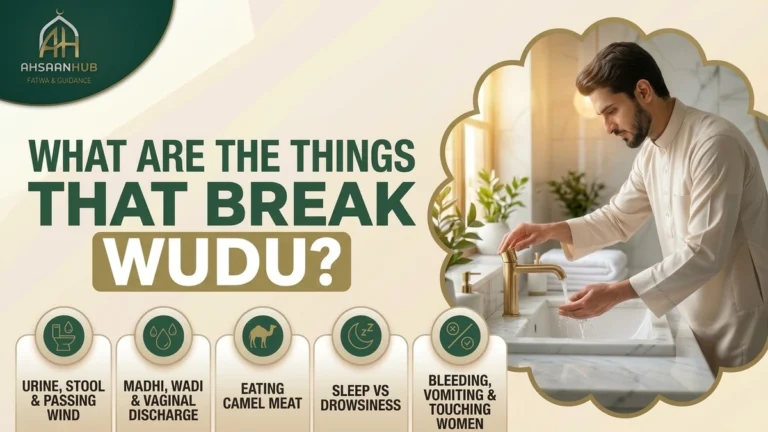
What Breaks Wudu? (Nullifiers of Wudu)
To maintain valid purity for prayer, a Muslim must know what authentic causes break Wudu and what common occurrences do NOT break it:
- Things that Authentically Nullify Wudu:
- Anything discharged from the private exits (urine, feces, passing wind, prostatic fluid / Madhi)
(Sahih al-Bukhari: 135). - Deep sleep where one loses full awareness and conscious control
(Sunan Ibn Majah: 478). - Directly touching one’s private parts with the bare hand without a barrier
(Sunan Abi Dawud: 181). - Eating camel meat
(Sahih Muslim: 360a). - Loss of consciousness due to fainting, intoxication, or medical anesthesia.
- Anything discharged from the private exits (urine, feces, passing wind, prostatic fluid / Madhi)
- Things that Do NOT Break Wudu (Debunked Misconceptions):
- Minor bleeding from a wound or nosebleed (unless impurity exits the
private passages). - Vomiting (Jami` at-Tirmidhi: 87).
- Ordinary non-lustful physical contact between spouses (Sahih al-Bukhari: 513).
- Doubt or whispering (Waswas) about having passed wind unless one actually
hears a sound or detects an odor (Sahih al-Bukhari: 137).
- Minor bleeding from a wound or nosebleed (unless impurity exits the
📖 Detailed Guide: Detailed Nullifiers Guide
Review the evidence-based scholarly breakdown of every cause that breaks or preserves Wudu: Read Complete Nullifiers Guide →
Summary Checklist: Obligatory (Fard) vs. Sunnah Acts
Islamic jurisprudence categorizes Wudu actions into essential obligations (without which Wudu is completely invalid) and recommended Sunnahs
(which increase reward and fulfill the perfect prophetic example):
| Obligatory Elements (Fard / Arkan) | Recommended Sunnahs (Mustahabb) |
|---|---|
| 1. Intention in the heart (Niyyah) | 1. Using Miswak before Wudu |
| 2. Washing the entire face once | 2. Saying Bismillah at the beginning |
| 3. Washing arms to the elbows once | 3. Washing hands up to the wrists initially |
| 4. Wiping over the head once (Masah) | 4. Washing limbs two or three times (instead of once) |
| 5. Washing both feet to the ankles once | 5. Sniffing water deeply into the nose (unless fasting) |
| 6. Following the prescribed order (Tartib) | 6. Khilal of the beard and between the fingers and toes |
| 7. Continuity without long pauses (Muwalat) | 7. Starting with the right side before the left (Tayamun) |
| — | 8. Reciting the authentic supplications after Wudu |
Frequently Asked Questions (FAQ)
Does nail polish or waterproof makeup invalidate Wudu?
Yes. Any substance that forms a physical, impermeable barrier preventing water from directly touching the surface of the skin or nails prevents the obligatory washing of that limb from occurring.
Nail polish, waterproof mascaras, and thick petroleum coatings must be completely removed before performing Wudu.
Non-barrier substances like natural Henna (mehndi) leave only a dye/stain without creating an impermeable barrier and are fully permissible.
Can I dry my limbs with a towel after Wudu?
Yes. Drying oneself with a clean towel or cloth after completing Wudu is completely permissible.
The Mother of the Believers, Aisha (RA), narrated that the Prophet (PBUH) had a cloth with which he would dry himself after Wudu (Jami` at-Tirmidhi: 99).
What should I do if I suffer from constant doubts (Waswas)?
The foundational legal principle in Islam is that certainty is not removed by doubt
(al-yaqinu la yazulu bish-shakk).
If you know you performed Wudu, you remain in a state of purity until you are 100% certain that an authentic nullifier occurred (such as clearly hearing a sound or smelling an odor).
Do not repeat your Wudu based on mere whispers of Shaytan (Sahih al-Bukhari: 137).
Next in Purification: What If You Require a Major Bath (Ghusl)?
Wudu purifies a person from minor ritual impurities (Hadath Asghar).
However, when a person enters a state of major ritual impurity (Hadath Akbar) such as following marital intimacy, seminal emission, or the completion of menses Wudu
alone is insufficient, and a complete ritual bath (Ghusl) is strictly obligatory before Salah
can be performed.
📖 Detailed Guide: Transition to Major Purification (Ghusl)
Discover what conditions necessitate Ghusl and the exact step-by-step Sunnah method for performing it according to Sahih Hadiths: Read Causes That Make Ghusl Obligatory →
May Allah (SWT) accept our purification, grant us sincerity in following the Sunnah of
Prophet Muhammad (PBUH), and count us among those whose limbs radiate with light
on the Day of Resurrection. Ameen.