What Do the Quran and Hadith Say About the Adhan?
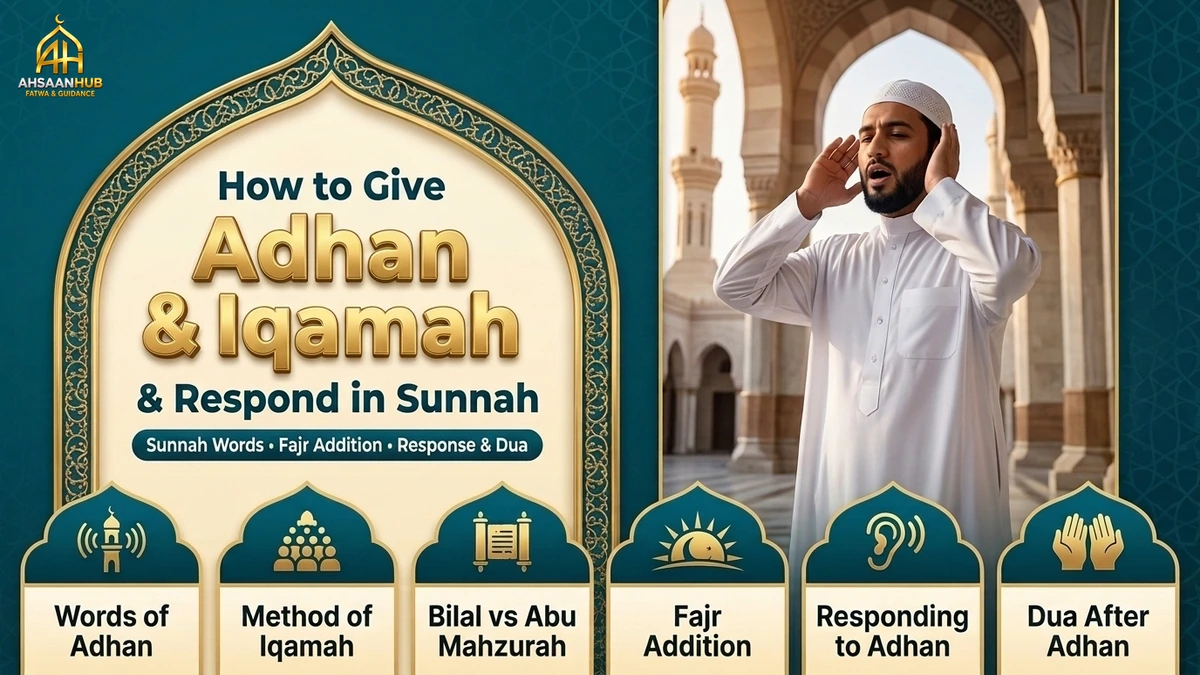
The method the Prophet (PBUH) established for calling Muslims to prayer and announcing its time is the Azan. The Messenger of Allah (PBUH) instructed Malik ibn Huwayrith (RA):
“إِذَا حَضَرَتِ الصَّلَاةُ فَلْيُؤَذِّنْ لَكُمْ أَحَدُكُمْ”
Idha hadarat-is-salatu fal-yu’adhdhin lakum ahadukum.
When the time of prayer arrives, let one of you give the Azan.
(Sahih al-Bukhari: 628; Sahih Muslim: 674)
This is a direct and formal command of the Messenger of Allah (PBUH).
It should therefore be understood that giving the Azan and reciting the Iqamah are both acts commanded by the Prophet (PBUH).
What Are the Words of Azan and Iqamah?
When the Prophet (PBUH) arrived in Madinah al-Munawwarah, the congregational prayer with its full details was established there.
Bilal (RA) was appointed as the Mu’adhdhin (caller to prayer) in Madinah. In the authentic narration of Abdullah ibn Zayd ibn Abd Rabbih (RA), the words that the Prophet (PBUH) taught Bilal (RA) for the Azan are as follows:
- اللَّهُ أَكْبَرُ، اللَّهُ أَكْبَرُ، اللَّهُ أَكْبَرُ، اللَّهُ أَكْبَرُ
Allahu Akbar, Allahu Akbar, Allahu Akbar, Allahu Akbar (four times, in pairs)
Allah is the Greatest - أَشْهَدُ أَنْ لَا إِلٰهَ إِلَّا اللَّهُ، أَشْهَدُ أَنْ لَا إِلٰهَ إِلَّا اللَّهُ
Ashhadu an la ilaha illallah, Ashhadu an la ilaha illallah (twice)
I bear witness that there is no god but Allah - أَشْهَدُ أَنَّ مُحَمَّدًا رَسُولُ اللَّهِ، أَشْهَدُ أَنَّ مُحَمَّدًا رَسُولُ اللَّهِ
Ashhadu anna Muhammadan Rasulullah, Ashhadu anna Muhammadan Rasulullah (twice)
I bear witness that Muhammad is the Messenger of Allah - حَيَّ عَلَى الصَّلَاةِ، حَيَّ عَلَى الصَّلَاةِ
Hayya ‘alas-salah, Hayya ‘alas-salah (twice)
Come to prayer - حَيَّ عَلَى الْفَلَاحِ، حَيَّ عَلَى الْفَلَاحِ
Hayya ‘alal-falah, Hayya ‘alal-falah (twice)
Come to success - اللَّهُ أَكْبَرُ، اللَّهُ أَكْبَرُ
Allahu Akbar, Allahu Akbar (once in pair)
Allah is the Greatest - لَا إِلٰهَ إِلَّا اللَّهُ
La ilaha illallah (once)
There is no god but Allah
(Sunan Abi Dawud: 499; Jami’ al-Tirmidhi: 189; Sunan Ibn Majah: 706)
For the Fajr Azan specifically, after Hayya ‘alal-falah, the following words are added twice:
- الصَّلَاةُ خَيْرٌ مِنَ النَّوْمِ، الصَّلَاةُ خَيْرٌ مِنَ النَّوْمِ
As-salatu khayrum minan-nawm, As-salatu khayrum minan-nawm (twice)
Prayer is better than sleep
(Sunan Abi Dawud: 500; Sunan Ibn Majah: 716; Sunan an-Nasa’i: 647)
The Iqamah taught to Bilal (RA) is as follows:
- اللَّهُ أَكْبَرُ، اللَّهُ أَكْبَرُ
Allahu Akbar, Allahu Akbar (twice)
Allah is the Greatest - أَشْهَدُ أَنْ لَا إِلٰهَ إِلَّا اللَّهُ
Ashhadu an la ilaha illallah (once)
I bear witness that there is no god but Allah - أَشْهَدُ أَنَّ مُحَمَّدًا رَسُولُ اللَّهِ
Ashhadu anna Muhammadan Rasulullah (once)
I bear witness that Muhammad is the Messenger of Allah - حَيَّ عَلَى الصَّلَاةِ
Hayya ‘alas-salah (once)
Come to prayer - حَيَّ عَلَى الْفَلَاحِ
Hayya ‘alal-falah (once)
Come to success - قَدْ قَامَتِ الصَّلَاةُ، قَدْ قَامَتِ الصَّلَاةُ
Qad qamat-is-salah, Qad qamat-is-salah (twice)
The prayer has begun - اللَّهُ أَكْبَرُ، اللَّهُ أَكْبَرُ
Allahu Akbar, Allahu Akbar (once in pair)
Allah is the Greatest - لَا إِلٰهَ إِلَّا اللَّهُ
La ilaha illallah (once)
There is no god but Allah
(Sahih al-Bukhari: 605; Sahih Muslim: 378; Sunan Abi Dawud: 499)
This is the Sunnah method of Azan and Iqamah that the Prophet (PBUH) taught to Bilal (RA).
How Did Abu Mahzurah (RA) Deliver the Azan and Iqamah?
When the Messenger of Allah (PBUH) conquered Makkah in 8 AH, the Companion he appointed as Mu’adhdhin there was Abu Mahzurah (RA).
The Azan taught to Abu Mahzurah (RA) differs slightly from that of Bilal (RA).
In the Azan of Abu Mahzurah (RA), the two testimonies (Shahadatayn), Ashhadu an la ilaha illallah and Ashhadu anna Muhammadan Rasulullah, are said four times each (known as Tarjee’). That is, after saying each testimony twice in a lower tone, it is repeated again twice in a raised audible voice, bringing the total to four repetitions of each.
(Sahih Muslim: 379; Sunan Abi Dawud: 500; Sunan an-Nasa’i: 631)
Similarly, the Iqamah taught to Abu Mahzurah (RA) uses doubled phrases throughout:
- اللَّهُ أَكْبَرُ، اللَّهُ أَكْبَرُ، اللَّهُ أَكْبَرُ، اللَّهُ أَكْبَرُ
Allahu Akbar, Allahu Akbar, Allahu Akbar, Allahu Akbar (four times)
Allah is the Greatest - أَشْهَدُ أَنْ لَا إِلٰهَ إِلَّا اللَّهُ، أَشْهَدُ أَنْ لَا إِلٰهَ إِلَّا اللَّهُ
Ashhadu an la ilaha illallah, Ashhadu an la ilaha illallah (twice)
I bear witness that there is no god but Allah - أَشْهَدُ أَنَّ مُحَمَّدًا رَسُولُ اللَّهِ، أَشْهَدُ أَنَّ مُحَمَّدًا رَسُولُ اللَّهِ
Ashhadu anna Muhammadan Rasulullah, Ashhadu anna Muhammadan Rasulullah (twice)
I bear witness that Muhammad is the Messenger of Allah - حَيَّ عَلَى الصَّلَاةِ، حَيَّ عَلَى الصَّلَاةِ
Hayya ‘alas-salah, Hayya ‘alas-salah (twice)
Come to prayer - حَيَّ عَلَى الْفَلَاحِ، حَيَّ عَلَى الْفَلَاحِ
Hayya ‘alal-falah, Hayya ‘alal-falah (twice)
Come to success - قَدْ قَامَتِ الصَّلَاةُ، قَدْ قَامَتِ الصَّلَاةُ
Qad qamat-is-salah, Qad qamat-is-salah (twice)
The prayer has begun - اللَّهُ أَكْبَرُ، اللَّهُ أَكْبَرُ
Allahu Akbar, Allahu Akbar (once in pair)
Allah is the Greatest - لَا إِلٰهَ إِلَّا اللَّهُ
La ilaha illallah (once)
There is no god but Allah
(Sunan Abi Dawud: 501; Sunan an-Nasa’i: 630; Jami’ al-Tirmidhi: 191)
Which Sunnah Method of Adhan and Iqamah Should You Follow?
There is a clear difference between the Azan and Iqamah of these two Companions.
In Bilal’s (RA) Azan, each of the two testimonies is said twice, while in Abu Mahzurah’s (RA) Azan they are said four times each (with Tarjee’).
Conversely, in the Iqamah, Bilal’s (RA) version uses single phrases for the testimonies and calls, while Abu Mahzurah’s (RA) Iqamah uses doubled phrases throughout.
Both methods are permissible and authentically established from the Prophet (PBUH).
A person may follow the method of Bilal (RA) in its entirety, or follow the method of Abu Mahzurah (RA) in its entirety.
However, if someone takes the Azan from Bilal’s (RA) method and the Iqamah from Abu Mahzurah’s (RA) method, that becomes a third self-invented combination that is not established from the Prophet (PBUH).
The correct approach is that whichever Companion’s method is adopted, both the Azan and the Iqamah should be kept consistent with that same method.
What Is the Ruling on Saying “As-Salatu Khayrum Minan-Nawm” in the Fajr Adhan?
It should also be understood in relation to the rulings of Azan that the words As-salatu khayrum minan-nawm (known as Tatweeb) recited in the Fajr Azan are an established Sunnah of the Messenger of Allah (PBUH).
The Prophet (PBUH) directly taught these words to Abu Mahzurah (RA) and approved them for Bilal (RA).
(Sunan Abi Dawud: 500; Sunan an-Nasa’i: 647; Sunan Ibn Majah: 716)
It is entirely incorrect to assume that the Companions added these words from themselves at a later time.
The truth is that during the blessed era of the Prophet (PBUH) himself, the Sunnah was established that whenever the Mu’adhdhin called the Fajr prayer, he would add
As-salatu khayrum minan-nawm after Hayya ‘alal-falah.
Anas ibn Malik (RA) explicitly stated: “It is from the Sunnah that when the Mu’adhdhin says in the Fajr prayer: Hayya ‘alal-falah, he should say: As-salatu khayrum minan-nawm.”
(Sahih Ibn Khuzaymah: 385; Sunan ad-Daraqutni: 1/243; graded Sahih by al-Albani in Irwa’ al-Ghalil: 234)
This is therefore a firmly established Sunnah of the Prophet (PBUH).
What Should You Say When You Hear the Adhan?
Responding to the Azan is a Sunnah that carries great virtue. Abdullah ibn Amr (RA) narrates that the Messenger of Allah (PBUH) said:
“إِذَا سَمِعْتُمُ الْمُؤَذِّنَ فَقُولُوا مِثْلَ مَا يَقُولُ”
Idha sami’tum-ul-mu’adhdhin fa-qulu mithla ma yaqul.
When you hear the Mu’adhdhin, say what he says.
(Sahih Muslim: 384)
Similarly, Abu Sa’id al-Khudri (RA) narrates that the Messenger of Allah (PBUH) said: “Whenever you hear the Adhan, say what the Mu’adhdhin is saying.”
(Sahih al-Bukhari: 611; Sunan Abi Dawud: 522)
Therefore, after each phrase of the Azan, the listener repeats the same words; for example, when the Mu’adhdhin says Allahu Akbar, Allahu Akbar, the listener also responds with Allahu Akbar, Allahu Akbar.
However, Hayya ‘alas-salah and Hayya ‘alal-falah are exceptions to this rule.
Umar ibn al-Khattab (RA) narrates that upon hearing these two phrases, the response commanded by the Prophet (PBUH) is to say:
“لَا حَوْلَ وَلَا قُوَّةَ إِلَّا بِاللّٰهِ”
La hawla wa la quwwata illa billah.
There is no power and no might except with Allah.
(Sahih Muslim: 385; Sunan an-Nasa’i: 677)
What Dua Should You Recite After the Adhan?
After completing the full response to the Azan, Durood is recited upon the Messenger of Allah (PBUH), and then the following Sunnah supplication taught by the Prophet (PBUH) is recited.
Jabir ibn Abdullah (RA) narrates that the Prophet (PBUH) said: whoever recites this supplication after responding to the Azan:
“اللَّهُمَّ رَبَّ هٰذِهِ الدَّعْوَةِ التَّامَّةِ وَالصَّلَاةِ الْقَائِمَةِ، آتِ مُحَمَّدًا الْوَسِيلَةَ وَالْفَضِيلَةَ، وَابْعَثْهُ مَقَامًا مَحْمُودًا الَّذِي وَعَدْتَهُ”
Allahumma Rabba hadhihid-da’watit-tammati was-salatil-qa’imah, ati Muhammadan-il-wasilata wal-fadilah, wab’ath-hu maqaman mahmuda-nil-ladhi wa’adtah.
O Allah, Lord of this perfect call and the prayer that is about to be established, grant Muhammad the right of intercession and the position of distinction, and raise him to the praised station that You have promised him.
The Prophet (PBUH) said about such a person:
“حَلَّتْ لَهُ شَفَاعَتِي يَوْمَ الْقِيَامَةِ”
Hallat lahu shafa’ati yawmal-qiyamah.
My intercession will be granted to him on the Day of Resurrection.
(Sahih al-Bukhari: 614)
Regarding this supplication, it should also be kept in mind that some people have
made self-invented additions to this dua on their own.
The Sunnah supplication is only what has been transmitted in the Hadiths; nothing more should be added.
A person should pause during the Azan, respond to each phrase of the Mu’adhdhin, then recite Durood upon the Prophet (PBUH), and finally recite this Sunnah supplication.
This act makes a person deserving of the intercession of the Prophet (PBUH). May Allah grant us all the ability to attain this great virtue. Ameen.